If you’re looking at your CCRIS report for the first time, the rows of numbers, codes and status labels may seem confusing. The report becomes much easier to understand once you know what each section is telling you.
Let’s start with the biggest section: Outstanding Credit, which shows the loans, credit cards and other credit facilities you currently have.
Outstanding Credit
This section lists the credit facilities you currently have open. These can include your housing loan, car loan, credit cards, overdraft and other forms of credit.
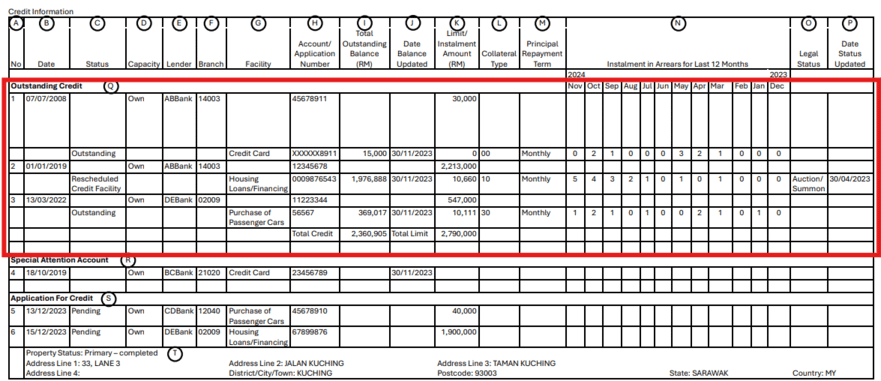
For each account, you'll see details such as how much you still owe, your credit limit and the instalment due each month. The report also shows whether you hold the account on your own, jointly with someone else, or through a business you own as a sole proprietor.
You'll also see a status beside each account. Most active accounts are simply marked Outstanding, which means the facility is still open. If something has changed with the account, you may see a different status instead.
Here are some of the other status labels you might come across:
| Status Label | What It Means |
| Restructured Credit Facility | The original loan was swapped for a new one |
| Rescheduled Credit Facility | Only the repayment schedule changed, the loan itself stayed the same |
| Outstanding from Call of Guarantee/Standby LC | The borrower has defaulted and the guarantee has been called |
Is the account secured against anything?
Your report also shows whether a credit facility is secured against an asset, known as collateral. For example, a housing loan may be secured against a property, while a car loan may be secured against the vehicle.
This information appears as a code in your report:
| Code | What It Means |
| 00 | No collateral |
| 10 | Secured against property |
| 30 | Secured against a motor vehicle registered with JPJ |
Have you missed any payments?
Next, look at the row of numbers beside each account. This shows your repayment record for the past 12 months.
Each number shows how many instalments you were behind that month. A 0 means you had no overdue payments, a 1 means you were one instalment behind, a 2 means you were two instalments behind, and so on.
Your repayment record is updated every month. If you catch up on an overdue payment, the latest month will show that your account is back on track. However, the earlier late payments will still appear in your 12-month record until they eventually drop off.
If legal action has been taken for an unpaid debt, such as a summons or an auction of the property used as collateral, this will appear separately on the report.
Special Attention Account
A Special Attention Account is a loan that your lender is monitoring more closely. BNM defines it as an account where the lender is taking steps to recover the debt or is already in the collection process.
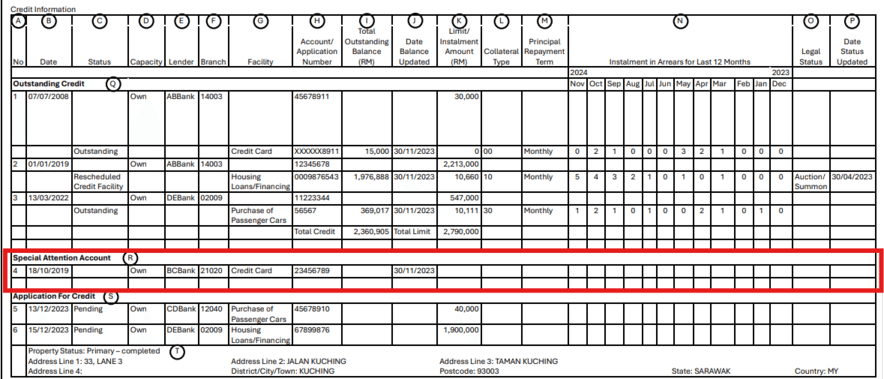
It appears separately from your regular accounts, but shows similar information, including the outstanding balance, credit limit and your repayment record for the past 12 months.
One reason an account may end up here is serious arrears. Under BNM's loan classification rules, a loan is generally considered impaired, meaning it has serious repayment problems, once repayments are 90 days, or about three months, overdue.
This is different from seeing a 1 or 2 in an account's repayment record that is still listed under Outstanding Credit.
If You've Been Through AKPK
If you've received repayment assistance through AKPK (Agensi Kaunseling dan Pengurusan Kredit), you may also see this reflected in your CCRIS report.
It appears in the same Status field mentioned earlier, but instead of the usual Outstanding label, you may see a status related to an AKPK programme. This may include the Debt Management Programme (DMP) or Small Debt Resolution Scheme (SDRS).
Older reports may also show past AKPK relief programmes, such as URUS (Financial Management and Resilience Programme) or FIRST (Financial Resilience Support Scheme), even though these programmes are no longer open to new applicants.
The same Status field may also show Impaired Loan/Financing Sold to Third Party. This can happen when a lender writes off a loan because it considers the debt unlikely to be repaid, and then sells the debt to a collection agency. A written-off loan does not necessarily mean the debt has been cancelled.
Application For Credit
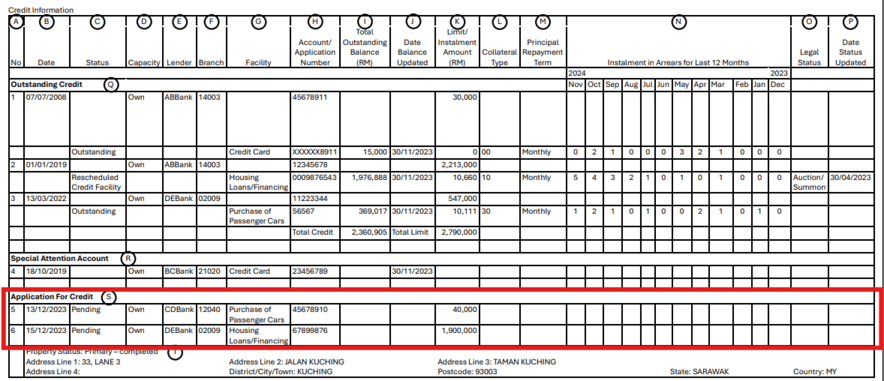
This final section shows the credit applications you've made in the past 12 months, rather than accounts you already have.
Rejected applications do not appear here. For the applications that do appear, you'll see one of these three statuses:
- Pending: The bank is still reviewing your application.
- Approved by Financial Institution: The bank has approved your application, but you have not taken up the facility.
- Pending Acceptance by Customer: The application has been approved and is awaiting your acceptance.
You can read more about how credit applications may affect a lender's view of your credit history in the FAQ section of our main CCRIS guide.
Example Of How To Read A CCRIS Report
Now let's look at an example of how these sections come together in a CCRIS report.
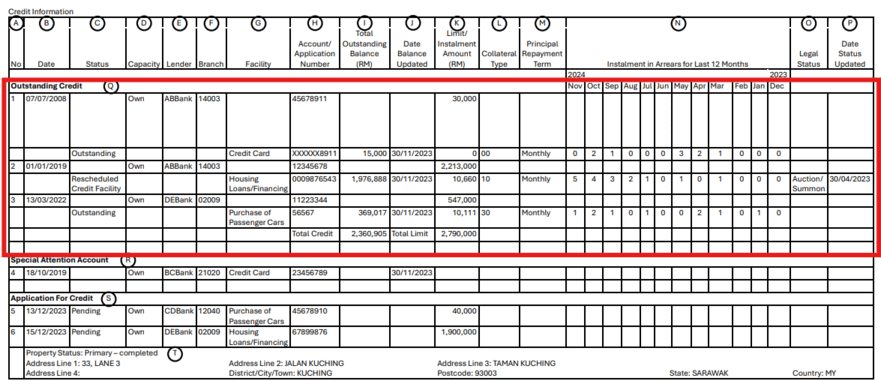
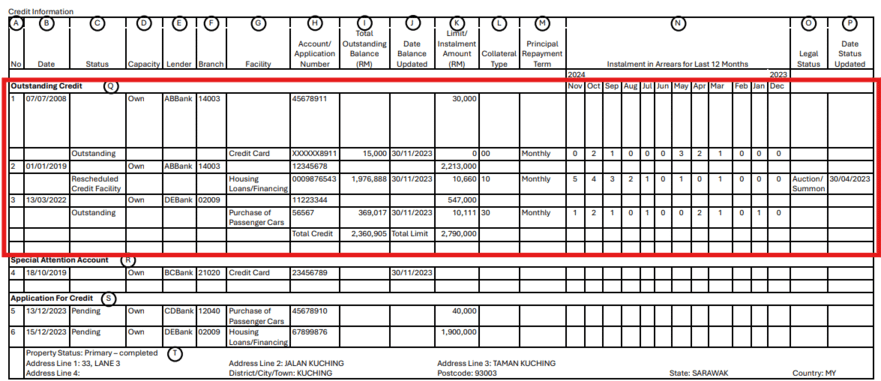
This report shows three credit facilities: a credit card, a housing loan and a car loan.
The credit card has an outstanding balance of RM15,000 and is marked Outstanding. Its repayment record shows several late payments over the past 12 months, including months when the borrower was one, two, or three instalments behind.
The housing loan has an outstanding balance of RM1,976,888 and is marked as a Rescheduled Credit Facility. This tells us that its repayment schedule has been changed. Its collateral type is 10, which means the loan is secured against property.
The repayment record also shows several late payments, including a 5 in the most recent month shown. This means the borrower was five instalments behind at that point. The Legal Status field also shows Auction/Summon, indicating that legal action has been recorded for this account.
The car loan has an outstanding balance of RM369,017 and is marked Outstanding. Its collateral type is 30, meaning it is secured by a motor vehicle. Its repayment record also shows several late payments during the past 12 months.
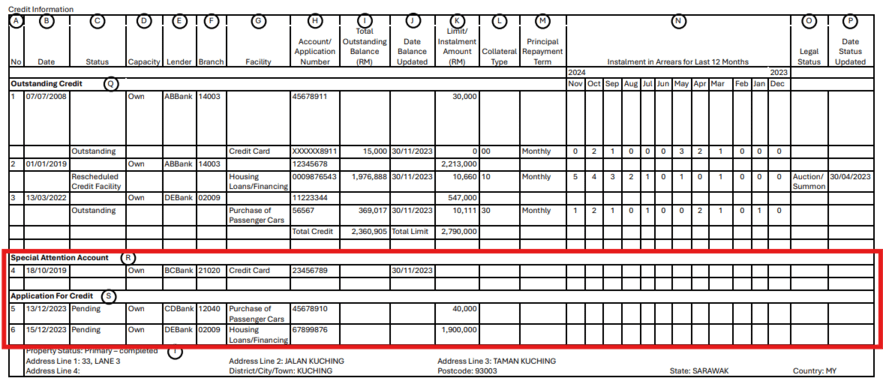
The report also lists a credit card under Special Attention Account.
Unlike the three facilities under Outstanding Credit, this account has been placed in a separate section for closer monitoring or debt recovery. The report itself does not explain why the account was placed here, so the borrower would need to contact the lender for more information.
Finally, the report shows two recent credit applications.
One is for the purchase of a passenger car, with a limit or instalment amount of RM40,000. The other is for a housing loan or financing facility in the amount of RM1,900,000.
Both applications are marked Pending, which means the lenders were still reviewing them when this report was generated.
Taken together, the report shows the borrower's existing credit facilities, repayment history, an account under special attention and two pending credit applications. These are the main areas you should look at when reading your own CCRIS report.
Your CCRIS Report Is Only Part Of The Picture
Understanding your CCRIS report helps you see the information a bank has about your credit history. But the report itself does not decide whether your next loan or credit application will be approved.
Banks also look at whether you can afford to take on more debt. One way they do this is through your Debt Service Ratio (DSR), which compares your monthly debt commitments with your income.
Your credit cards can affect this calculation. Some banks may count roughly 5% of your card's credit limit as a monthly commitment, even if you have not used the full limit. For example, a card with a RM10,000 limit could add around RM500 to your monthly commitments.
However, 5% is a commonly reported figure rather than an official rule. Each bank calculates DSR differently and does not publicly disclose its full formula.
What To Do With What You Find
Now that you know what the different sections of your CCRIS report mean, the next step depends on what you find.
If something on your report is wrong
You might spot a misspelt name, a loan that isn't yours, or a balance that doesn't match your records. If something looks incorrect, you can flag it through eCCRIS or contact the bank that reported the information. The bank has up to 14 working days to respond, while CCRIS itself is updated monthly.
That's why it's a good idea to check your CCRIS report two to three months before making a major credit application. It gives you more time to find and correct any errors.
Our main CCRIS guide explains what to do if you need to correct information on your report.
If an account has a status you don't understand
You might see a Special Attention Account or another status that you weren't expecting.
BNM does not explain why an account has been given a particular status. It only shows the information your lender has reported.
To find out why an account appears that way, contact the bank that reported it. The bank can explain why the account carries that status.
If you're behind on repayments
If you're struggling to keep up with your repayments, contact your lender as early as possible. Your lender may be able to offer repayment assistance, such as restructuring or rescheduling your loan.
You can also contact AKPK for free financial counselling. If you're managing debts with several lenders, AKPK may be able to help you work out a repayment plan.
If you want to know how a bank will read your report
This guide explains what the information in your CCRIS report means. It does not tell you exactly how a bank will assess that information when you apply for credit.
For example, a bank may consider your repayment history, existing commitments and recent credit applications when reviewing an application. How much each factor matters can vary.
For more on how lenders may assess your CCRIS record, see the FAQ in our main CCRIS guide.