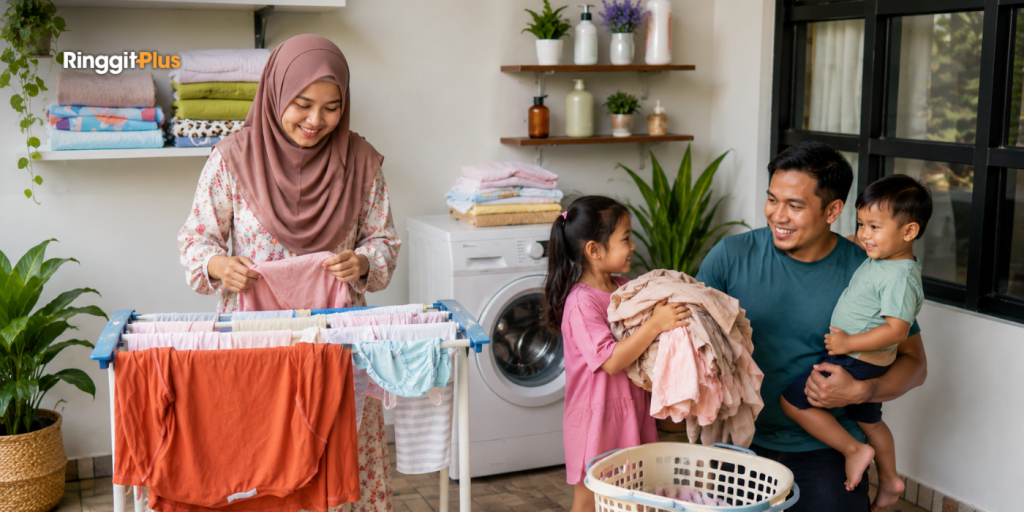
Malaysians spend an average of five hours and 12 minutes a day on unpaid household chores and caregiving, according to the Department of Statistics Malaysia (DOSM). That is 21.7% of each day, or more than 36 hours a week. It is almost a full working week, done on top of paid jobs and studies, with no salary at all.
The figures come from DOSM’s Special Release on Time Spent on Unpaid Domestic and Care Work, based on the National Household Indicators Survey (NHIS) 2025, announced by Chief Statistician Datuk Seri Dr Mohd Uzir Mahidin on 2 July 2026.
The Unpaid Hours Are Worth About RM1,380 A Month
If you grew up with a full-time kakak at home, you already know this work costs real money when a family pays someone to do it. Fewer families can afford that today, and even a part-time cleaner or babysitter in the Klang Valley charges well above minimum wage for every hour. When a family cannot pay for help, the work falls on the family, squeezed into the same 24 hours as everything else.
Malaysia has no official figure for what this work is worth in ringgit, so we used the current minimum wage of RM8.72 an hour, in force under the Minimum Wages Order 2024, as a starting point. Priced at that rate, the average Malaysian’s unpaid hours add up like this:
Period
Unpaid Work
Value at RM8.72 an Hour
Per day
5 hours 12 minutes
About RM45
Per week
More than 36 hours
About RM317
Per month
About 158 hours
About RM1,380
Per year
About 1,900 hours
About RM16,550
A real kakak or nanny charges more than minimum wage, so the true cost of your household’s unpaid hours would be even higher.
Three Decades Of Unpaid Work Add Up To Over RM500,000
The people doing the most unpaid work are adults in their busiest working years. This table shows DOSM’s reported hours for each age group, priced at the same minimum wage rate:
Age Group
Unpaid Work per Day
Estimated Value per Year
15 to 24
3 hours 53 minutes
About RM12,360
25 to 44
5 hours 35 minutes
About RM17,770
45 to 54
5 hours 43 minutes
About RM18,200
55 to 64
5 hours 31 minutes
About RM17,560
The heaviest load falls on those aged 25 to 54, the same years when most people are building careers and raising children. The heaviest load at home arrives at the same time as the heaviest load at work.
Using the same minimum wage rate, an adult does about 5.6 hours of unpaid work a day between the ages of 25 and 54, worth roughly RM17,900 a year. Over those 30 years, that adds up to more than RM537,000 of unpaid work for one person. That is over half a million ringgit each. A married couple will do over a million ringgit of unpaid work between them across those same 30 years.
Women Do About RM5,600 More Of It Every Year
Malaysian women spend six hours and seven minutes a day on unpaid housework and caregiving, or 25.5% of their time. Over a week, that comes to nearly 43 hours, which is more than a full-time job, before a single hour of paid work is counted. The difference between the sexes looks like this at the same minimum wage rate:
Group
Unpaid Work per Day
Estimated Value per Year
Women
6 hours 7 minutes
About RM19,500
Men
4 hours 21 minutes
About RM13,800
Difference
1 hour 46 minutes
About RM5,600
That extra hour and 46 minutes does not take weekends or public holidays off, and across the 30 busiest caregiving years, it means a woman does close to RM169,000 more unpaid work than a man. Those extra hours come from her rest and her paid working time.
Malaysians of both sexes also do far more of this work than people in richer countries. Women in Organisation for Economic Co-operation and Development (OECD) countries spend about 17% of their day on unpaid work, while men there spend around 9% to 11%.
Missed Retirement Contributions Grow Into A Bigger Loss Over Time
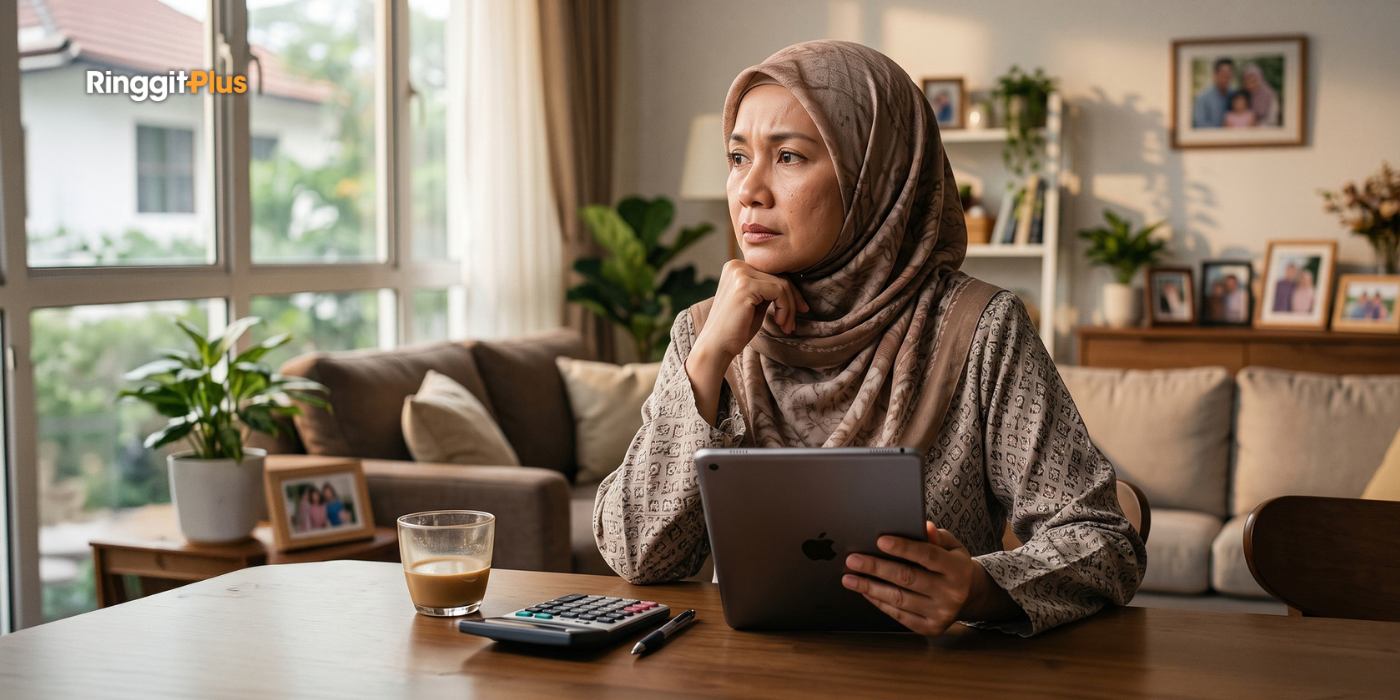
Caregiving can also shrink your retirement savings without you noticing. A parent or adult child who leaves a job, or switches to part-time work, to care for family stops receiving Employees Provident Fund (EPF) contributions from an employer during that time. The loss is bigger than the missed contributions alone, because money that never enters the account also never earns the yearly dividends that make savings grow over the decades.
Women face this more often, since they take on the larger share of care work during their prime earning years. i-Suri gives women registered under the National Poverty Data Bank (eKasih) a 50% top-up, capped at RM300 a year and RM3,000 in a lifetime, and from 2026 women can join up to age 60.
EPF’s i-Saraan scheme also lets anyone without a fixed income save into their own EPF account, and the government adds 20% on top of what you put in, up to RM500 a year and RM5,000 in a lifetime.
Even small, regular deposits keep the account earning dividends through the caregiving years, so you can look after your family now and still have your own savings waiting for you at retirement.
The ringgit figures above are illustrations calculated from DOSM’s reported hours using the minimum wage rate of RM8.72 per hour under the Minimum Wages Order 2024, and are not official DOSM estimates.
Follow us on our official WhatsApp channel for the latest money tips and updates.
As a creative content writer, Eloise has covered finance, business, lifestyle topics, and even moonlights as a singer-songwriter outside of RinggitPlus. Her current interests are learning the best ways to optimise spending and credit card hacks to gain more airline miles.
51vote
Article Rating
SHARE
About THE AUTHOR
Eloise Lau
Eloise Lau
As a creative content writer, Eloise has covered finance, business, lifestyle topics, and even moonlights as a singer-songwriter outside of RinggitPlus. Her current interests are learning the best ways to optimise spending and credit card hacks to gain more airline miles.






Comments (0)