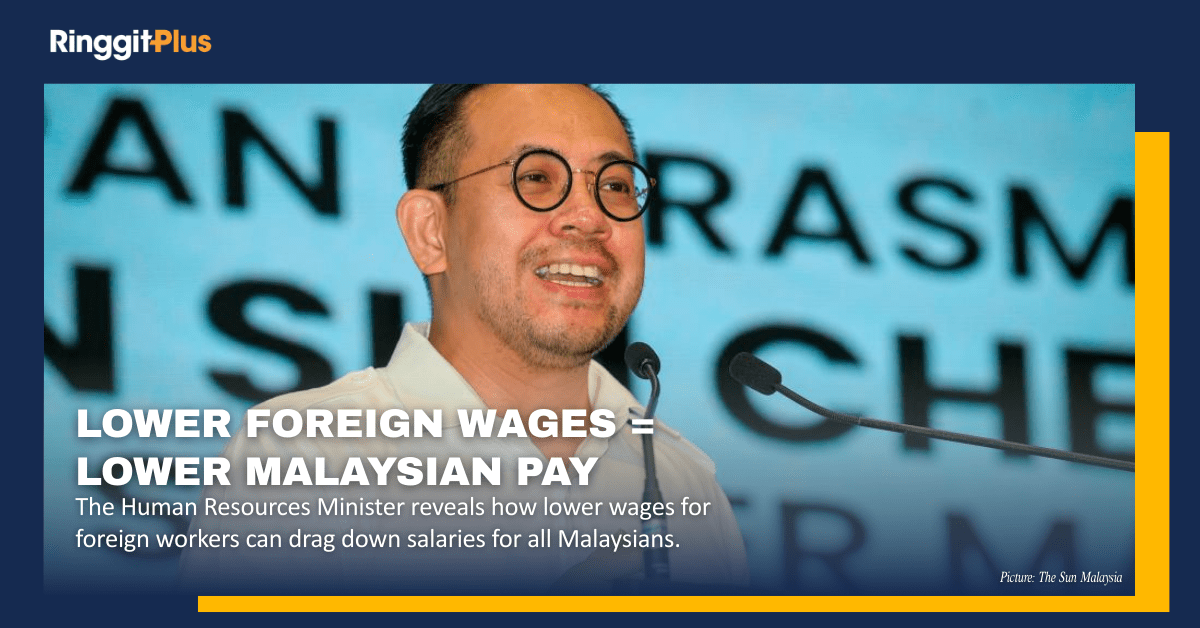
Human Resources Minister Steven Sim has stated that excluding foreign workers from the RM1,700 minimum wage could negatively impact Malaysian employees in the long run. He explained that if employers are allowed to pay foreign workers a lower wage, it could create downward pressure on salaries for everyone.
The logic is that a lower wage standard for one group of workers can influence the entire job market. The minister’s comments were made during the debates on the 13th Malaysia Plan (RMK13) in the Dewan Rakyat.
The Risk of a Depressed Wage Market
According to Sim, if a lower wage tier is established for foreign workers, the labour market may shift to favour them. This could potentially reduce job opportunities and suppress wages for local citizens.
“Employers will prioritise foreign workers and wages for locals will also be dragged down,” he said. This creates a situation where the entire system is affected. “If we let the labour system pressure certain groups, the same system will jeopardise all Malaysians,” he explained. By ensuring a standard minimum wage for all, the system protects the earning potential of local workers and prevents a race to the bottom on salary standards.
Minimum Wage Lifts Malaysian Incomes
Sim highlighted that the implementation of the minimum wage has already proven to be beneficial, particularly for Malaysians. Before the wage was increased, a significant number of workers, at least 4.37 million, were earning less than RM1,700 per month, with 80% of these workers being Malaysians. The increase is a positive step; many experts believe that urban Malaysians need around RM3,000 to survive comfortably.
The argument Sim makes is that raising the wage floor directly helps the local workforce. “(Increasing wages) actually benefits Malaysians the most,” he added. He also pointed to statistics showing that Malaysian workers in the lower wage brackets have seen an overall wage increase of 60% since the minimum wage was first introduced in January 2013. This policy has been a key factor in improving the income of many Malaysians over the last decade.
A Legal and Moral Responsibility
Beyond the economic arguments, Sim emphasised that paying a minimum wage to all workers is a matter of law and ethics. The Employment Act 1955 is clear on this matter, mandating that the minimum wage applies to every worker, irrespective of their nationality.
The legal requirement ensures fair treatment and prevents discrimination based on citizenship. “It is not just legislation but a symbol of our humanity. It’s about doing the right thing,” he said.
Follow us on our officialWhatsApp channelfor the latest money tips and updates.
As a creative content writer, Eloise has covered finance, business, lifestyle topics, and even moonlights as a singer-songwriter outside of RinggitPlus. Her current interests are learning the best ways to optimise spending and credit card hacks to gain more airline miles.
As a creative content writer, Eloise has covered finance, business, lifestyle topics, and even moonlights as a singer-songwriter outside of RinggitPlus. Her current interests are learning the best ways to optimise spending and credit card hacks to gain more airline miles.



Comments (0)