Filing personal income tax in Malaysia is a vital responsibility for individuals earning above the taxable threshold. The Year of Assessment (YA) 2024 pertains to income earned in 2024, which must be filed in 2025.
Starting from YA 2024, the Inland Revenue Board (LHDN) mandates that all taxpayers submit their Income Tax Return Forms (ITRF) electronically. This digital submission is facilitated through the MyTax portal, ensuring a streamlined and efficient process. Here is a comprehensive guide of Malaysia’s personal income tax system:
Who Needs To Pay Income Tax In Malaysia?
(Image: Malay Mail/Shafwan Zaidon)
Income tax in Malaysia applies to anyone earning taxable income above a certain threshold. If you meet any of the following conditions, you are required to file your taxes:
Salaried employees with an annual income exceeding RM37,333 (after EPF deductions).
Self-employed individuals, freelancers, and business owners earning taxable income.
Foreigners who have worked in Malaysia for at least 182 days in a calendar year (considered tax residents).
If you fall into any of these categories, make sure you submit your tax return before the deadline to avoid penalties.
Malaysia Personal Income Tax Rates For YA 2024
Malaysia’s tax system operates on a progressive tax rate, meaning higher income earners pay higher tax percentages. Below is the latest tax rate structure for residents in YA 2024:
Chargeable Income (RM)
Calculations (RM)
Rate %
Tax (RM)
0 – 5,000
On the first 5,000
0
0
5,001 – 20,000
On the first 5,000 Next 15,000
1
0 150
20,001 – 35,000
On the first 20,000 Next 15,000
3
150 450
35,001 – 50,000
On the first 35,000 Next 15,000
6
600 900
50,001 – 70,000
On the first 50,000 Next 20,000
11
1,500 2,200
70,001 – 100,000
On the first 70,000 Next 30,000
19
3,700 5,700
100,001 – 400,000
On the first 100,000 Next 300,000
25
9,400 75,000
400,001 – 600,000
On the first 400,000 Next 200,000
26
84,400 52,000
600,001 – 2,000,000
On the first 600,000 Next 1,400,000
28
136,400 392,000
Exceeding 2,000,000
On the first 2,000,000 Every next ringgit
30
528,400 ………..
As you can see, the more you earn, the higher the percentage of tax you are required to pay. However, you can reduce your chargeable income by claiming various tax reliefs, deductions, and incentives, which in turn reduces your final tax amount.
Let’s take an example:
If your chargeable income is RM48,000, you will fall under the 6% tax bracket, meaning your total income tax payable is RM1,500 (RM600 + RM900). However, if you manage to claim RM13,500 in tax reliefs and deductions, your chargeable income drops to RM34,500. This means your tax rate is reduced to 3%, and your final tax payable decreases to RM585 – saving you almost RM900 in taxes!
This is why it’s crucial to take advantage of all eligible tax reliefs to maximise your savings.
Tax filing For Foreigners (Residents & Non-residents)
(Image: Nikkei Asia/Yukinori Okamura)
Foreigners and expatriates working and earning income in Malaysia are also subject to income tax, depending on the length of their stay and employment status.
If a foreigner has worked in Malaysia for at least 182 days within a calendar year, they are classified as tax residents and are taxed at the same progressive rates as Malaysian citizens, with access to tax reliefs and deductions.
On the other hand, if a foreigner stays in Malaysia for less than 182 days but is employed for at least 60 days, they are considered non-residents and are taxed at a flat rate based on their income type, without eligibility for tax reliefs or deductions.
– Royalty – Payments for services in connection with the use of property or installation, operation of any plant or machinery purchased from a non-resident – Payments for technical advice, assistance, or services rendered in connection with technical management or administration of any scientific, industrial, or commercial undertaking, venture, project, or scheme – Rent or other payments for the use of any movable property
10
Foreigners will not be taxed in Malaysia if they meet any of the following conditions:
Employed in Malaysia for less than 60 days.
Working on board a Malaysian-registered ship.
Receiving a pension from Malaysian employment at age 55 or older.
Earning interest from Malaysian banks.
Receiving tax-exempt dividends.
For further clarification, expatriates should consult LHDN or a licensed tax professional to ensure they meet all tax obligations based on their residency status.
How To File Income Tax In Malaysia
Now that you’re ready to file your taxes, the first step is determining which tax return form you need to use. The form required depends on the type of income you earn:
BE Form – For resident individuals who do not carry on a business
B Form – For resident individuals who carry on a business
M Form – For non-residents (foreigners) filing their taxes in Malaysia
There are additional forms and classifications depending on specific circumstances, which will be covered in more detail under the “Accessing e-Filing and Your ITRF” section below.
For now, it is important to note that income tax filing deadlines in Malaysia vary based on the type of form being submitted.
BE Form (salaried individuals without business income):
Manual submission deadline: 30 April 2025
e-Filing submission deadline: 15 May 2025
B Form (individuals with business income):
Manual submission deadline: 30 June 2025
e-Filing submission deadline: 15 July 2025
With that sorted, let’s move on to the next section, where we will take you through the entire tax filing process step by step.
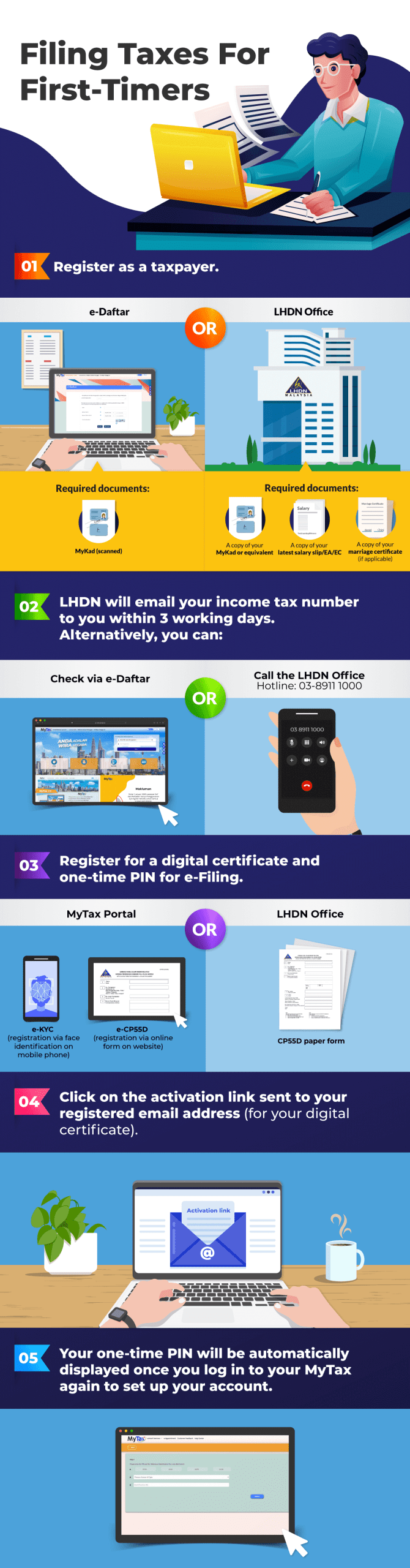
1) Registering As A First-Time Taxpayer On e-Daftar
If you’re filing your income tax online for the first time, there are two key things you need before you can begin:
A Tax Identification Number (TIN) – This confirms that you are a registered taxpayer in Malaysia.
A one-time PIN for e-Filing – This allows you to access the e-Filing platform, where you will submit your Income Tax Return Form (ITRF).
Step 1: Registering for a Tax Identification Number (TIN)
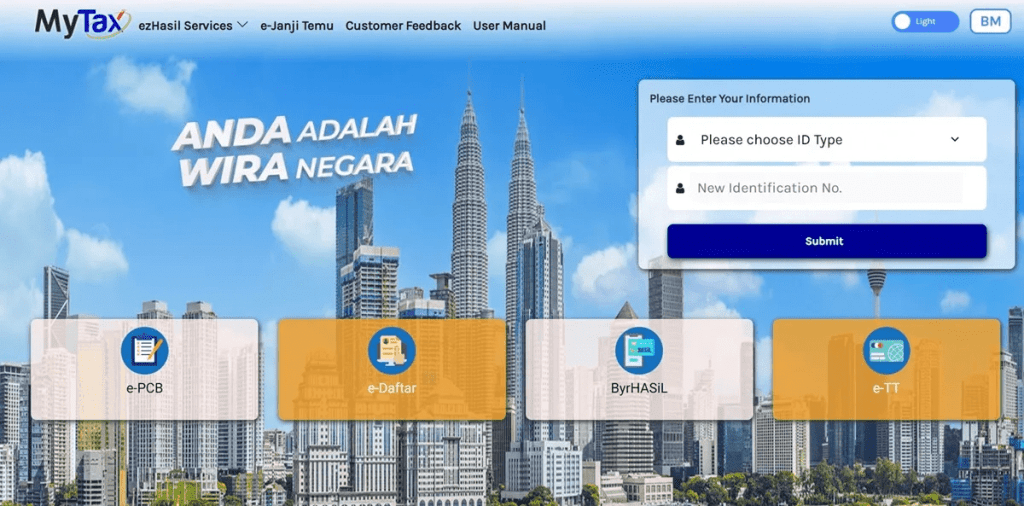
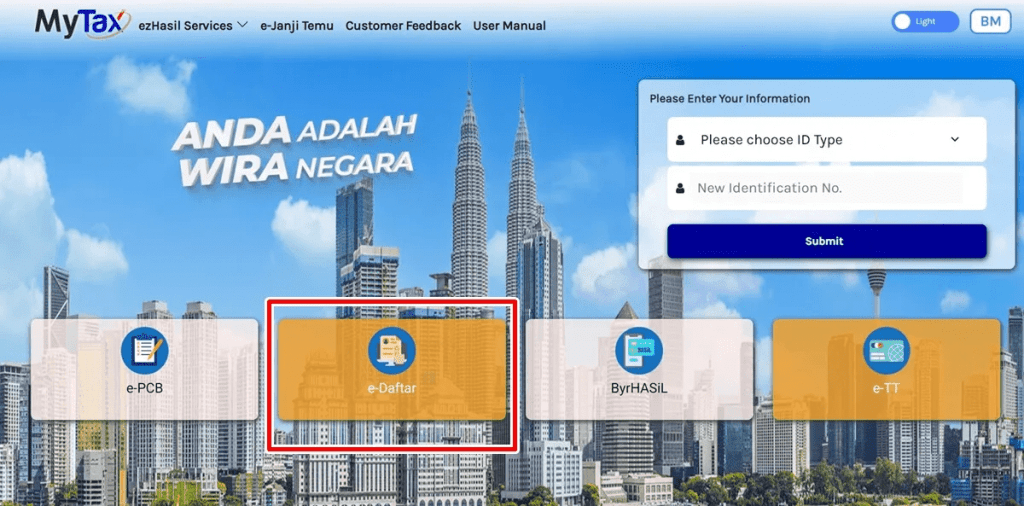
Before you can start filing your taxes, you’ll need to register as a taxpayer through e-Daftar, which is available on LHDN’s MyTax portal. Once your registration is processed, you will be issued a TIN, which is required for all tax-related matters.
Step 2: Getting Your One-Time PIN for e-Filing
Once you have your TIN, the next step is to obtain your PIN for e-Filing. You can get this online via the MyTax portal OR by visiting any LHDN branch in person.
For a step-by-step guide on how to register as a first-time taxpayer, check out our comprehensive guide:
2.Accessing e-Filing And Your Income Tax Return Form (ITRF) Via MyTax
If you’re an existing taxpayer, you can skip the registration steps and go straight to the MyTax website to access e-Filing and submit your Income Tax Return Form (ITRF).
One useful feature of MyTax and the e-Filing portal is the language toggle option, allowing you to switch between Bahasa Malaysia and English. If you’re more comfortable with one language over the other, make sure to adjust the settings—this will help make your tax filing process smoother and easier.
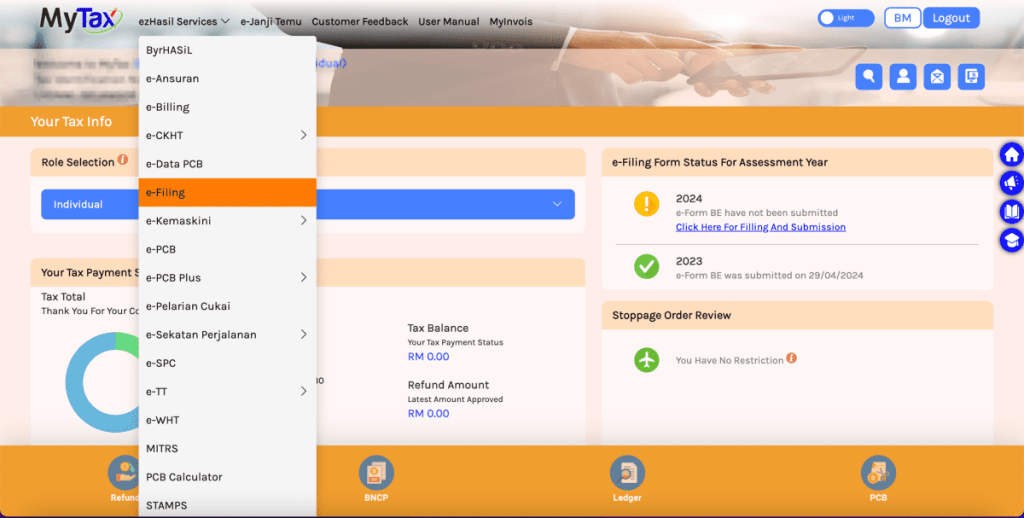
How to Access e-Filing via MyTax:
1. Log in to your MyTax account using your registered credentials.
2. Once inside your dashboard, you’ll see important information such as your current tax balance and any applicable refund amounts.
3. To start filing, go to “EzHasil Services” and click on “e-Filing” from the dropdown menu.
4. Select the appropriate Income Tax Return Form (ITRF) and begin filling in your details.
By following these steps, you’ll be able to efficiently file your taxes online without hassle.
Once you’re on the correct page, click on “e-BE Year of Assessment 2024” (or the relevant form applicable to your situation) to access your Income Tax Return Form (ITRF) straight away.
If you don’t see the quick link, or if your source of income has changed—for example, if you’ve switched from employment to running your own business—you will need to click on “e-Form” instead to manually select the correct ITRF for your tax submission.
As you make your selection, be sure to choose the right type based on the category of income that you fall under:
Income tax
Category
e-B/e-BT
For residents earning income from business/knowledge or expert workers
e-BE
For residents earning income without a business
e-M/e-MT
For non-resident individuals/knowledge workers
You can also find the full list of other types of forms (including for partnerships, associations, and deceased persons’ estate) on the LHDN website here.
On top of choosing the right form, make sure to also select the right year of assessment: YA 2024! Remember, you’re declaring your income earned for the previous year.
3. Filling Up Your ITRF
Now that you’ve selected the correct form, let’s go through the process of filling in your income tax return—specifically for residents earning income without a business.
To make it easier, we’ll break it down section by section, guiding you through each part of the form so that you can complete your tax filing accurately and efficiently.
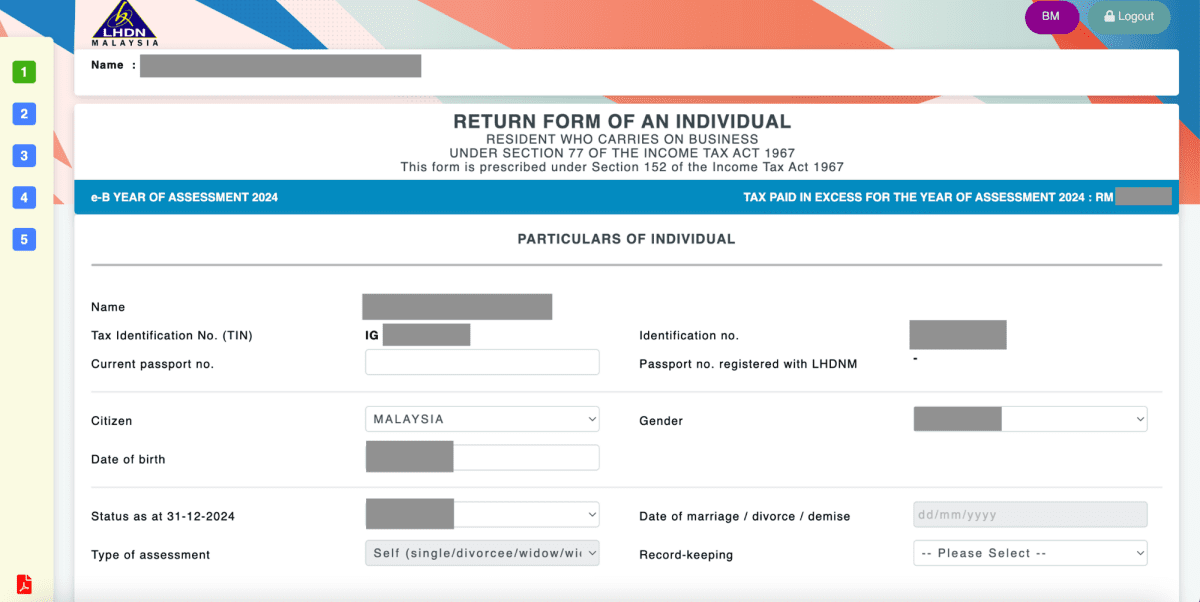
i) Particulars Of Individual
This section focuses on your basic personal information, which is essential for ensuring an accurate tax submission. Some details, such as your identification number and date of birth, will already be pre-filled based on LHDN’s records. However, it is always good practice to review these details carefully to ensure there are no errors before proceeding.
Another key part of this section is selecting your type of tax assessment, which determines whether you are filing as an individual or with your spouse. If you are married, you have the option to choose between joint or separate assessment, depending on which is more advantageous for your tax situation. Selecting the correct option is important, as it can affect the total amount of tax you are required to pay as well as your eligibility for spousal tax reliefs.
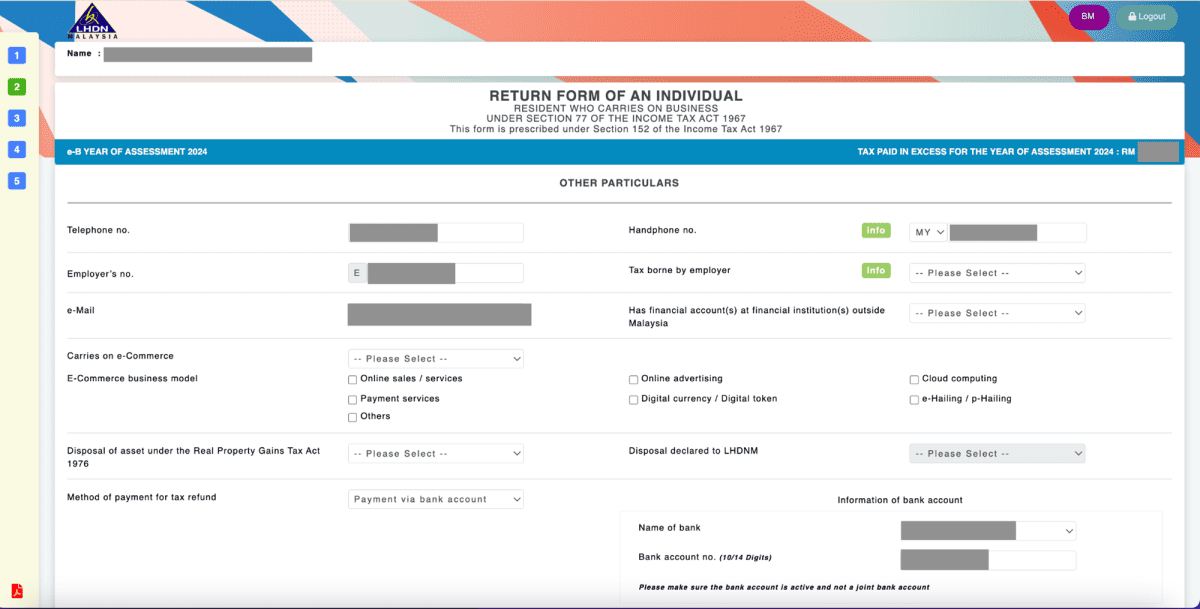
ii) Other Particulars
This section continues from the previous one, focusing on your contact information and banking details. It is important to ensure that your mobile number is correct, as you will need to receive a TAC (Transaction Authorisation Code) from LHDN when you sign and submit your e-form later. Any errors in this section could delay the submission process.
Additionally, double-check that your bank account number is accurate to ensure that any tax refunds you are entitled to are processed smoothly. If you prefer, you also have the option to receive your tax refund via DuitNow. Simply select your preferred method under “Method of payment for tax refund” and enter the necessary details.
If you have changed employers in the past year, make sure to update the Employer’s Number accordingly. Furthermore, if your job comes with the benefit of having your income tax covered by your employer (such as when a tax allowance is included as part of your gross salary package), remember to tick “yes” under “Tax borne by employer”.
For those who have sold any properties in the previous year, the section on disposal of assetsunder the Real Property Gains Tax Act 1976 will apply. If this is relevant to you, be sure to provide the necessary details.
You will also come across the section for Incentive Claims under paragraph 127(3)(b) and subsection 127(3A), which relates to specific tax exemptions granted under gazette orders or exemptions issued by the Minister of Finance. If this does not apply to you, simply leave this section blank.
iii) Declare Your Income
In this section, you will need to declare your total income earned throughout the year under statutory income. This includes earnings from employment, rental income, and other sources, all of which must be entered into their respective boxes. Your EA form will be especially useful here, as it provides a breakdown of your annual income from employment as reported by your employer.
However, while the EA form serves as a helpful reference, it is important to carefully review the figures before entering them into your ITRF. This is because, in some cases, the income reported in your EA form may not be the final figure for your statutory income. You are also required to declare any non-salary related benefits that qualify as “income from employment”, meaning they must be added to your total income. These include rental income, interest earnings, discounts, royalties, premiums, pensions, periodical payments, and payments received for part-time or occasional jobs, such as freelance work in broadcasting, lecturing, and writing.
At the same time, you should also exclude any income that qualifies for tax exemptions. For instance, while perquisites (such as parking, medical benefits, and transport allowances) and benefits-in-kind (such as company cars, accommodation, or personal drivers) are generally taxable, the government provides some exemptions for these. Additionally, severance packages may also be exempt from tax under specific conditions.
Once you have entered your relevant income sources, the system will automatically calculate your aggregate income, which represents your total earnings for the year. The next step is to apply any tax deductions that you are eligible for, as these will help reduce your taxable amount. If you have made donations to registered charitable organisations or gifts to eligible entities, you can claim a tax deduction from your aggregate income, which will then give you your total taxable income.
You will also need to enter the total amount of monthly tax deductions (MTD) that have been deducted from your salary throughout the year. This information can be found on your EA form. The MTD, also known as Potongan Cukai Bulanan (PCB), is a mandatory system where employers deduct a portion of an employee’s salary for income tax payments on a monthly basis.
Additionally, you may come across other fields in this section, such as non-employment income from previous years that was not declared, self-instalments, or investments approved under the angel investor tax incentive. There is also a section to declare foreign-sourced income, which remains tax-exempt if it has already been taxed in the country of origin. These sections should only be filled in if they apply to you; otherwise, you can proceed to the next step.
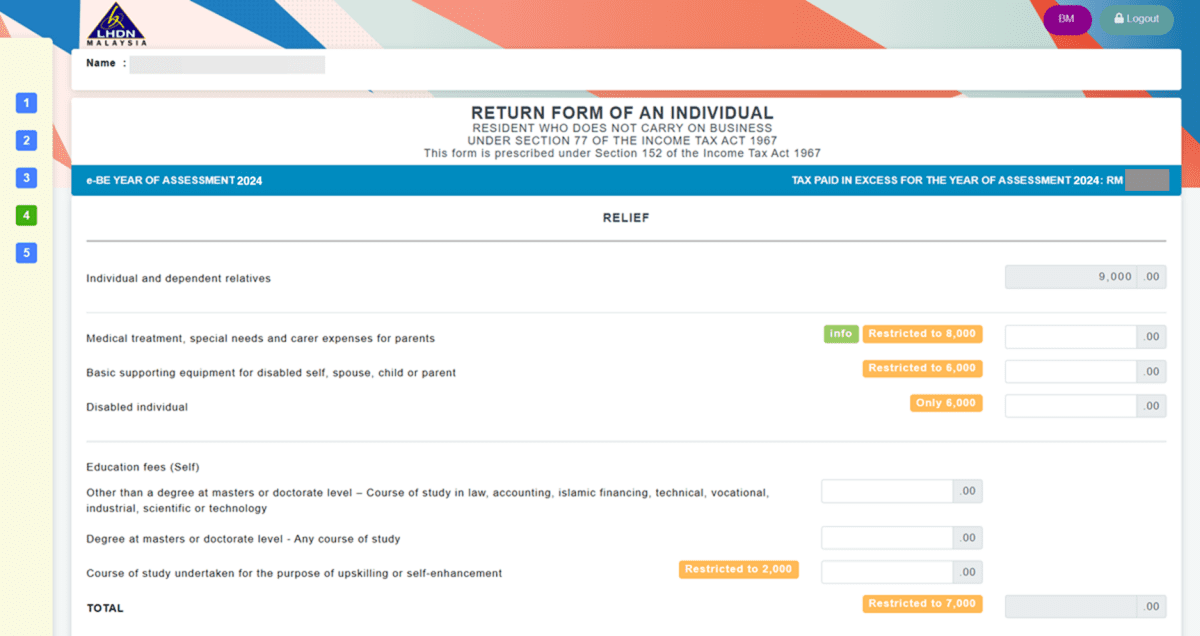
iv) Claim For Tax reliefs and Tax Rebates
This is the section where all those receipts from your previous year’s expenses come in handy! Keeping track of your eligible spending is crucial, as claiming the right tax reliefs and deductions can significantly reduce your chargeable income—which in turn lowers both your tax rate and the total tax payable.
As mentioned earlier, tax reliefs allow you to offset specific expenses against your taxable income, so it’s important to claim everything that you are entitled to. By maximising your reliefs, you can ensure that you pay the least amount of tax possible while also benefiting from government incentives that support education, healthcare, retirement savings, and more.
Here is the full list of tax reliefs that you can claim for YA 2024.
Once you have claimed all the tax reliefs you are eligible for, you will arrive at your chargeable income—the final figure that determines which tax bracket you fall under and how much tax you need to pay for YA 2024. If you’ve carefully maximised your tax reliefs, you should see a significant reduction in the amount of tax payable.
In addition to tax reliefs, you should also check whether you qualify for any tax rebates, as these are directly deducted from your final tax amount. For instance, if your chargeable income does not exceed RM35,000, you are entitled to a RM400 tax rebate for yourself. Similarly, zakat and fitrah contributions can also be claimed as rebates, up to the actual amount you have contributed, but not exceeding your total tax payable.
Let’s take an example to illustrate how this works. Suppose your total income for YA 2024 is RM50,000, and you have successfully claimed RM15,000 in tax reliefs. This reduces your chargeable income to RM35,000, meaning you now fall within the 6% tax bracket, and your total tax payable amounts to RM600.
Because your chargeable income is exactly RM35,000, you will not qualify for the RM400 tax rebate granted to individuals earning below RM35,000. However, if you paid RM400 in zakat last year, you can claim it as a tax rebate, effectively reducing your final tax payable to RM200.
By understanding how chargeable income, tax reliefs, and rebates work together, you can take a more strategic approach to tax planning—ensuring that you only pay what is necessary while benefiting from available deductions.
v) Check Your Summary
Now that you’ve reached the summary page, you’re almost done with your tax filing for the year! Here, you’ll see the final tax amount displayed, which reflects the total amount you owe or the refund you’re entitled to receive.
If the amount appears negative, there’s no need to worry—this simply means that you have overpaid your taxes through MTD and are eligible for a tax refund from the government.
At this stage, if you spot any errors, you can still go back to previous sections of your ITRF and make the necessary corrections. The system will automatically recalculate the final tax amount once any amendments are made. When you’re confident that everything is accurate and complete, click “Next” to proceed.
On the declaration page, request a TAC via the mobile number you have registered with LHDN and enter it in the required field. Then, click the “Sign and Submit” button. A pop-up window will appear, prompting you to enter your identification number and password—make sure your browser allows pop-ups for this step. Once entered, press “Sign” to complete the submission process.
And just like that, congratulations—you’ve successfully fulfilled your tax obligations as a responsible taxpayer! Before you close the website, be sure to save and print both the acknowledgement and your e-BE form for your records. These, along with your receipts, should be kept for at least seven years, in case LHDN requires further verification or an audit in the future.
Amending Your Income Tax Form
It’s always important to be as careful as possible when filing your taxes, but if you realise that you’ve made a mistake in your ITRF after submitting it, don’t panic! You can still correct errors by submitting an appeal for amendments by 30 April 2025.
To make corrections to your submitted tax return, follow these steps:
Print a copy of your e-Form and manually make the necessary corrections. Be sure to initial each correction to verify the changes.
Recalculate your taxes manually, ensuring the final figures match your revised submission.
Prepare a letter of appeal explaining the corrections you’ve made and why the changes are necessary.
Submit your amended form and appeal letter to the LHDN branch handling your tax file. If you prefer, you can visit a LHDN branch in person for assistance.
Attach all relevant supporting documents, such as your EA form, receipts, invoices, and any other proof related to your corrections.
Alternatively, you can submit your amendment request through the LHDN Customer Feedback Portal under the “Enquiry” section. Keep in mind that LHDN will review each appeal as part of their audit process, and the approval time may vary depending on the accuracy and completeness of the information provided.
For certain types of errors, you may also be able to make online amendments via e-Filing, but this option is only available in two specific cases:
Over-declaration of income (where you mistakenly reported more income than you actually earned).
Under-claimed tax reliefs or rebates (where you forgot to include eligible deductions in your original submission).
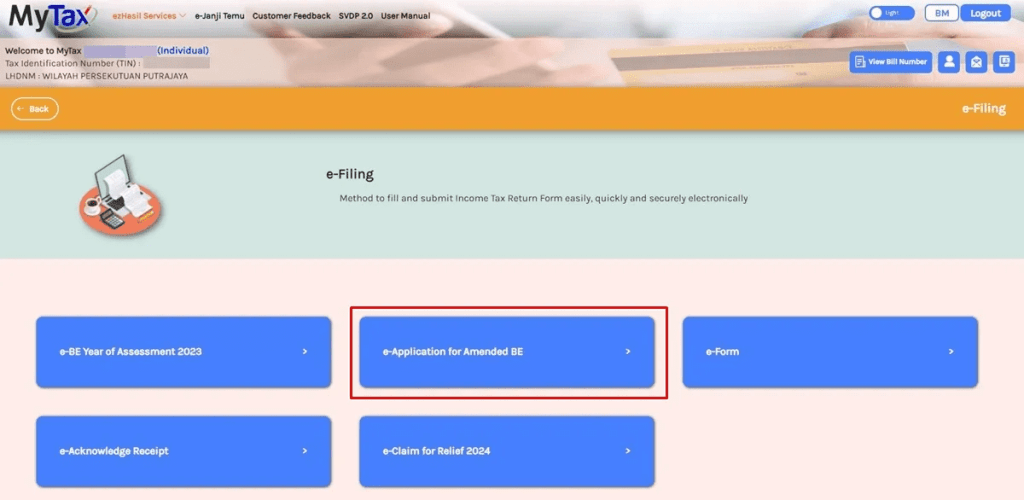
To use this service, you must have submitted your BE Form before the original filing deadline. If eligible, simply:
Log in to your MyTax dashboard.
Click on e-Filing, then select “e-Application for Amended BE”.
Fill in the form and submit it.
By following these steps, you can ensure that any errors in your tax filing are corrected promptly, preventing potential issues with LHDN later on.
If you realise that you need to amend your ITRF after 30 April 2025, you can still submit an Amended Return Form (ARF) within six months from the original submission deadline. However, this is only allowed for taxpayers who have submitted their ITRF on time. The ARF must be sent to the LHDN branch handling your tax file, and it is only required in specific cases of misreporting, including:
Under-declared or undeclared income
Overclaimed expenses or other deductions
Overclaimed capital allowances, incentives, or tax reliefs
If your correction does not fall under these categories, you do not need to submit an ARF. Instead, you should send a detailed letter outlining the errors and enclose any supporting documents to justify your request for amendments. LHDN will review the submission on a case-by-case basis before making the necessary adjustments.
Paying Your Income Tax
Now that your tax return has been submitted and your final tax amount calculated, you’ll find yourself in one of two possible situations:
1) You Are Eligible for a Tax Refund
If you have been paying MTD or PCB throughout the year, your tax reliefs and rebates may have reduced your total tax liability to an amount lower than what you have already paid. In this case, you are entitled to a tax refund for the excess amount.
Your refund will be automatically credited to the bank account you provided in your tax return. Typically, LHDN processes refunds within 30 days after your tax submission, provided that all information is accurate and complete.
2) You Have Outstanding Taxes to Pay
If your tax calculation shows that you still owe taxes, you will need to settle the outstanding amount before the payment deadline to avoid penalties. Fortunately, there are multiple convenient ways to make your tax payment, ensuring that you can fulfil your tax obligations on time:
According to LHDN, credit card payments can only be made at PPTH Kuala Lumpur, following the termination of manual tax payment acceptance (including cash, cheques, and bank drafts) for all direct tax payments at PPTH Kuching and PPTH Kota Kinabalu, effective 1 February 2024.
It is worth noting that most banks do not offer cashback or rewards points for government-related transactions made using credit cards. However, some banks may allow these expenses to count towards your monthly or annual spending requirements, which could help you qualify for higher cashback tiers or annual fee waivers. As such, it is advisable to evaluate whether paying your taxes with a credit card aligns with your financial strategy.
Additionally, the government has made it mandatory to use bill numbers as the reference for tax payments, replacing the previous method of using TIN. This change officially took effect on 1 January 2023. However, to facilitate a smoother transition, taxpayers are still allowed to use TIN as a payment reference for the time being, until further notice.
The bill number is a 16-digit identifier introduced by LHDN to enhance the tracking of tax payments. It applies to all types of tax payments, except for Monthly Tax Deduction (MTD/PCB) and stamp duty payments.
You can easily find your bill number in your MyTax dashboard. Once you submit your ITRF via e-Filing, a bill number is automatically generated if there is a balance of tax to be paid. Simply click on “View Bill Number” in the top right corner of your MyTax dashboard to retrieve it.
For taxpayers who file their taxes manually, LHDN will eventually phase out the use of TIN as a tax payment reference, meaning you will also be required to generate a bill number via MyTax. Unlike e-Filing users, your bill number will not be automatically generated, so you will need to follow these steps:
Log in to MyTax
Navigate to “ezHasil Services”
Select “e-Billing”
Click on “Generate Bill”
For those residing abroad who need to pay their taxes, an additional step is required. You must use the Electronic Telegraphic Transfer (e-TT) service to generate a Virtual Account (VA) number, which is necessary for international transactions.
(Note: Although e-TT is primarily used by overseas taxpayers, some taxpayers in Malaysia may also opt for this method. However, most local residents prefer to use FPX payments for convenience.)
Late Income Tax Payments
If you fail to pay your income tax by the stipulated deadline—30 April for individuals without business income and 30 June for those with business income—a 10% penalty will be imposed on the outstanding tax amount.
Should you disagree with the penalty, you have the right to appeal. To do so, you must submit a written appeal to the Collection Unit of the Inland Revenue Board of Malaysia (LHDN) within 30 days of receiving the Notice of Increased Assessment. It’s important to note that you are required to settle the imposed penalty first, even if you intend to appeal. If your appeal is successful, LHDN will subsequently refund the relevant amount.
In addition to penalties for late payment, other tax-related offences and their corresponding penalties include:
Failure to file your Income Tax Return Form: This offence can result in a fine ranging from RM200 to RM20,000, or imprisonment for up to six months, or both.
Omitting or understating income in your tax filing: Such actions may lead to a fine between RM1,000 and RM10,000, along with a penalty of 200% of the tax undercharged.
Wilfully evading tax or assisting others in tax evasion: This serious offence carries a penalty of RM1,000 to RM20,000, or imprisonment for up to three years, or both, in addition to a penalty of 300% of the tax undercharged.
These penalties are enforced to ensure compliance with tax regulations and to deter tax evasion. It’s crucial to adhere to tax filing and payment deadlines to avoid such penalties.
Appealing Your Income Tax Notice Of Assessment
After filing your taxes, LHDN may issue you a Notice of Assessment detailing your taxable income and the amount of tax due. It’s crucial to review this notice thoroughly. If you identify any discrepancies or errors, you have the right to appeal the assessment. This appeal must be lodged within 30 days from the date of the notice.
Steps to File an Appeal:
Complete Form Q: This form serves as your official notice of appeal. Ensure all required fields are accurately filled.
Prepare a Cover Letter: Draft a letter outlining the specific discrepancies you’ve identified in the assessment.
Gather Supporting Documents: Attach all relevant documents to support your claims, including a copy of your ITRF.
Submit the Appeal: Send the completed Form Q, cover letter, and supporting documents to the LHDN branch that issued the assessment.
If you miss the initial 30-day window for filing an appeal, you can apply for an extension of time by submitting Form N. Valid reasons for late submission, such as prolonged hospitalisation or being out of the country, must be provided. If the extension is granted, you’ll receive a Form CP15A, after which you must submit Form Q within 30 days from the date of issuance of Form CP15A.
Both Form Q and Form N can be downloaded from the LHDN website. It’s essential to adhere to these procedures to ensure your appeal is considered valid.
For detailed guidelines on filling out Form Q, refer to LHDN’s official guide. Adhering to these steps ensures that your appeal is processed efficiently and in accordance with LHDN’s regulations.
When To Stop Filing Taxes?
In Malaysia, individuals are generally required to file annual income tax returns. However, under specific circumstances, you may be eligible to permanently close your tax file. According to LHDN, these circumstances include:
Retirement with No Taxable Income: If you have retired and no longer receive any taxable income.
Permanent Departure from Malaysia: If you are leaving Malaysia permanently.
Individuals Aged 55 and Above with No Taxable Income: If you are aged 55 or above and do not have any taxable income.
It’s important to note that if you continue to receive income, such as from freelance work, that does not exceed the taxable threshold (e.g., RM34,000 per annum), or if you are below 55 years old with no taxable income, you are still required to file your taxes annually. This is because tax filing serves as a formal declaration of your income, ensuring compliance with tax regulations.
To close your tax file permanently, you should:
Submit an Official Letter: Write to the LHDN branch handling your tax file, stating your intention to close the file.
Ensure No Outstanding Amounts: Before submitting your application, verify that there are no outstanding taxes to be paid or refunds pending.
For individuals leaving Malaysia permanently, it is advisable to apply for a Tax Clearance Letter to ensure all tax matters are settled before departure. This process involves notifying LHDN of your intention to leave and settling any outstanding tax obligations.
And there you have it! Hopefully, this guide has been useful in helping you navigate the ins and outs of tax filing for 2025 (YA 2024), from understanding tax rates and reliefs to knowing what to do if you owe taxes or need to appeal an assessment.
Filing your taxes might not be the most exciting thing in the world, but with the right knowledge, you can make the process smooth and even save some money along the way. Whether you’re aiming for a tax refund or just trying to avoid late penalties, staying informed is the key to a stress-free tax season.
So, set your reminders, keep those receipts, and file your taxes before the deadline! And if in doubt, check with LHDN or a tax professional to ensure everything is in order.
Now go forth and conquer tax season like a pro! We will also be providing you a list of our other tax articles for this year, including:
Samuel writes about personal finance and financial news, focusing on how banking updates, policies, and promotions affect everyday money decisions. He enjoys making complicated financial topics easier to follow. Outside of writing, he spends his time watching TV shows and occasionally convincing himself he will only watch one episode.
Samuel writes about personal finance and financial news, focusing on how banking updates, policies, and promotions affect everyday money decisions. He enjoys making complicated financial topics easier to follow. Outside of writing, he spends his time watching TV shows and occasionally convincing himself he will only watch one episode.
Even if your annual income is below RM34,000, once you have a TIN, you’re generally required to file an income tax return. For income earned from affiliate work on TikTok, it’s considered taxable income, so you should declare it when filing.
You might also want to check with LHDN or a tax professional for any exemptions, reliefs, or simplified filing options for small or side incomes.
Anonymous
1 year ago
I’m now age 55 and have stopped working since 2005 till now, and received rental income since 2022, do I still need to submit tax return?
Yes, you definitely need to submit a tax return as LHDN taxes all sources of income, including rent.
The good news is you can deduct expenses like repairs and quit rent to lower your taxable profit. Since your income started in 2022, it’s important to file the now-overdue returns for 2022, 2023, and 2024 to get your records up to date. Remember, filing is mandatory, but you’ll only pay tax if your final profit is higher than your personal reliefs.
Llynn
1 year ago
If working & paying taxes abroad for the entire year but with rental income in Malaysia – presumably I have to file taxes – If yes which form (BE or M)?
Yes, you’ll still need to report your Malaysian rental income even if you’re working and paying taxes abroad. For this, you would typically file Form M (for non-residents) if you’re considered a non-resident in Malaysia, or Form BE if you’re still a Malaysian tax resident. It’s best to check your residency status for tax purposes first.
Yes. In Malaysia, rental income tax is calculated based on the actual rental income received, not the annual valuation (AV) of the property. The AV is mainly used for local assessment rates (cukai pintu) to the local council, but for income tax purposes, you declare the rental you actually collect, minus allowable expenses.
Anonymous
1 year ago
If an individual owns a certain percentage of company shares, does it mean the individual will have to submit tax under B Form?
Yes, generally if you own shares in a company and earn income such as dividends or director’s fees, you’ll need to submit your income tax using Form B, as this is for individuals with business income or shareholding income.
If you’re only a passive shareholder (no business income or director role) and only receive dividends that are already taxed at the company level, you might still file Form BE instead.
When in doubt, it’s best to confirm with LHDN or a tax professional to ensure you’re using the right form.
Anonymous
1 year ago
This is a very useful article, thanks!
If we have missed the efiling timeline, can we still do the submission? If so, how do we go about it?
I understand that if we are not working in Malaysia, there is still a need to submit a zero income tax, is this true?
Missed the e‑Filing deadline?
Yes, you can still submit your tax return online. Just log in to MyTax and file as usual. LHDN may impose a late submission penalty, so the sooner you submit, the better.
Working overseas but still a Malaysian?
Yes, you’re generally still required to submit a zero income return if you haven’t officially changed your tax residency status with LHDN.
If in doubt, it’s always best to call LHDN to confirm your specific situation.
Yes, you can claim tax relief for the life insurance premiums paid for your wife if she has no income and you’re doing joint assessment. The maximum relief is RM3,000 per year for both of you.
Additionally, if your income is below RM35,000, you may be eligible for a RM400 tax rebate for your spouse.
Yes, manual filing is still allowed for the Year of Assessment (YA) 2024. The deadline for manual submission of Form BE is 30 April 2025, while the e-Filing deadline is 15 May 2025.






















Comments (21)
Hi, i have gotten my TIN and my annual income has not reach the 34k. I’m planning to do affliate under tiktok. Do i still need to file for income tax?
Hi Hazel! 🙂
Even if your annual income is below RM34,000, once you have a TIN, you’re generally required to file an income tax return. For income earned from affiliate work on TikTok, it’s considered taxable income, so you should declare it when filing.
You might also want to check with LHDN or a tax professional for any exemptions, reliefs, or simplified filing options for small or side incomes.
I’m now age 55 and have stopped working since 2005 till now, and received rental income since 2022, do I still need to submit tax return?
Yes, you definitely need to submit a tax return as LHDN taxes all sources of income, including rent.
The good news is you can deduct expenses like repairs and quit rent to lower your taxable profit. Since your income started in 2022, it’s important to file the now-overdue returns for 2022, 2023, and 2024 to get your records up to date. Remember, filing is mandatory, but you’ll only pay tax if your final profit is higher than your personal reliefs.
If working & paying taxes abroad for the entire year but with rental income in Malaysia – presumably I have to file taxes – If yes which form (BE or M)?
Hi Llynn,
Yes, you’ll still need to report your Malaysian rental income even if you’re working and paying taxes abroad. For this, you would typically file Form M (for non-residents) if you’re considered a non-resident in Malaysia, or Form BE if you’re still a Malaysian tax resident. It’s best to check your residency status for tax purposes first.
Thank you for your advice
Does rental income tax in Malaysia consider the annual valuation of the property?
Yes. In Malaysia, rental income tax is calculated based on the actual rental income received, not the annual valuation (AV) of the property. The AV is mainly used for local assessment rates (cukai pintu) to the local council, but for income tax purposes, you declare the rental you actually collect, minus allowable expenses.
If an individual owns a certain percentage of company shares, does it mean the individual will have to submit tax under B Form?
Hi there! 😊
Yes, generally if you own shares in a company and earn income such as dividends or director’s fees, you’ll need to submit your income tax using Form B, as this is for individuals with business income or shareholding income.
If you’re only a passive shareholder (no business income or director role) and only receive dividends that are already taxed at the company level, you might still file Form BE instead.
When in doubt, it’s best to confirm with LHDN or a tax professional to ensure you’re using the right form.
This is a very useful article, thanks!
If we have missed the efiling timeline, can we still do the submission? If so, how do we go about it?
I understand that if we are not working in Malaysia, there is still a need to submit a zero income tax, is this true?
Hi there! Thanks for the kind words. 😊
Missed the e‑Filing deadline?
Yes, you can still submit your tax return online. Just log in to MyTax and file as usual. LHDN may impose a late submission penalty, so the sooner you submit, the better.
Working overseas but still a Malaysian?
Yes, you’re generally still required to submit a zero income return if you haven’t officially changed your tax residency status with LHDN.
If in doubt, it’s always best to call LHDN to confirm your specific situation.
thank you for this guidance, very good.
You’re welcome! I’m glad the guidance was helpful. If you have any more questions or need further assistance, feel free to reach out anytime! 😊
Hi, when my wife has no income, and I declare Self and Wife for joint assessment, and i buy Life Insurance for my wife, do I get Tax Relief ?
Yes, you can claim tax relief for the life insurance premiums paid for your wife if she has no income and you’re doing joint assessment. The maximum relief is RM3,000 per year for both of you.
Additionally, if your income is below RM35,000, you may be eligible for a RM400 tax rebate for your spouse.
Thanks for the simplified tax benefits info
You’re most welcome! Glad you found the info helpful! 😊 If you have any more questions, feel free to drop a comment anytime.
Deadline for maual filing is 30-4-25 and e-filing is 15-5-25. Is manual filing still allowed for Year of Assessment 2024?
Yes, manual filing is still allowed for the Year of Assessment (YA) 2024. The deadline for manual submission of Form BE is 30 April 2025, while the e-Filing deadline is 15 May 2025.