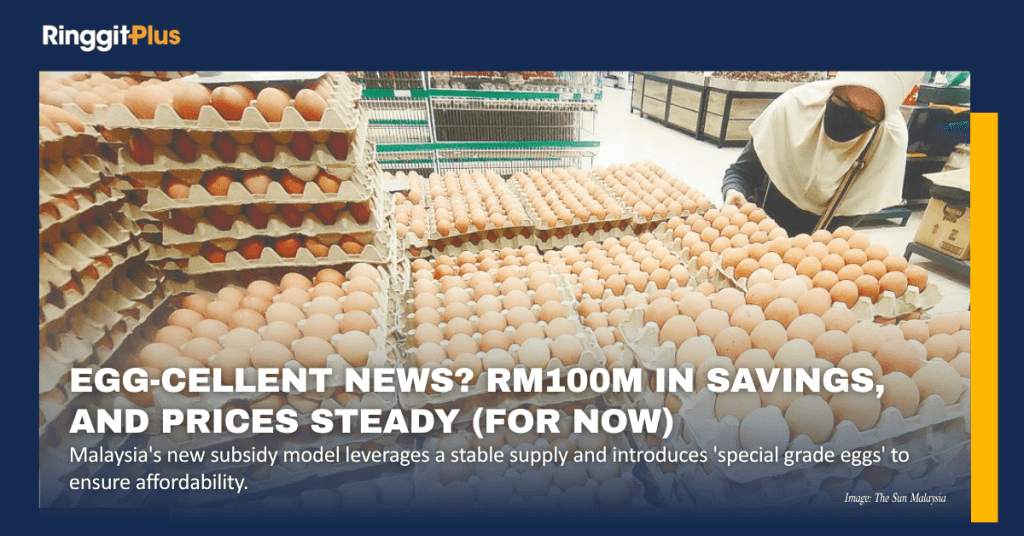
The Malaysian government has restructured its chicken egg subsidies, with changes taking effect from 1 August. This new approach includes the introduction of “special grade eggs” designed to be available at more reasonable prices for consumers.
Why Prices Aren’t Expected To Rise
Despite removing the subsidy, the government does not anticipate a significant price increase. Communications Minister Fahmi Fadzil stated that the current market price for eggs is already trending lower than the previous ceiling price.
The decision to float the price comes as the nation’s egg supply has stabilised, removing the pressure of shortages that often leads to higher prices. The government is confident that the poultry industry can maintain a sufficient supply. This stability is a key reason why floating the price now is considered viable without hurting consumers.
A Phased Approach to Subsidy Optimisation
According to a statement from the Ministry of Agriculture and Food Security, this restructuring is part of a deliberate, phased approach towards rationalising subsidies. The aim is to ensure sustainability and achieve a high impact, allowing for more efficient use of government funds. The ministry expressed confidence in the poultry industry’s capacity to maintain a consistent and sufficient supply of eggs.
More Affordable Egg Options for Consumers
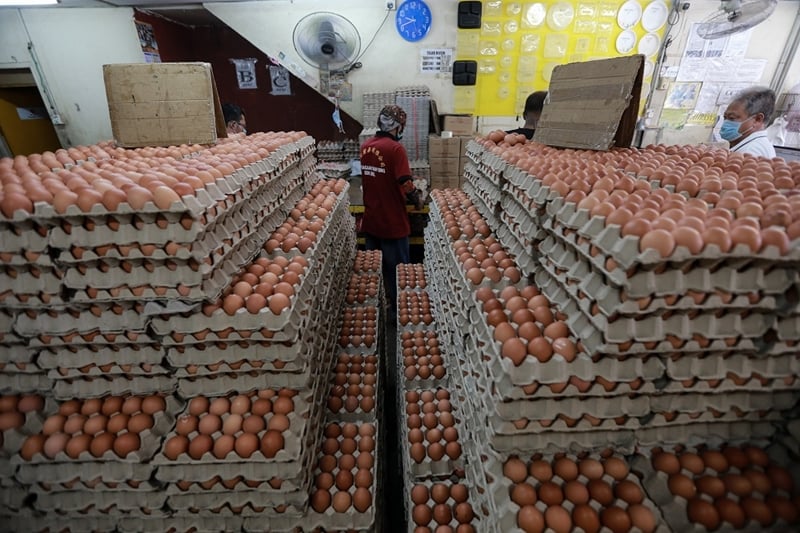
(Image: Malay Mail/Ahmad Zamzahuri)
Beyond the new special grade eggs, consumers will also find competitively priced eggs through various nationwide initiatives. These include the Agro Madani Sales and Jualan Rahmah programmes, which are available at Federal Agricultural Marketing Authority, or Fama, and Farmers’ Organisation Authority, or LPP, outlets across the country. These initiatives offer alternative avenues for purchasing eggs at reduced prices.
Redirecting Savings for Welfare Programmes
The ministry has indicated that optimising subsidy spending is a key objective of this restructuring. The savings generated from these changes will be redirected towards core welfare programmes, ensuring that government funds benefit the public effectively. This decision follows a period of significant government expenditure on temporary egg subsidies. Between February 2022 and December 2024, nearly RM2.5 billion was spent to support households and industries during the pandemic and periods of global supply chain disruptions. With market conditions now stabilising, the subsidies are being refined for a broader, more targeted impact.
Preventing Price Manipulation
To safeguard consumers from potential price manipulation following these changes, the Ministry of Domestic Trade and Cost of Living, or KPDN, will strengthen its enforcement efforts. This will be carried out under the provisions of the Price Control and Anti-Profiteering Act 2011, ensuring fair pricing and protecting consumers’ interests.
Follow us on our officialWhatsApp channelfor the latest money tips and updates.
Iman writes about personal finance with curiosity. She is interested in the stories behind money, the hesitation around big decisions, and the small habits that shape financial futures. Off the clock, she is either dissecting a film or climbing her way up the leaderboard in her favourite games.
Iman writes about personal finance with curiosity. She is interested in the stories behind money, the hesitation around big decisions, and the small habits that shape financial futures. Off the clock, she is either dissecting a film or climbing her way up the leaderboard in her favourite games.
We provide weekly updates on every Friday at 5pm on the prices of RON95, RON97 and Diesel in Malaysia and a chart that shows the movement of fuel prices across a 6-week period. Bookmark this page now!








Comments (0)