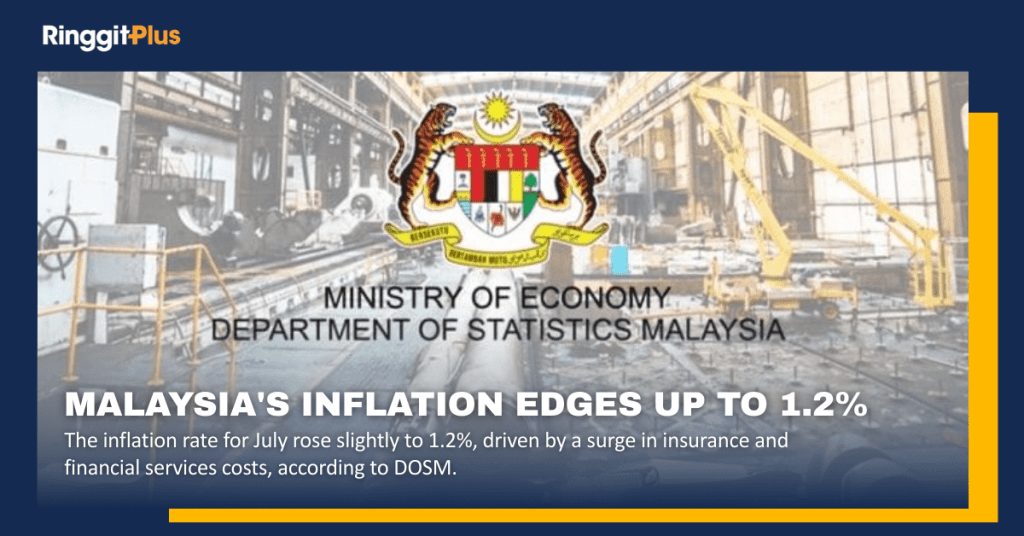
Malaysia’s inflation rate rose slightly to 1.2% in July 2025, compared to 1.1% in June. The Department of Statistics Malaysia (DOSM) reported that the Consumer Price Index (CPI) reached 134.7 points, up from 133.1 in July 2024.
Insurance and Services Drive Increase
The main contributor to July’s rise was the Insurance and Financial Services group, which surged 5.5% compared to 1.5% in June. This was largely due to higher hospital benefit insurance premiums, which climbed 14.7%, alongside increases in motorcycle and scooter insurance premiums.
The Restaurants and Accommodation Services group rose 3.1% (June: 2.8%), supported by higher prices for beverage preparation services (3.7%) and accommodation services (1.0%). Transport inflation also edged up to 0.4% (June: 0.3%), driven by higher costs in public transport services, which rose 1.5%.
Food Prices Slow, Chicken Remains Cheaper
The Food and Beverages group, which accounts for nearly 30% of the CPI basket, grew at a slower pace of 1.9% in July (June: 2.1%).
Prices for food at home fell -0.3%, continuing June’s decline, with vegetables (-6.6%), milk and dairy products (-1.1%), and meat (-0.9%) contributing to the drop. Standard chicken averaged RM10.25 per kilogramme in July, down from RM10.35 a year earlier. In Peninsular Malaysia, chicken prices averaged RM9.43, also lower than RM9.53 in July 2024.
Meanwhile, food away from home rose 4.3% in July, slightly slower than June’s 4.7%. Popular items such as roasted pork rice, satay, and plain rice all posted more moderate increases.
Housing, Utilities, and Fuel
Inflation for Housing, Water, Electricity, Gas and Other Fuels moderated to 1.3% in July, from 1.7% in June. This was due to the electricity, gas and fuels subgroup, which fell -3.4% after the Energy Commission implemented a new tariff schedule under the Incentive-Based Regulation framework effective 1 July 2025.
Fuel prices continued to weigh on transport costs. RON97 petrol remained in negative territory at -7.8% year-on-year, while diesel declined -7.1%. The average price of RON97 was RM3.20 per litre in July, compared to RM3.47 in July 2024. Diesel averaged RM2.89 in Peninsular Malaysia, down from RM3.35 a year earlier.
Labour Market Supports Economic Growth
Alongside the inflation report, DOSM also released its Labour Market Review for Q2 2025. The labour market remained resilient, with the number of employed persons rising 2.9% year-on-year to 16.85 million. The unemployment rate eased to 3.0%, while the labour force participation rate increased slightly to 70.8%.
Labour demand reached a record 9.10 million jobs, of which 97.9% were filled. Productivity continued to improve, with value added per employment up 2.8% to RM24,887 and productivity per hour worked up 3.4% to RM43.20.
Malaysia’s economy expanded 4.4% year-on-year in Q2, supported by sustained job creation, stronger demand for electrical and electronic goods, and higher tourism activity. However, global headwinds remain, including newly imposed US tariffs on certain exports and potential higher levies on semiconductors.
State-Level Inflation
At the state level, 12 states recorded inflation below the national rate of 1.2%. Kelantan registered no change, while four states recorded higher inflation than the national average: Johor (1.8%), Selangor (1.5%), Negeri Sembilan (1.4%), and Melaka (1.3%).
Food and Beverages inflation was positive in all states except Kelantan (-0.1%). The highest increases were seen in Negeri Sembilan (3.3%) and Selangor (2.9%).
Core Inflation and Regional Context
Core inflation, which excludes volatile items like fuel and fresh food, remained unchanged at 1.8% in July. The main drivers were Insurance and Financial Services (5.5%), Personal Care and Miscellaneous Goods and Services (3.9%), Food and Beverages (3.5%), and Restaurants and Accommodation Services (3.1%).
Regionally, Malaysia’s inflation of 1.2% was lower than Vietnam (3.2%), Indonesia (2.4%), and South Korea (2.1%), but higher than the Philippines (0.9%), China (0.0%), and Thailand (-0.7%).
Follow us on our official WhatsApp channel for the latest money tips and updates.
Samuel writes about personal finance and financial news, focusing on how banking updates, policies, and promotions affect everyday money decisions. He enjoys making complicated financial topics easier to follow. Outside of writing, he spends his time watching TV shows and occasionally convincing himself he will only watch one episode.
Samuel writes about personal finance and financial news, focusing on how banking updates, policies, and promotions affect everyday money decisions. He enjoys making complicated financial topics easier to follow. Outside of writing, he spends his time watching TV shows and occasionally convincing himself he will only watch one episode.
We provide weekly updates on every Friday at 5pm on the prices of RON95, RON97 and Diesel in Malaysia and a chart that shows the movement of fuel prices across a 6-week period. Bookmark this page now!







Comments (0)