Most adults in Malaysia have a bank account, but far fewer save in one. World Bank figures cited in a new study show 89% of adults have a financial account, while 52.5% have saved money at a bank or similar institution.
The study, a white paper by Mastercard and GXBank, looked at what happens after you open an account. It followed more than 39,000 GXBank customers who opened accounts between November 2023 and December 2024, over their first 12 months. The customers who kept using their accounts stood out for their habits, such as how often they deposited and saved, more than for how much they earned.
Mastercard commissioned the study, and research firm Kaiser Associates carried it out. GXBank’s debit cards run on the Mastercard network. The data covers GXBank’s own customers only, and the paper says its findings may not apply to other banks.
Among customers who kept using their accounts, activity jumped between their first and second month. Their debit card payments grew by 250%, QR payments by 139% and deposits by 44%. The researchers counted a customer as active if they made at least one transaction a month, on average, over 12 months or more.
The Paper’s Four Stages
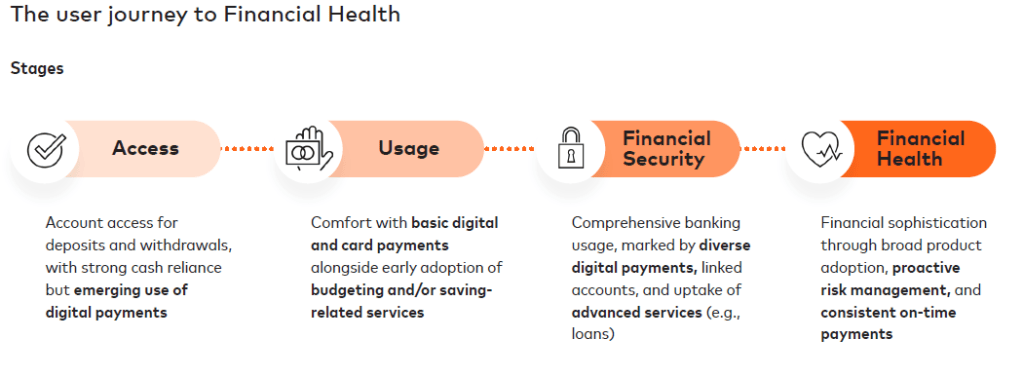
The paper placed each customer in one of four stages, based on how they used their account. At Access, you have an account but still pay mostly in cash, and you move to Usage once you pay and transfer money digitally on a regular basis and have started saving. Financial Security and Financial Health come after that. Both are measured mostly by how many banking products you use, such as insurance and loans, and whether you pay on time.
Taking out a loan moves you up the paper’s scale even though it means you now owe the bank money, so using more bank products isn’t the same as being better off. Within the first 12 months, most customers stayed at Access or Usage, and only 1% to 4% reached Financial Health.
Before You Move Money In
The paper found that complicated sign-up paperwork and worries about security put people off at the start. They valued a quick digital sign-up and real-time transaction alerts, and linking the account to payment services they already used helped too. GXBank is part of the Grab group, and customers who linked a payment method to Grab were 25% more likely to become active.
Once customers reached the Usage stage, they made three times as many debit card payments as those still paying mainly in cash, and 4.3 times as many instant transfers, such as DuitNow. Most of this was small, everyday spending, and 90% of active customers used a debit card.
The paper describes reliable payments as something customers expect from day one, at every stage. If you’re choosing a digital bank, check how easy the sign-up is, whether you get instant alerts and how often customers report payment problems before you move money in.
Taking Up Several Products At Once
Customers who took up too many products in their first month were more likely to move back a stage. The paper saw steadier progress when customers took up several products together after an early settling-in period, giving day 45 as an example.
Separately, customers who took up several products in the same month were four times more likely to reach the Financial Security stage than those who added them one at a time.
Saving In Your First Month
In their first month, customers who kept using their accounts made 51% more instant deposits than customers who later stopped using their debit card. What set the long-term customers apart was how often they deposited, and the size of their first deposit made little difference.
Putting part of each deposit into savings was linked to better results too. Customers who moved 10% to 20% of their deposits into GXBank’s Savings Pockets, which are sub-accounts for goals such as a holiday or an emergency fund, were 22% more likely to reach the Usage stage. Those who moved 15% or more were 31% less likely to slip back to paying mainly in cash. Customers who opened a pocket within 90 days of getting their debit card were 69% less likely to slip back.
If you open a new account, at GXBank or anywhere else, set up a small regular transfer into a separate savings pocket or account in your first month. RM25 a week comes to RM1,300 over a year, and small amounts like these keep growing the longer you leave them. GXBank’s Savings Pockets pay 2.00% p.a., and rates differ between banks, so compare yours on our savings account comparison page. Leave credit products such as personal loans until you’ve used the account for a while.
Follow us on our official WhatsApp channel for the latest money tips and updates.
Iman writes about personal finance with curiosity. She is interested in the stories behind money, the hesitation around big decisions, and the small habits that shape financial futures. Off the clock, she is either dissecting a film or climbing her way up the leaderboard in her favourite games.
00votes
Article Rating
SHARE
About THE AUTHOR
Iman Aminuddin
Iman Aminuddin
Iman writes about personal finance with curiosity. She is interested in the stories behind money, the hesitation around big decisions, and the small habits that shape financial futures. Off the clock, she is either dissecting a film or climbing her way up the leaderboard in her favourite games.
We provide weekly updates on every Friday at 5pm on the prices of RON95, RON97 and Diesel in Malaysia and a chart that shows the movement of fuel prices across a 6-week period. Bookmark this page now!







Comments (0)