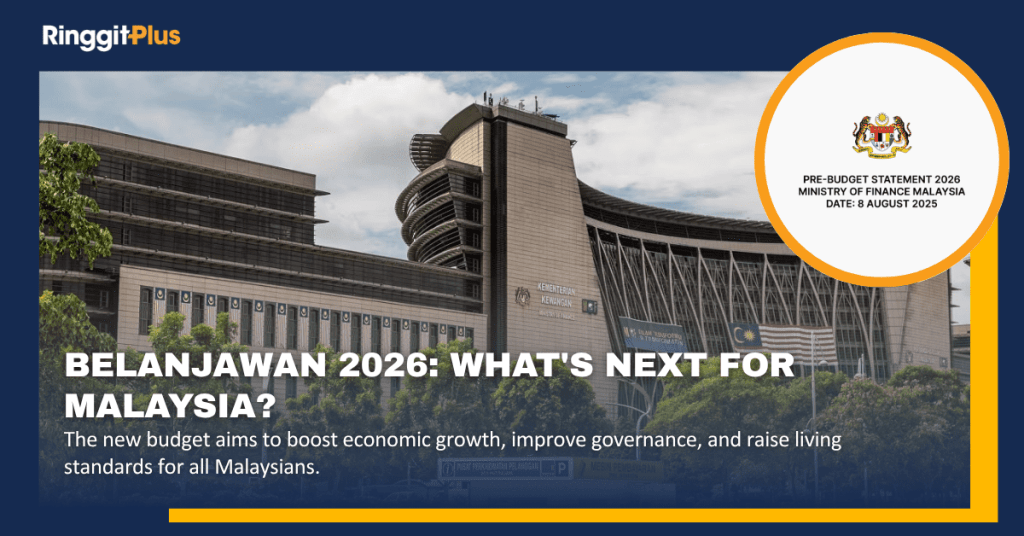
The Ministry of Finance (MOF) has released its Pre-Budget Statement 2026, the fourth in the MADANI Budget series. This important document outlines the government’s economic and fiscal strategies.
Budget 2026 marks the first budget under the Thirteenth Malaysia Plan (2026–2030), highlighting its long-term significance.
It aims to strengthen fiscal resilience, build the nation’s economic foundations, and improve the lives of the Malaysian people
Building On Economic Momentum: Current Position And Achievements
MOF states that Malaysia’s economy showed strength in 2025, with its Gross Domestic Product (GDP) growing by 4.4% in the first three months. The expected growth for the whole year is a good 4% to 4.8%. Inflations have gone down, reaching 1.1% in June 2025. The job market has become stronger, with the unemployment rate declining to 3.0% in May 2025.
The government is still dedicated to managing its finances better, working to lower the budget deficit to 3.8% in 2025 and control yearly debt. This effort is supported by things like increasing the Sales and Service Tax (SST), and giving out money to specific groups of people. The Malaysian Ringgit has also gone up against the US dollar, which shows the economy is doing better.
KeyAchievements And Ongoing Initiatives
Malaysia has achieved several notable milestones, including bringing in RM384.4 billion in approved investments in 2024. The country has successfully maintained a ‘Stable’ sovereign credit rating and made a significant leap to 23rd place in the IMD World Competitiveness Ranking. The Government-linked Enterprises Activation and Reform Programme (GEAR-uP) has played a crucial role, mobilising RM11 billion in domestic direct investments (DDI) and securing living wage commitments for 153,000 workers.
The government has also transitioned towards targeted subsidies, leading to an increase in allocations for programmes such as Sumbangan Tunai Rahmah (STR) to RM15 billion. Revenue enhancement measures, including the expansion of Sales and Service Tax (SST) and the implementation of e-Invoicing, are underway. Major infrastructure projects are progressing, including the Light Rail Transit 3 (LRT3), the Electric Train Service (ETS) extension, the East Coast Rail Link (ECRL), and the Johor Bahru-Singapore Rapid Transit System (RTS) Link. Concurrently, there are ongoing improvements in healthcare and climate resilience initiatives.
Looking Ahead: Priorities For Budget 2026
MOF expects the Malaysian economy to continue its moderate growth into 2026, driven by resilient domestic demand, private investment, stable employment, and ongoing income-enhancing initiatives. The tourism sector is also anticipated to be a significant contributor to this growth. For Budget 2026, the government will prioritise strengthening domestic growth sources, diversifying export markets, and expanding opportunities for household income.
The upcoming budget will focus on three key pillars of the Ekonomi MADANI framework:
Driving Reform And Good Governance
This pillar aims to modernise public service delivery and strengthen institutional integrity. Key initiatives include implementing new legislation, such as the Government Procurement Act and the Ombudsman Act, to enhance fiscal governance.
The government will also leverage technology through digitalisation, AI, and big data analytics, streamlining GovTech for better services, to improve public finance management and citizen services, alongside undertaking comprehensive civil service reforms.
Raising The Ceiling Of National Growth
This area focuses on attracting quality investments, particularly in high-growth, high-value (HGHV) sectors such as semiconductors, advanced manufacturing, AI-driven services, renewable energy, and digital technology. It also aims to streamline approval processes to stimulate economic expansion.
This also involves realigning incentives for targeted industries and fostering a ripple effect across the economy by supporting Micro, Small, and Medium Enterprises (MSMEs) and promoting digital adoption. Additionally, this pillar seeks to boost tourism and services growth, strengthen Islamic finance, and accelerate regional development initiatives.
Raising The Floor Of Rakyat’s Living Standards
This pillar focuses on ensuring economic growth translates into a better quality of life for all Malaysians. It continues the shift from blanket subsidies to targeted support, improving efficiency and ensuring help reaches those who need it most.
To improve living standards, healthcare priorities include making services more affordable, expanding access to essential medicines, strengthening rural facilities, and adopting innovations such as telemedicine and electronic health records to enhance care and crisis preparedness. Education reforms led by the National Education Council will promote STEM, TVET, and lifelong learning, close achievement gaps, and prepare talent for high-growth, high-value sectors.
Labour market initiatives aim to drive sustainable wage growth, create clearer career pathways, and restructure employment to match evolving industry needs. Infrastructure upgrades in rural Sabah and Sarawak will improve roads, clean water supply, electricity, and internet access, helping bridge the urban-rural divide.
The government also aims to empower all segments of society with equitable access to opportunities. For youth, initiatives will strengthen Technical and Vocational Education and Training (TVET), foster entrepreneurship, and expand digital connectivity. Women will benefit from improved access to affordable childcare and flexible work arrangements.
Senior citizens will see enhanced social protection and aged care services, while persons with disabilities (OKU) will gain from inclusive education and greater accessibility. For Orang Asli and indigenous communities, efforts will focus on better healthcare, education, and infrastructure. Bumiputera participation will be further encouraged through greater involvement in strategic economic sectors.
A Continuous Journey Of Reform
The MOF emphasises that these reforms represent a continuous process. Budget 2026 is an important step towards realising Malaysia’s full potential, addressing structural challenges, and leveraging the nation’s abundant resources and diverse strengths. The government is committed to incorporating public and stakeholder feedback into Budget 2026, which is scheduled to be presented in Parliament on October 10, 2025. Feedback can be submitted via the Belanjawan 2026 portal at https://belanjawan.mof.gov.my.
Follow us on our official WhatsApp channel for the latest money tips and updates.
Christina writes about personal finance with an eye for making the complicated feel straightforward. She is drawn to the everyday money decisions people face and genuinely enjoys finding the clearest way to explain them. Between articles, she is probably napping, on a hiking trail, or terrorising her sister’s cats.
Christina writes about personal finance with an eye for making the complicated feel straightforward. She is drawn to the everyday money decisions people face and genuinely enjoys finding the clearest way to explain them. Between articles, she is probably napping, on a hiking trail, or terrorising her sister's cats.
We provide weekly updates on every Friday at 5pm on the prices of RON95, RON97 and Diesel in Malaysia and a chart that shows the movement of fuel prices across a 6-week period. Bookmark this page now!









Comments (0)