Alex Cheong Pui Yin
Previously covered recruitment-related stories and had a short stint as a copywriter for the property industry. She subsequently developed an interest in investment and robo-advisors.

20th March 2023 - 4 min read

Switzerland’s largest bank, the Union Bank of Switzerland (UBS) has agreed to take over Credit Suisse, its troubled rival bank, for 3 billion Swiss francs (US$3.25 billion, equivalent to approximately RM14.6 billion). This came following a turbulent weekend of discussions, with hopes that the deal will help to avoid the onset of a wider international banking crisis.
This takeover was necessary to prevent Credit Suisse’s bankruptcy, which – as the second largest bank in Switzerland – could cause “irreparable economic turmoil” and “huge collateral damage” for the Swiss financial market and send ripples into the global financial market.
Its downfall could massively add to the ongoing turmoil of the international banking industry, which is still reeling from the collapse of US regional banks, Silicon Valley Bank (SVB) and Signature Bank, just two weeks ago. This is especially given Credit Suisse’s status as one of the Globally Systematically Important Banks (GSIB), being highly globally interconnected with multiple international subsidiaries and significant trading desks around the world.
Credit Suisse’s descent into its current predicament was a relatively swift affair. Already plagued by numerous scandals from previous years due to risk mismanagement, Credit Suisse was further impacted by investors’ apprehension of banking stocks in general following the collapse of the two major US banks. Notably, the stocks of financial institutions in Europe fell by 11%, overall.

The bank’s situation then worsened when it revealed that US regulators – specifically the US Securities and Exchange Commission (SEC) – had found “material weaknesses” in its financial reporting processes and control procedures for 2022 and 2021. Among other things, it included the “failure to design and maintain an effective risk assessment process to identify and analyse the risk of material misstatements”.
The last straw came, however, when Credit Suisse’s biggest shareholder, Saudi National Bank – which has a 9.9% stake in the bank – said that it will not be able to provide Credit Suisse with any further financial assistance. “We cannot because we would go above 10%. It’s a regulatory issue,” the chairman of Saudi National Bank, Ammar Al Khudairy had went on to explain.
This situation ultimately caused Credit Suisse’s stocks to crash on 15 March, falling below 2 Swiss francs for the first time, with trading forced to be halted several times throughout the morning. It even dropped by more than 30% at one point This is a far cry from its previous performances; even during the financial crisis of 2007-08, Credit Suisse’s shares traded at more than 80 francs.
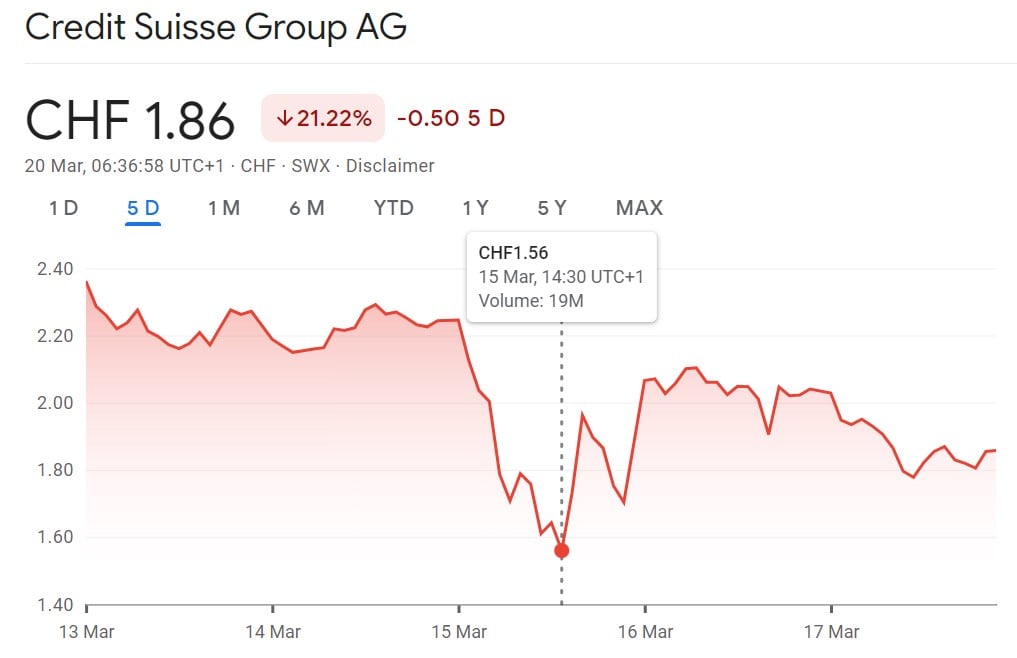
Following that, Swiss regulators were forced to step in to try and inject calm, stating that the Swiss National Bank will provide additional liquidity if necessary. However, this did little to help.
The situation eventually led to rival bank UBS stepping in on Sunday, with the intention to acquire Credit Suisse for approximately 1 billion Swiss francs. Negotiations then commenced, and the amount was subsequently settled at 3 billion Swiss francs. Credit Suisse shareholders, on the other hand, will receive one UBS share for 22.48 Credit Suisse shares.
Credit Suisse – which once contributed to the stellar reputation of Switzerland’s banking industry – had a balance sheet of approximately 530 billion Swiss francs at the end of 2022. It lost about 38% of its deposits in the fourth quarter of 2022, and reported a full-year net loss of 7.3 billion Swiss francs for 2022. It also expected further losses in 2023. Bloomberg also noted that UBS is now more than eight times larger than Credit Suisse.

At the heels of this news, most global markets have mostly seen a decline on Monday; Hong Kong’s Hang Seng index, for instance, fell by more than 2.5%, where as Australia’s S&P/ASX 200 fell by 1.16%. Japan’s Nikkei 225 is also down 1.02%, and the TOPIX (Tokyo Price Index) was 1.17% lower. However, financial authorities are of the view that Credit Suisse’s takeover will likely not affect the stability of their local banks.
(Sources: Malay Mail)
Previously covered recruitment-related stories and had a short stint as a copywriter for the property industry. She subsequently developed an interest in investment and robo-advisors.








Comments (0)