As households prepare for Hari Raya shopping, the cost of common cooking ingredients often rises in the weeks leading up to the celebration. To limit sudden price spikes, the government will cap the prices of selected essential food items during the festive period.
The Festive Season Maximum Price Scheme for Hari Raya Aidilfitri 2026 will take effect this Saturday and run until March 28, according to the Domestic Trade and Cost of Living Ministry.
Temporary Price Caps Aim To Stabilise Festive Food Costs
Domestic Trade and Cost of Living Minister Datuk Armizan Mohd Ali said the scheme will cover seven days before Hari Raya, the first day of Syawal, and seven days after.
A total of 27 essential items will fall under the scheme this year, compared with 26 items last year. The price ceilings will be enforced under the Price Control and Anti Profiteering Act, which allows authorities to take action against traders who exceed the permitted limits.
In Peninsular Malaysia, 24 of the 27 items are included in the controlled price list.
According to the ministry, most of the maximum price ceilings have either been maintained or reduced this year. Only a small number of items have seen increases, largely due to factors such as import supply conditions, weather disruptions, and fluctuations in global supply.
These factors tend to affect imported ingredients more directly than locally sourced goods.
Common Raya Cooking Ingredients Included In Price Controls
The list mainly focuses on ingredients that households typically buy in larger quantities during the festive season.
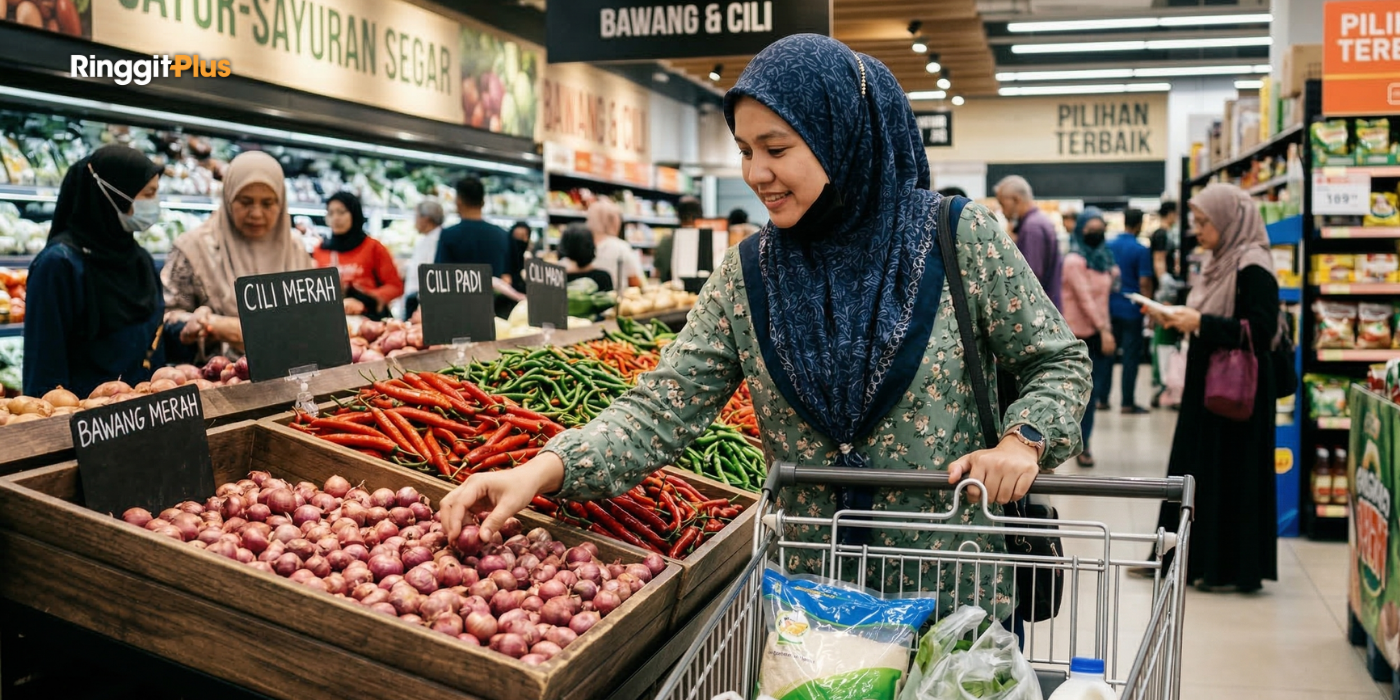
Among the controlled items are brown onions, red onions, garlic from China, dried curly chillies, red chillies, Australian dhal, and imported old ginger.
Several common vegetables used in daily cooking are also included, such as long beans, peanuts, imported round cabbage from Indonesia and China, carrots, mustard greens, cucumbers, potatoes, and tomatoes.
The inclusion of these items reflects their regular use in festive dishes as well as everyday meals during the Raya period.
Selected Seafood And Meat Prices Also Regulated
The scheme also covers several seafood and meat products that are commonly purchased ahead of family gatherings.
Price ceilings will apply to Indian mackerel, known locally as ikan kembung or mabung, and mackerel scad or ikan selayang. These fish are regulated based on sizes between eight and 12 fish per kilogram.
In the east coast states of Pahang, Terengganu, and Kelantan, tuna or mackerel tuna, commonly known as ikan aya or tongkol, sized between one and two fish per kilogram will also be controlled.
In Sabah, price limits will apply to fish species such as Demuduk, Sagai, Cermin, and Cupak when sold at sizes between three and five fish per kilogram.
For meat products, the scheme sets a price ceiling for imported buffalo meat from India in Peninsular Malaysia, Sabah, and Labuan. Imported beef will be controlled in Sarawak, while local beef, excluding tenderloin cuts, will have capped prices in Peninsular Malaysia. Chicken wings are also included under the scheme in Sabah, Sarawak, and Labuan.
Coconut products are regulated at different points in the supply chain, with wholesale price limits applied to coconuts and retail caps applied to grated coconut and coconut milk.
Traders Required To Display Pink Price Tags
Traders selling items under the scheme are required to display pink price tags to clearly show that the product falls under the festive price control list.
The ministry said enforcement officers will conduct inspections to ensure traders comply with the regulated prices throughout the scheme period.
Authorities have also been working with the Agriculture and Food Security Ministry as well as industry players to ensure that supply levels remain stable, including for imported goods.
Rahmah Sales Expanded And Vehicle Service Discounts Continue
Alongside the festive price control measures, the Jualan Rahmah Madani programme will expand the range of goods offered at discounted prices.
The number of items available through the programme will increase from 40 to at least 50 following a directive from Prime Minister Datuk Seri Anwar Ibrahim. The expanded list will include baking essentials such as sugar, icing sugar, and caster sugar, which typically see higher demand ahead of Raya.
Meanwhile, the Service Ihsan Madani programme will run from now until March 31, offering vehicle servicing discounts of between 10 and 30% at 124 participating workshops nationwide.
Bookings can be made through the Setel application to secure servicing appointments at nearby locations.
Temporary Controls Aim To Ease Festive Spending
Festive price control schemes are introduced each year to reduce the risk of sudden price increases during major celebrations when household demand for food tends to rise.
While the scheme does not reduce overall food prices across the board, it sets clear maximum limits on commonly purchased ingredients to help households plan their festive spending with greater certainty during the Raya period.
Follow us on our official WhatsApp channel for the latest money tips and updates.
Samuel writes about personal finance and financial news, focusing on how banking updates, policies, and promotions affect everyday money decisions. He enjoys making complicated financial topics easier to follow. Outside of writing, he spends his time watching TV shows and occasionally convincing himself he will only watch one episode.
00votes
Article Rating
SHARE
About THE AUTHOR
Samuel Chua
Samuel Chua
Samuel writes about personal finance and financial news, focusing on how banking updates, policies, and promotions affect everyday money decisions. He enjoys making complicated financial topics easier to follow. Outside of writing, he spends his time watching TV shows and occasionally convincing himself he will only watch one episode.
We provide weekly updates on every Friday at 5pm on the prices of RON95, RON97 and Diesel in Malaysia and a chart that shows the movement of fuel prices across a 6-week period. Bookmark this page now!







Comments (0)