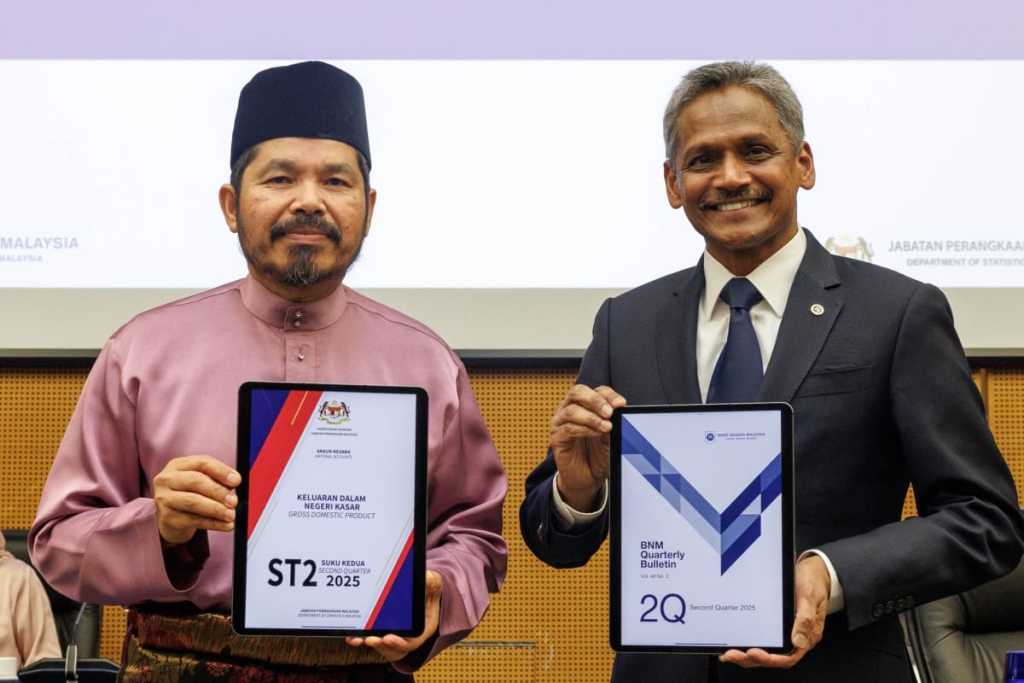
Malaysia’s economy grew by 4.4% in the second quarter of 2025 compared to the same period last year, matching the pace of the first quarter, according to data released at a Bank Negara Malaysia (BNM) press conference.
Growth was supported by resilient household spending, rising investments, and a healthy labour market. Higher minimum wages, salary adjustments for civil servants, and stable employment helped sustain domestic demand.
Private investment increased by 11.8% and public investment rose by 13.6%, supported by new and ongoing infrastructure and industrial projects. Government consumption grew by 6.4%.
Exports were weighed down by weaker commodity shipments, particularly from the mining sector. However, electrical and electronics products and tourism activity provided some support. Net exports contracted by 72.6% due to a drop in mining-related exports and higher capital imports, especially for data centre and IT equipment.
A 19% tariff on Malaysian exports to the United States took effect earlier this month, although some goods remain exempt pending a review of United States laws. BNM also said export growth is expected to be moderate in the second half of 2025.
Sector Performance Shows Strong Growth in Construction and Services
All major sectors expanded except for mining and quarrying. Services grew by 5.1%, manufacturing by 3.7%, agriculture by 2.1%, and construction by 12.1%. Mining and quarrying contracted by 5.2%.
The services sector benefited from consumer-focused and government-related activities. Manufacturing was supported by domestic-oriented industries but affected by disruptions in refined petroleum production. Agriculture growth was driven by higher oil palm production due to favourable weather, while construction growth was broad-based across non-residential, residential, and specialised trade works.
On a seasonally adjusted basis, the economy expanded by 2.1% quarter-on-quarter, an improvement from 0.7% in the first quarter.
Current Account Surplus Narrows, FDI Declines
The current account surplus fell to RM0.3 billion, or 0.1% of GDP, from RM16.7 billion in the first quarter. The decline reflected weaker mining-related exports from planned maintenance activities and higher capital imports for E&E and data centre equipment.
Foreign direct investment inflows dropped to RM1.6 billion from RM15.6 billion in the previous quarter, with most channelled into services, particularly financial and ICT activities. The main sources of FDI were Singapore, Japan, and the United Kingdom.
Inflation Eases to Lowest in More Than Four Years
Headline inflation moderated to 1.3% in the second quarter from 1.5% in the first quarter. Core inflation remained stable at 1.8%.
In June, the Consumer Price Index rose 1.1% year-on-year, the slowest pace in more than four years. Lower fuel prices, including RON97 petrol and diesel, and slower increases in food prices helped ease inflationary pressures. This was partly offset by a smaller decline in mobile communication service charges compared to the previous quarter.
Inflation pervasiveness, which measures the share of Consumer Price Index items recording monthly price increases, eased to 41.8%.
Monetary Policy Shift to Support Growth
In July, BNM reduced the Overnight Policy Rate to 2.75%, marking the first cut in five years. The move aimed to cushion the economy from external uncertainties and preserve growth momentum while inflation remained moderate.
The rate cut has already reduced repayment amounts for households with floating-rate loans.
Last month, the central bank also revised its 2025 GDP growth forecast to between 4.0% and 4.8%, down from the earlier range of 4.5% to 5.5%.
Credit Growth Steady, SME Financing Expands
Credit to the private non-financial sector grew by 5.2% in the second quarter, slightly below the 5.4% recorded in the first quarter.
Outstanding business loans rose by 4.5%, while household loans grew by 6%, supported by demand across most loan categories. SME financing expanded by 6.9%, with strong disbursements to the services, construction, and manufacturing sectors.
Tourism and Investment to Drive Outlook
BNM Governor Datuk Seri Abdul Rasheed Ghaffour said that while Malaysia continues to face external headwinds, domestic demand, resilient E&E exports, and a diversified export base will provide important buffers.
Tourism recovery is expected to remain strong, supported by improved flight connectivity, visa-free extensions, and promotional campaigns ahead of Visit Malaysia 2026. Investment activity will benefit from major infrastructure projects, the realisation of approved private investments, and a healthy pipeline of planned projects.
BNM now projects headline inflation to average between 1.5% and 2.3% in 2025, down from its March forecast of 2.0% to 3.5%. Softer global commodity prices and contained domestic cost pressures are expected to help keep consumer prices stable.
Samuel writes about personal finance and financial news, focusing on how banking updates, policies, and promotions affect everyday money decisions. He enjoys making complicated financial topics easier to follow. Outside of writing, he spends his time watching TV shows and occasionally convincing himself he will only watch one episode.
Samuel writes about personal finance and financial news, focusing on how banking updates, policies, and promotions affect everyday money decisions. He enjoys making complicated financial topics easier to follow. Outside of writing, he spends his time watching TV shows and occasionally convincing himself he will only watch one episode.
We provide weekly updates on every Friday at 5pm on the prices of RON95, RON97 and Diesel in Malaysia and a chart that shows the movement of fuel prices across a 6-week period. Bookmark this page now!







Comments (0)