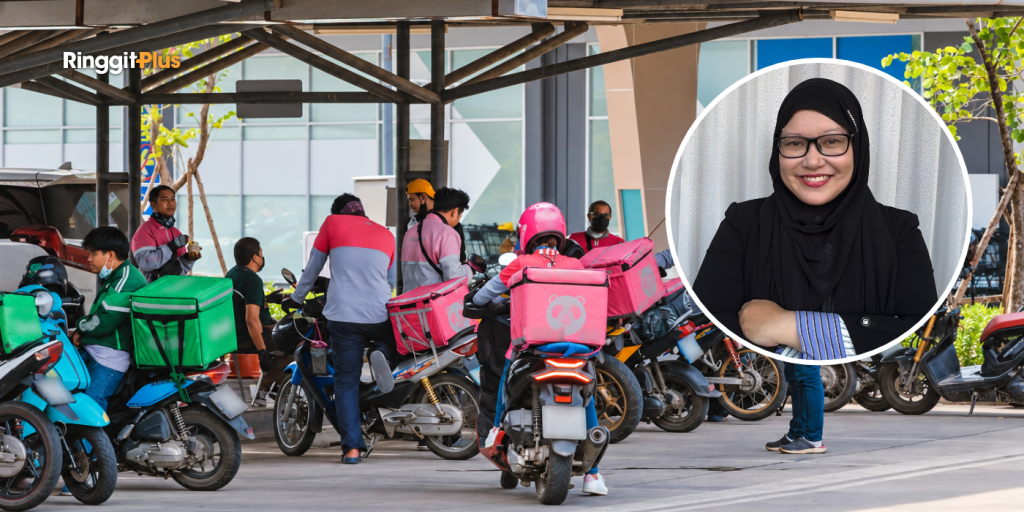
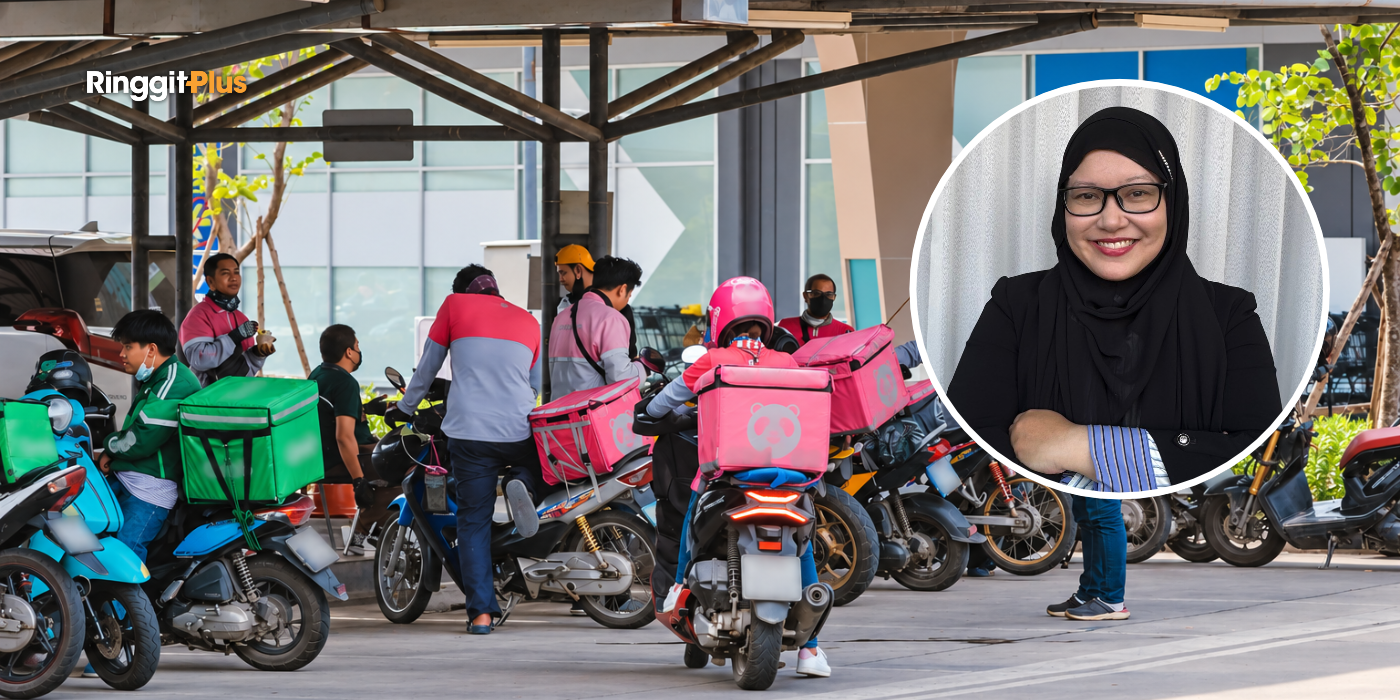
Gig workers can earn as much as salaried workers, but they can’t count on the same amount every month. Without a fixed salary or an employer contributing to their Employees Provident Fund (EPF), they also have to plan for their own savings and financial protection.
We asked Rozanna Rashid, CFP, how gig workers can build their own financial safety net. She’s a licensed financial planner, a member of the Financial Planning Association of Malaysia (FPAM) and a director at Alpine Advisory Sdn Bhd.
“The biggest difference is actually certainty,” Rozanna says of salaried jobs and gig work. Without a steady amount coming in each month, it’s harder to know how much you can spend and save.
Work Out What You Really Earn Each Month
Rozanna’s advice is to budget using your average income over the last three to six months. Don’t plan around your best month. “Maybe the low income is just a one-off,” she says, so don’t plan around your worst one either. For example, if you earned RM3,000, RM2,000 and RM2,500 over three months, your average is RM2,500. That’s what you’d plan your spending around.
Gig workers should also think like business owners and deduct what they spend to do the job first, she says. That includes petrol, tolls, servicing, and any loan on their motorcycle or car.
What’s left is their real take-home pay. A rider who earns RM2,500 a month on average and spends RM600 on petrol, tolls and servicing takes home RM1,900. Rent, food, bills and savings all have to come out of that RM1,900, so it’s the starting point for the monthly budget.
Build A Buffer For The Bad Months
Rozanna calls an emergency fund a “financial umbrella”. It’s money you keep aside for bad days, such as an accident, a broken motorcycle or a slow month. For gig workers, she says it’s the first thing to build. If you have no savings at all, start in your first 30 days, once your living and work costs are paid.
She suggests saving enough to cover three to six months of expenses. Gig workers may need more than six months, she says, and “maybe a year or more” if they’re married with small kids. For someone who spends RM2,500 a month, that means saving RM7,500 to RM30,000 or more, by our calculation.
Your Situation
Months To Save
On RM2,500 A Month
Single
3 to 6 months
RM7,500 to RM15,000
With a family
12 months or more
RM30,000 or more
If you take home RM1,900 a month and save RM300 for emergencies, that leaves RM1,600 for everything else. By our calculation, RM300 a month builds a first buffer of RM1,000 to RM3,000 in about three to 10 months. Saving RM7,500, or three months of expenses, takes just over two years.
You can build towards this in stages while you deal with other money priorities. “A six-month emergency fund is the destination, not the starting line,” Rozanna says. Start with enough for a tyre replacement, servicing, a new phone or a few slow weeks. Then build towards one month of expenses, then three, then six or more.
Pay Down Card Debt While You Save
You don’t have to wait until your emergency fund is full before paying off high-interest debt. “If you’re carrying credit card debt at 15% to 18% interest, that debt is growing much faster than your savings,” Rozanna says.
She recommends building a small buffer of RM1,000 to RM3,000 first, while paying down high-interest debt aggressively, not just the minimum. Without that buffer, a motorcycle breakdown or a slow month often goes on a credit card again. “The goal is to avoid being trapped in a cycle where every emergency becomes new debt,” she says.
When money is tight, her order is a basic emergency fund first, then high-interest debt, then regular EPF contributions. After that, keep growing your emergency fund towards six months or more. “Emergency savings protect today’s income. EPF protects tomorrow’s income,” she says. “Both matter, but surviving the next emergency comes first.”
Investing comes last, once your emergency fund is full and your card debt is cleared. As Rozanna puts it, “For as long as you have not filled up your emergency fund, I’m not going to talk to you about any form of investment.” Before you invest, pay into EPF until you’ve contributed RM2,500 for the year, which gets you the full i-Saraan top-up. After that, put what’s left into ASB if you’re eligible, or unit trusts, which can rise or fall in value. You can also save it for a goal, such as a house deposit or a car.
Protect Yourself For The Months You Can’t Work
PERKESO (SOCSO) covers gig workers who contribute if they’re hurt while working. It costs from RM13.10 a month and is compulsory for e-hailing drivers, but it doesn’t cover illness that isn’t caused by your work. Rozanna says this basic cover may not be enough to support your family.
On top of your emergency fund, she recommends personal accident insurance, which pays out if you’re hurt, and life insurance, which pays your family if you pass away. Delivery riders and e-hailing drivers are on the road every day, so one accident could stop them working for weeks. “If they can’t ride, then there’s no income for the family,” she says.
Gig workers may also need to arrange their own medical and critical illness cover. You’ll have to pay for these yourself, so she suggests including the cost in your monthly budget alongside your savings.
Plan For Retirement Without An Employer
You can pay into your own EPF account any time, from as little as RM1. Under EPF’s i-Saraan scheme, the government adds 20% of what you put in, up to RM500 a year. E-hailing drivers and delivery riders can get up to RM600 a year under i-Saraan Plus. By our calculation, putting in RM100 a month comes to RM1,200 a year, so the government would add RM240. To get the full RM500, you’d need to put in RM2,500 over the year.
Rozanna says to aim for that full top-up. “No one’s going to give you 50 ringgit at the mamak, let alone 600 ringgit,” she says. “It is free money from the government.”
Budget 2027, tabled on 9 October 2026, keeps i-Saraan Plus going. It also proposes matching 35% of what drivers and riders pay into PERKESO, or 50% if the platform also pays part. These are proposals, and no start date has been announced. To receive the matching incentives, you’ll need to make your own contributions first.
Even with the top-ups, Rozanna warns that putting only RM3,000 or RM3,500 a year into EPF isn’t enough. “You might be very broke when the time comes for your golden days,” she says. She points out that if you spend RM5,000 a month now, you’ll probably need the same or more later, because “you cannot run away from inflation”. She suggests working out what you’ll realistically need to retire with dignity, and saving towards it.
For comparison, a salaried worker’s employer adds 13% of a salary of RM5,000 or less every month. On a RM2,500 salary, that’s RM3,900 a year from the employer alone, by our calculation.
Don’t Overlook Taxes And Your Income Records
Gig income is taxable, and a large tax bill at the end of the year can be a shock. When Rozanna moved from a salaried job to running her own business, her tax came due as one lump sum. “I got that shock before, and it was not pleasant,” she says.
She recommends working with a tax agent or financial planner to estimate how much tax you’ll owe and identify tax reliefs that lower your taxable income. Once you have an estimate, set aside part of it every month or every three months.
If you freelance on the side of a full-time job, the same order applies. Your employer already pays into EPF, so Rozanna says the extra income should go to a basic emergency fund first, then to high-interest debt, before you invest.
Keep your records in order if you plan to apply for a home loan or business financing without a payslip. Rozanna recommends keeping at least two years of tax filings with the Inland Revenue Board (LHDN), invoices, receipts and payment slips. These records can help demonstrate your income history when a bank assesses your loan application.
Nobody Else Will Build Your Safety Net For You
Rozanna says financial planning is even more relevant for gig workers than for salaried staff, because “you really have to plan for your rainy days”. Without an employer, setting aside tax, paying into EPF and covering your bills when you can’t work are all up to you.
She asks every client, salaried or not, whether they can afford to retire at 55. If the answer is no, they’ll need to work longer, save more, or find a better job or a side income.
“Help yourself first. Fund for yourself first. Protect yourself first,” Rozanna says of what gig workers should do with their money, “because no one else is going to do that for you.”
Follow us on our official WhatsApp channel for the latest money tips and updates.
As a creative content writer, Eloise has covered finance, business, lifestyle topics, and even moonlights as a singer-songwriter outside of RinggitPlus. Her current interests are learning the best ways to optimise spending and credit card hacks to gain more airline miles.
00votes
Article Rating
SHARE
About THE AUTHOR
Eloise Lau
Eloise Lau
As a creative content writer, Eloise has covered finance, business, lifestyle topics, and even moonlights as a singer-songwriter outside of RinggitPlus. Her current interests are learning the best ways to optimise spending and credit card hacks to gain more airline miles.
We provide weekly updates on every Friday at 5pm on the prices of RON95, RON97 and Diesel in Malaysia and a chart that shows the movement of fuel prices across a 6-week period. Bookmark this page now!





Comments (0)