Most people assume debt becomes a problem when you stop paying your loan installments or credit card bills. The harder situation to spot is when you’re paying every month, on time, without ever meaningfully reducing what you owe. You keep up with the statements, the direct debits go through, and yet the total balance stays roughly where it was a year ago.
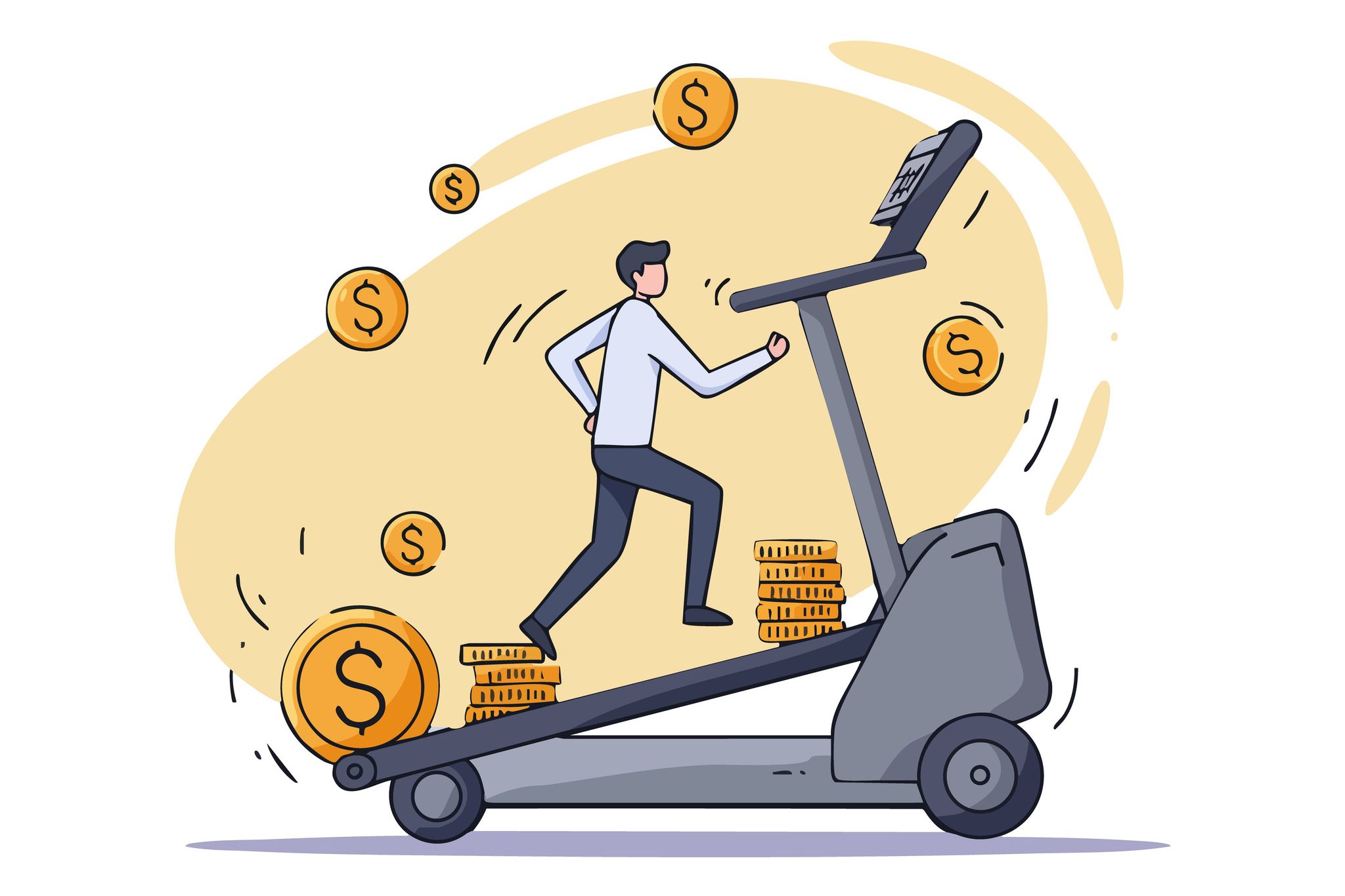
That’s the debt treadmill.
What Is The Debt Treadmill?
The debt treadmill is when your regular payments on loans and credit cards aren’t actually reducing what you owe. You’re covering interest and keeping accounts current, but the underlying balance isn’t moving.
This is different from simply having debt. A car loan or home loan is structured so that each payment chips away at what you borrowed. The treadmill happens when you’re only ever servicing interest, or when you need to borrow again just to get through the month. You can go years without missing a single payment and still find your total debt unchanged.
The Maths of Being Stuck
Malaysian credit cards charge up to 18% interest per annum. The minimum payment due each month is 5% of your outstanding balance or RM50, whichever is higher. On a RM3,000 balance, that’s RM150 a month. At that rate with no new spending, it takes four years and seven months to clear the balance, and you’ll pay RM1,055 in interest on top.
Those figures assume no new charges are added. If you keep spending while paying the minimum, the balance won’t shift. Across two or three cards held for several years, the total interest you pay can easily exceed what you originally borrowed.
How to Tell You’re on the Debt Treadmill
Credit Cards
Paying only the minimum for one difficult month is normal. It becomes a concern when you genuinely cannot remember the last time you cleared your full outstanding balance. Three months of minimum-only payments is manageable, but twelve months or more means you’re maintaining the debt rather than reducing it.
Using your credit card for groceries and petrol isn’t a warning sign on its own. Plenty of people do it to earn cashback and pay the balance in full each month, that’s how to sensibly use the bank’s money!
Problems arise when necessities are going on the card because your bank account doesn’t have enough to cover them. That gap is debt, and it compounds each month it goes unaddressed.
Balance transfers are worth watching too. Moving a balance to a 0% promotional rate can be a practical move, giving you 12 to 24 months to pay down debt without interest accumulating. But if you’ve done this two or three times on the same balance and it keeps returning to roughly where it started, the transfer is delaying the problem rather than solving it. Don’t spend more on the card whilst you’re paying off a Balance Transfer!
Loans
Consolidating by taking a personal loan to clear credit card debt can make sense, since personal loan rates are typically lower than credit card interest rates. The problem many people run into is that the cards get cleared, spending on them gradually resumes, and within months they’re repaying the consolidation loan while the card balances climb again.
Extending your car loan from five years to nine years reduces your monthly commitment, but the total amount you repay over nine years is generally higher than over five years, and you stay tied to a depreciating asset for much longer. It can be a reasonable short-term decision in a genuine cash crunch, but doing it repeatedly just pushes the problem further down the road.
Cash Flow
Running short before payday every single month is a sign that your outgoings exceed your income rather than a run of bad luck. A related signal is being unable to cover an unexpected RM500 expense without borrowing. Car repairs, medical bills, a broken appliance, these are predictable categories of expense even if the exact timing isn’t. Without a buffer to absorb them, each one adds to your debt load.
What Your Debt-to-Income Ratio Is Telling You
Your Debt Service Ratio (DSR) is the percentage of your take-home income that goes to debt repayments each month. To work it out, add up all your fixed monthly debt payments (credit card minimums, car loan, home loan, personal loan, PTPTN) and divide by your net monthly income after EPF and tax deductions. You can also use our DSR calculator to get your number quickly.
If your net income is RM5,000 a month and your total debt commitments come to RM2,500, your DSR is 50%.
Most Malaysian banks won’t approve new loans once your DSR exceeds 60%. Even at 45% to 50%, there’s very little room left for savings or unplanned costs. Among Malaysians who enrolled in AKPK’s debt restructuring programme, many had DSRs above 80%, meaning more than four out of every five ringgit they earned was already committed to debt repayments before anything else. At that level, taking on new borrowing doesn’t resolve the problem.
How to Start Reducing Your Debt
The first thing to do is stop adding to it. No new credit card applications, no personal loans to cover existing loans, no balance transfers as a way of buying time. Before any repayment plan can work, you need a clear picture of your total outstanding debt across every account.
The avalanche method means ranking all your debts by interest rate and directing any extra money each month to the highest-rate debt first, while paying the minimum on everything else. Once that’s cleared, you roll that payment into the next highest, and so on. It takes longer to see the first debt disappear, but you pay the least interest overall.
The snowball method works the opposite way, targeting the smallest balance first regardless of interest rate, which means you’ll clear an account sooner and get a concrete win early on. This approach helps people stay consistent, even if it costs slightly more in interest over time. Both methods work, and the more important factor is picking one and not abandoning it.
It’s also worth calling your bank directly to ask whether they can offer a lower rate or a restructured repayment schedule. Banks generally prefer negotiating with you over dealing with a default, and you don’t need to wait until you’re in arrears to have that conversation.
If your debt feels genuinely unmanageable, AKPK (Agensi Kaunseling dan Pengurusan Kredit) offers free financial counselling to all Malaysians, along with its Debt Management Programme for those who qualify. Under the programme, AKPK negotiates with your banks to restructure your repayments to something your income can actually support, and legal proceedings from creditors are deferred while you’re enrolled. Reaching out early keeps more options on the table.
Want more practical money tips? Join our WhatsApp Channel for regular updates.
Christina writes about personal finance with an eye for making the complicated feel straightforward. She is drawn to the everyday money decisions people face and genuinely enjoys finding the clearest way to explain them. Between articles, she is probably napping, on a hiking trail, or terrorising her sister’s cats.
00votes
Article Rating
SHARE
About THE AUTHOR
Christina Chandra
Christina Chandra
Christina writes about personal finance with an eye for making the complicated feel straightforward. She is drawn to the everyday money decisions people face and genuinely enjoys finding the clearest way to explain them. Between articles, she is probably napping, on a hiking trail, or terrorising her sister's cats.






Comments (0)