Alex Cheong Pui Yin
Previously covered recruitment-related stories and had a short stint as a copywriter for the property industry. She subsequently developed an interest in investment and robo-advisors.

1st April 2021 - 4 min read
(Image: The Sun Daily)
Stress tests from Bank Negara Malaysia (BNM) have indicated that the country’s financial institutions are able to continue maintaining their resilience even when placed under simulated severe credit, income, and funding shocks. Revealed in the Financial Stability Review for the second half of 2020, the central bank stated that two hypothetical adverse scenarios were applied for the purpose of these tests.
In sharing the information, BNM emphasised that stress testing is an integral component of its financial stability framework used to assess and manage risks to financial stability. It said that the actual economic impact from the Covid-19 pandemic had encouraged it to use its top-down, scenario-based stress tests in assessing the ability of banks to withstand the unfolding stress based on assumptions around a likely recovery path at the time.
“This was supplemented with additional sensitivity analyses performed under a bottom-up approach to provide more granular assessments of resilience based on the specific risk profile of individual banks,” said the central bank.
(Image: The Malaysian Reserve)
According to BNM, the first adverse scenario applied for the tests assumed a sharp economic downturn in the first quarter (Q1) of 2021, with a severity that is similar to the downturn experienced in the second quarter (Q2) of 2020. Following that, the economy will recover at a gradual pace akin to a V-shape.
Under this first adverse scenario, the initial recovery – which is driven by pent-up demand – will be unevenly distributed across industries before gradually normalising across all sectors by 2022. “Simultaneously, broad success with vaccination efforts in most countries results in global gross domestic product (GDP) returning to pre-pandemic levels by the third quarter of 2021, further bolstering domestic economic recovery,” said BNM.
Meanwhile, the second adverse scenario adopted a sharper economic contraction in Q1 of 2021, surpassing even the deepest slump experienced in the crisis so far. Its recovery is also fixed at a slower rate and is L-shaped, with the GDP recording negative growth in 2021 and remaining below pre-pandemic levels even by end of 2022.
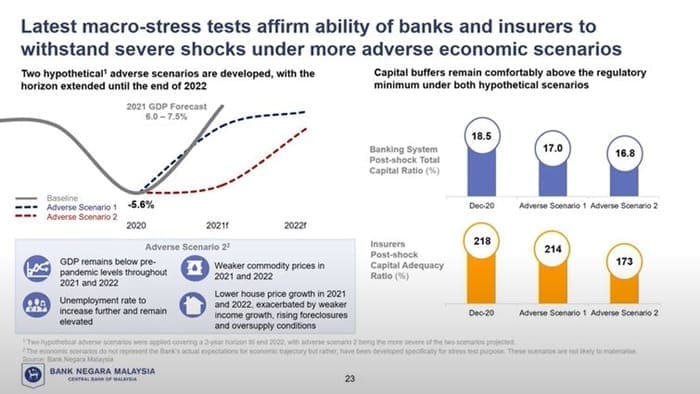
“This scenario assumes an ineffective vaccine and a marginal contraction in global growth in 2021, which will adversely impact Malaysian exports, investments, and consumptions,” the central bank also said. Under this second scenario, extended lockdown restrictions saw domestic demand suffer a prolonged decline with labour market conditions worsening throughout 2021.
Additionally, both scenarios assumed sovereign rating downgrades in 2021, and that there will be no further repayment assistance for household providers after Q1 of 2021. All rescheduling and restructuring of business loans are also assumed to end after Q2 of 2021.
With regard to the effects of both the scenarios, BNM said that the overall impairments incurred by banks may rise to 4% and 5.4% by the end of 2022 for the first and second scenario, respectively. Moreover, businesses are expected to drive the larger share of new impairments in 2021, followed by households in 2022.
(Image: Hari Anggara)
BNM also clarified that while this stress testing exercise assumed a greater degree of economic stress, impairments by end of 2021 are actually more likely to settle lower at 2.9% and 3.3% under the first and second scenario, respectively, compared with 4.1% in the previous exercise. “This is primarily due to conservative assumptions applied previously in translating economic shocks into business impairments where it was assumed all maturing bullet repayments in identified vulnerable business sectors would default,” it said.
Finally, BNM reassured that the economic scenarios used in the stress tests were not the central bank’s projection for Malaysia’s economy. Instead, they were drawn up to test the ability of financial institutions to withstand worse and prolonged economic shocks even as BNM expects Malaysia’s actual economic prospects to continue improving.
(Sources: Bank Negara Malaysia [1, 2], Malay Mail)
Previously covered recruitment-related stories and had a short stint as a copywriter for the property industry. She subsequently developed an interest in investment and robo-advisors.





Comments (0)