The number of families turning to food aid has surged by 35% to 40% over the past two years, according to The Lost Food Project (TLFP), as rising prices take up more of B40 household budgets.
TLFP, a not-for-profit food bank now in its 11th year of operations, currently provides food aid to more than 36,000 B40 families across 180 locations in the Klang Valley, Penang, and Johor, distributing over 150,000 meals every week.
General manager Stuart Galvin explained that demand from low-income communities has accelerated since the organisation first flagged a 30% increase in early 2024. B40 households already spend more than a third of their income on food, and the continued rise in living costs has pushed more families to seek help.
Turning Surplus Food Into Meals
TLFP works by grabbing quality surplus food that would otherwise end up in landfills and redirecting it to people who need it. The organisation calls this “lost food,” meaning surplus, in-date food from manufacturers, distributors, and grocery suppliers that goes unsold or unused.
In 2025, TLFP rescued 2.9 million kilogrammes of surplus food and converted it into 8.5 million meals for communities in need. Every kilogramme of food diverted from landfill also reduces greenhouse gas emissions from decomposition.
TLFP rescues around 40 tonnes per week. That is a fraction of theestimated 4,000 tonnes of edible food thrown away in Malaysia every day, enough to feed 10 million people. What TLFP intercepts represents roughly 1% of that daily waste figure.
Where The Food Goes
About 35% of what TLFP collects goes to charities, including soup kitchens, children’s homes, and homeless shelters. The remaining 65% is delivered to 50 PPR and B40 communities on a rotational basis.
The organisation’s distribution network currently covers 92 charities in the Klang Valley, 10 in Johor Bahru, and two in Penang. For PPR and B40 housing distributions, TLFP operates at 28 active locations plus 26 ad-hoc sub-beneficiary sites, with each community averaging around 5,000 residents. Resident committees select the families with the greatest need for each distribution day.
Dry goods are sourced from over 50 distributors, manufacturers, and grocers, while fresh produce comes from the Kuala Lumpur wholesale market. The dry goods include items like powdered drinks, instant noodles, rice, canned food, cooking oil, and biscuits. TLFP also receives non-food essentials to address hygiene and period poverty, such as sanitary towels, toothbrushes, shampoo, and detergents.
All goods are sorted and allocated at the TLFP warehouse on Jalan Chan Sow Lin. Charities visit on a scheduled basis to collect parcels, while deliveries and pickups run Monday to Friday. Fridays are reserved for corporate social responsibility (CSR) and volunteer charity distribution days. Galvin said the organisation is looking to expand further.
On The Ground
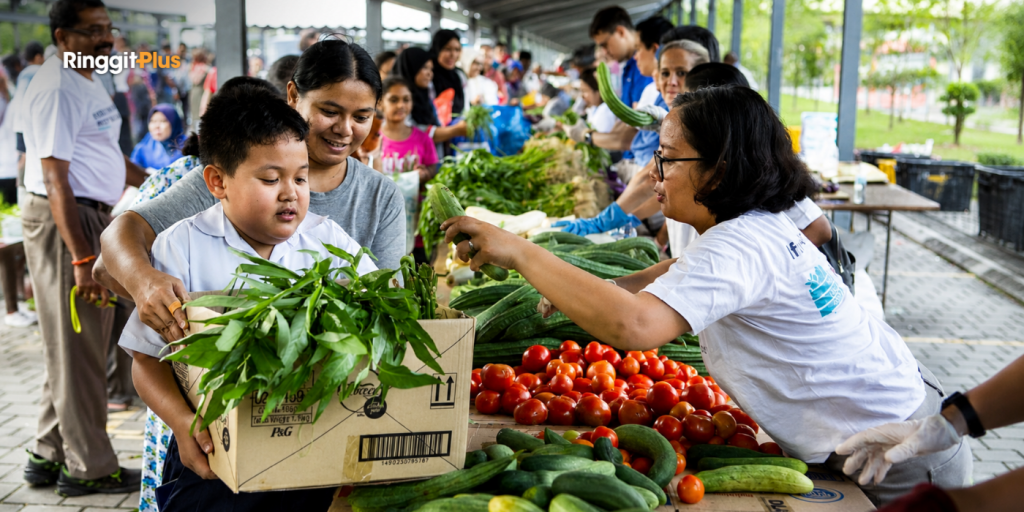
In one of the PPR communities in the Pandan area, the weekly food run follows a fixed schedule. J. Vikneswaran, chairman of the civil society group Voice of Pandan, has coordinated with TLFP for six years to support families around the area.
Every Monday, vegetables and fruits are delivered on a rotation: Pandan Jaya on the first Monday of the month, followed by Pandan Indah, Maju Jaya, and Taman Seraya. Between his volunteers and the TLFP team, around 400 families receive weekly aid across these four locations.
Siti Eshah Mahmud, 69, lives alone in the Ampang Hilir low-cost flats and has been a recipient for three years. “We are thankful to get the food aid. I live alone, so this is enough for me,” she said.
Where Your Grocery Bill Fits In
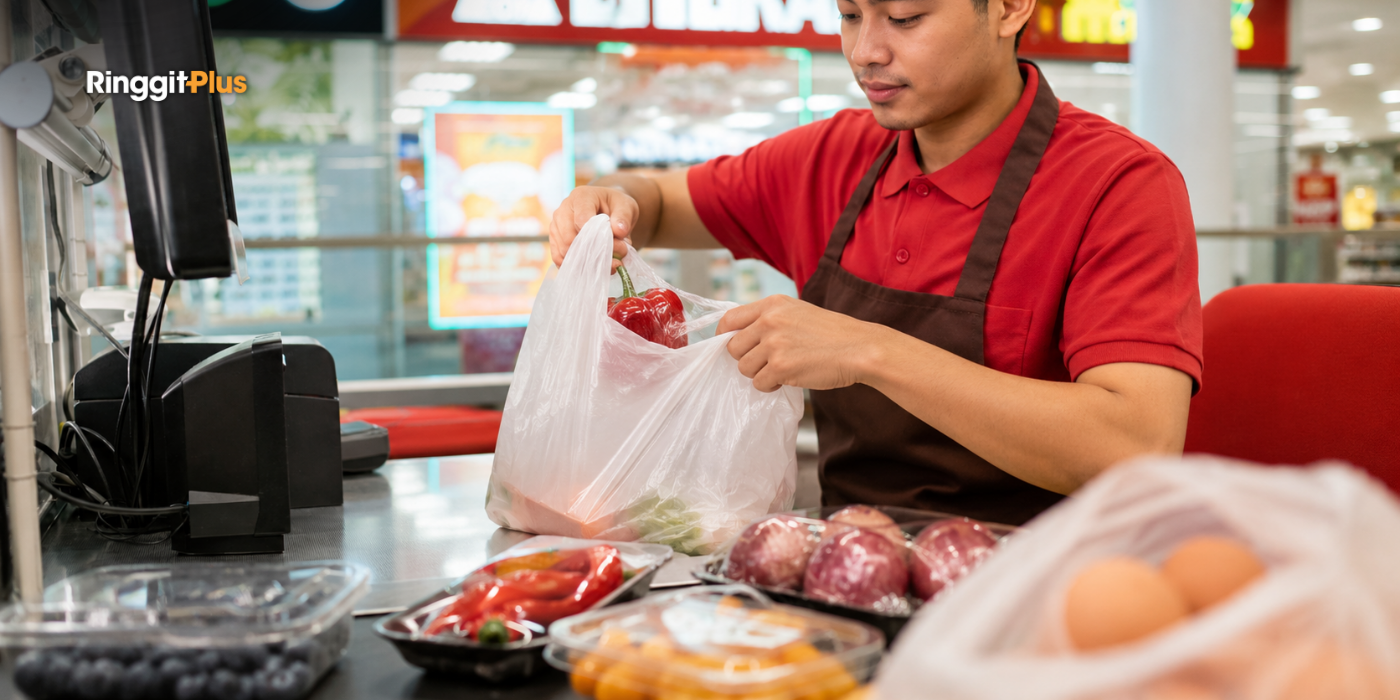
If you’re in a B40 household spending upwards of a third of your monthly income on food, the 40% jump in food aid demand tracks with what many families are experiencing. Even with subsidies on essentials like cooking oil and flour still in place, everyday grocery costs keep climbing. Items like fresh vegetables, protein, and even basic toiletries take up a growing share of the monthly budget.
For households earning under RM5,000 a month, there is not much room left. A weekly grocery run of RM150 to RM200 adds up to RM600 to RM800 a month before you account for school meals, transport, or utilities. Organisations like TLFP step in to help cover what household budgets cannot, and they accept donations of food, money, and volunteer time.
As a creative content writer, Eloise has covered finance, business, lifestyle topics, and even moonlights as a singer-songwriter outside of RinggitPlus. Her current interests are learning the best ways to optimise spending and credit card hacks to gain more airline miles.
00votes
Article Rating
SHARE
About THE AUTHOR
Eloise Lau
Eloise Lau
As a creative content writer, Eloise has covered finance, business, lifestyle topics, and even moonlights as a singer-songwriter outside of RinggitPlus. Her current interests are learning the best ways to optimise spending and credit card hacks to gain more airline miles.




Comments (0)