Every Chinese New Year, the same questions haunt newly married couples across Malaysia: How much should go in the ang pow for aunty’s kids? Can we get away with RM10 for the neighbour’s kid? And why does everybody seem to know the “right” amount to give?
Twenty years ago, RM2 in a red packet was perfectly respectable, but today, that same RM2 might get you a polite smile and a mental note that you’re cheap.
How Much Should You Give In An Ang Pow?
Odd numbers are generally avoided. RM5 or RM7 look stingy, and RM5 notes are awkward to fold anyway. Amounts ending in 4 (RM14, RM24) are out because the Cantonese pronunciation of the number 4 sounds like “death.” The number 8, on the other hand, sounds like “prosperity,” hence some people like giving ang pows in multiples of eight.
CNY 2026 Ang Pow Guide
Recipient
Typical Range
Strangers or service staff
RM6 – RM8
Acquaintances, neighbours’ children
RM8 – RM10
Friends’ children, distant relatives
RM10 – RM20
Close friends, extended family
RM20 – RM50
Immediate family (nieces, nephews)
RM50+
Parents, in-laws
RM100+
These figures have crept up noticeably. A decade ago, RM6-RM8 for acquaintances was standard, and RM2 was still acceptable for strangers. Inflation applies to ang pows too.
Prepare a range of denominations so you can adjust on the spot. Keep some RM1s, RM10s, RM20s, and RM50s ready. If you’re going to an open house, always bring more ang pow packets than you think you’ll need, because running out mid-visit is its own kind of embarrassing. And if you’re buying red packets with zodiac animals, avoid giving packets featuring pigs to Muslim friends or neighbours. It’s a small consideration that shows you’ve thought about who you’re giving to.
These aren’t fixed rules. A young couple just starting out shouldn’t feel pressured to match what their more established relatives give. Give what you can comfortably afford. Your aunty who’s been married for 20 years and owns two properties, can afford to stuff RM50 into every packet. You? Still paying off your first home and car loan. Cannot lah. That’s fine.
If you’re unsure where to start, think about what you received from specific relatives before you were married. If Uncle Tan always gave you RM20, you’re probably safe giving his kids RM20. Reciprocity is the invisible logic behind most ang pow amounts.
Marriage also doesn’t automatically disqualify you from the receiving end. Elderly relatives often insist on giving ang pows to younger married couples, especially if you’re visiting them. Unmarried adults (yes, even those in their 30s and 40s) still receive ang pows at family gatherings.
Accept graciously with both hands. Refusing repeatedly makes things awkward for everyone.
Can You Give An E-Wallet Ang Pow?
Remember queuing at the bank a few days before Chinese New Year, hoping they still had crisp RM10s and RM20s left? Or realising, halfway through a house visit, that you’d miscounted your red packets and were now mentally reshuffling who gets what?
This is where e-ang pows quietly solved a very specific kind of festive stress.
For many Malaysians, DuitNow has become the easiest option. A quick transfer using just a phone number means no scrambling for change and no awkward “next time lah” when unexpected guests turn up. It also works across all major local banks, which makes it practical for family members of all ages.
E-wallets like Touch ‘n Go, Boost, and GrabPay have leaned into the season too. Touch ‘n Go’s “Money Packet” feature, for instance, lets recipients scan a QR code and receive randomised amounts, recreating a bit of the surprise element. The trade-off is that the money stays within the app, which some people are perfectly fine with, and others less so.
Some purists argue that digital transfers lack the warmth of handing over a physical red packet. There’s something to that. The ritual of receiving an envelope with both hands does carry its own meaning. But there’s also something to be said for not spending your festive weekend explaining to your bank why you made 47 small transfers in two days.
Ang Pows Are About The Blessing, Not The Cash
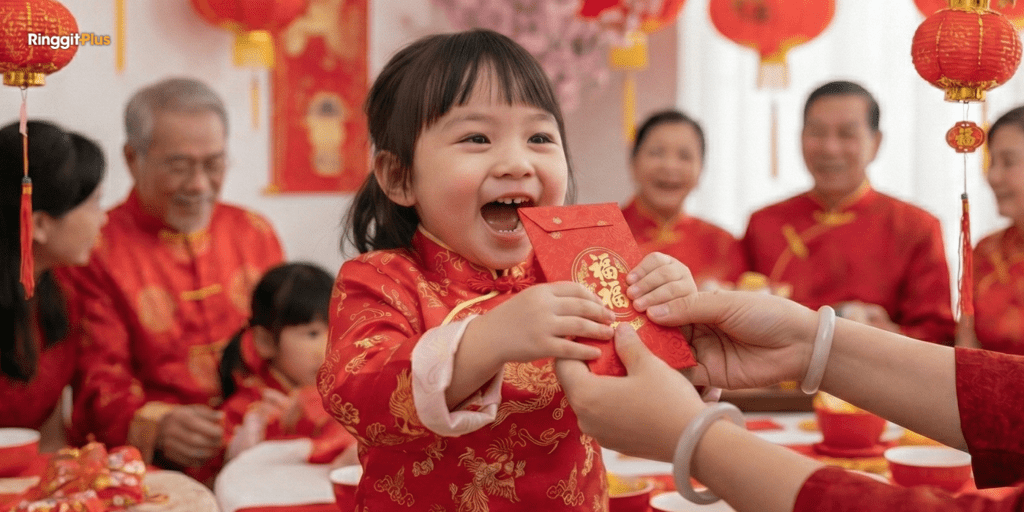
The significance of ang pow isn’t really the money inside. The red envelope itself carries the blessing. Whether there’s RM8 or RM88 tucked inside, the gesture represents well-wishing for a prosperous year ahead.
Yes, children will compare notes. Yes, some relatives notice more than others. But most people aren’t keeping score. They’re just happy you showed up, sat through three rounds of yee sang tossing, and made the effort to be part of the celebration.
Give what’s comfortable for your budget, respect the basic etiquette, and don’t overthink it. The ang pow is really just a way of saying you care enough to wish someone well.
That said, nobody’s keeping a spreadsheet. Probably. Follow us on our official WhatsApp channel for the latest money tips and updates.
As a creative content writer, Eloise has covered finance, business, lifestyle topics, and even moonlights as a singer-songwriter outside of RinggitPlus. Her current interests are learning the best ways to optimise spending and credit card hacks to gain more airline miles.
51vote
Article Rating
SHARE
About THE AUTHOR
Eloise Lau
Eloise Lau
As a creative content writer, Eloise has covered finance, business, lifestyle topics, and even moonlights as a singer-songwriter outside of RinggitPlus. Her current interests are learning the best ways to optimise spending and credit card hacks to gain more airline miles.






Comments (0)