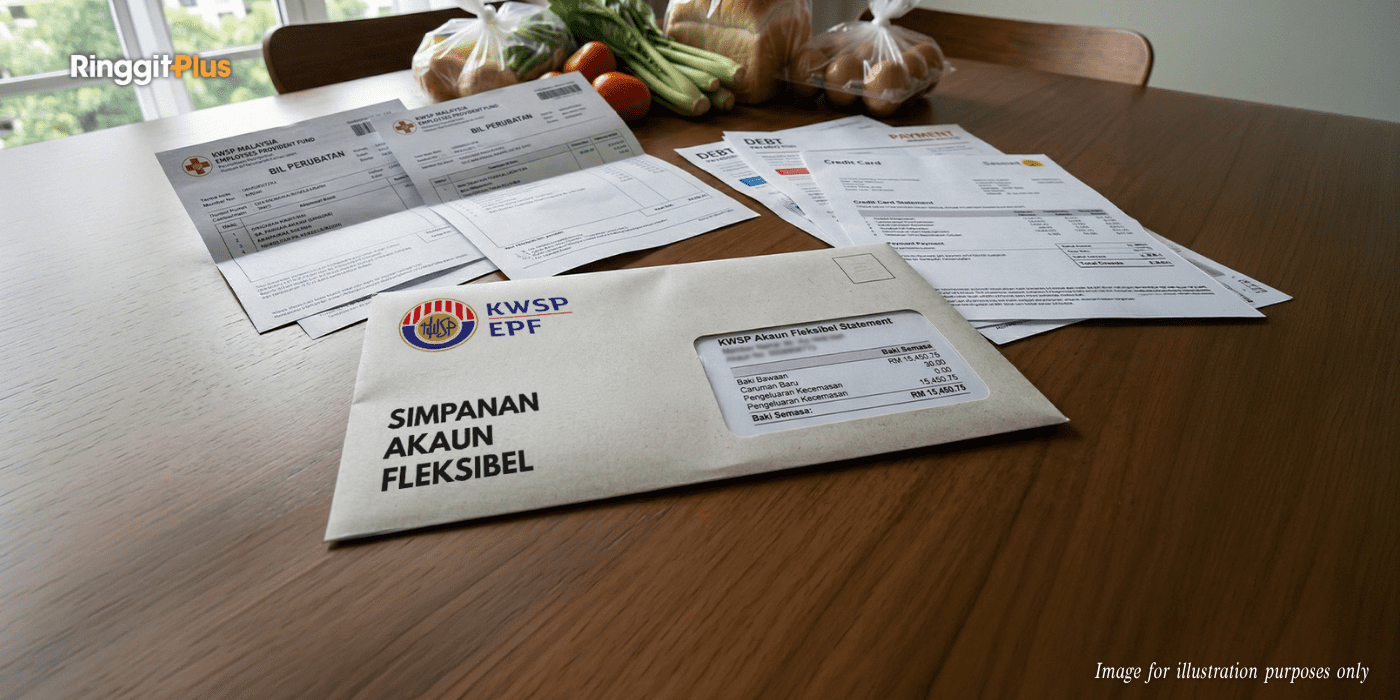
Since the Employees Provident Fund (EPF) launched Akaun Fleksibel in May 2024, nearly five million members under 55 have made withdrawals totalling RM16.6 billion, according to the fund’s latest research report. That works out to about 37% of the 13.3 million members eligible to use it.
The remaining 63% have not withdrawn anything. Among those non-withdrawers, 44% had enough in the account but chose not to, while 56% simply did not have sufficient savings to make a withdrawal.
How Akaun Fleksibel Fits Into The EPF Structure
Akaun Fleksibel was introduced as part of EPF’s three-account restructuring. Monthly contributions are now split 75:15:10 across Akaun Persaraan, Akaun Sejahtera, and Akaun Fleksibel, respectively. Members can withdraw from Akaun Fleksibel at any time, as long as the account has funds.
Between May and August 2024, EPF also offered a one-time transfer window that allowed members to move money from Akaun Sejahtera into Akaun Fleksibel. About 4.1 million members transferred a total of RM14.5 billion during this period. Of those, 3.6 million (88.1%) went on to make at least one withdrawal. The remaining 11.9% appear to have transferred as a precaution, leaving around RM2.5 billion sitting unused as of October 2025.
The Initial Rush Slowed Down Quickly
Withdrawal activity spiked in May 2024, when 2.6 million members made withdrawals worth RM6.01 billion. That was largely driven by the transfer window. By June, the number of withdrawals had dropped to about one million, and withdrawal values fell to RM1.97 billion. By August, total monthly withdrawals were down to RM990 million.
From September 2024 onwards, monthly withdrawal values tapered to roughly RM500 million and have stayed between RM420 million and RM530 million through most of 2025. A brief uptick in March 2025 coincided with the EPF dividend announcement, when withdrawals climbed to 1.4 million transactions, before settling back to around 1.3 million per month.
Average withdrawal amounts tell a similar story. In May 2024, the average withdrawal per member was RM2,294. By September, it had fallen to RM677, and by December, it was RM402. Through 2025, the average has stabilised at around RM330. Median withdrawals dropped even further, from RM1,063 in May 2024 to just RM120 by October 2025, which means most people are taking out small amounts at a time.
Most Withdrawals Go Towards Daily Necessities And Emergencies
An EPF survey of 14,204 members who withdrew between May 2024 and June 2025 found that spending was overwhelmingly directed at basic needs. About 93% used the money for daily necessities, 81.7% for emergency expenses, 74.4% for debt and investment obligations, and 73.3% for seasonal or lifestyle costs.
Food and groceries were the most common expense, cited by 70.3% of respondents, including items like infant formula and diapers. Health treatment costs accounted for 58.7%, and debt payments made up 56.6%. Only 18.3% said they used the funds for lifestyle spending, which suggests discretionary purchases were not the main reason people withdrew.
Usage also differed depending on how frequently members accessed the account. Those who withdrew in nine or more months tended to use it for recurring costs like food and transport. Those who withdrew only once or twice typically did so for bigger, one-off expenses such as job loss, business setbacks, or major home repairs.
The early months of Akaun Fleksibel saw large, one-off withdrawals, with amounts above RM1,000 common. That phase ended by around August 2024. What has replaced it is small, regular withdrawals, mostly under RM500, with the median now at RM120.
For many members, the account has become a monthly top-up to cover gaps in their household budget. When 70% of withdrawals go to food and groceries, and the median amount is RM120, people are using it to get through the month.
The EPF itself acknowledged this in its report, noting that addressing economic pressures, including rising living costs and stagnant wage growth, is central to reducing reliance on long-term savings for short-term needs. The fund also recommended integrating financial guidance tools into its i-Akaun app, offering personalised projections showing how withdrawals affect retirement balances over time, and expanding its financial literacy programmes.
What Regular Withdrawals Mean For Your Retirement Balance
If you’ve been dipping into Akaun Fleksibel to cover groceries or medical bills, you’re far from alone. The EPF’s own data shows that’s exactly what most members are using it for. The account exists for this reason, and using it when you need to is not a failure of planning.
It is worth keeping an eye on how often you’re withdrawing and how much is left, because the 10% contribution rate means the balance rebuilds slowly. For someone earning RM2,500, only about RM27.50 per month flows into Akaun Fleksibel, so even a RM120 withdrawal takes over four months to replenish. You can check your projected retirement balance anytime through the i-Akaun app.
Follow us on our official WhatsApp channel for the latest money tips and updates.
As a creative content writer, Eloise has covered finance, business, lifestyle topics, and even moonlights as a singer-songwriter outside of RinggitPlus. Her current interests are learning the best ways to optimise spending and credit card hacks to gain more airline miles.
00votes
Article Rating
SHARE
About THE AUTHOR
Eloise Lau
Eloise Lau
As a creative content writer, Eloise has covered finance, business, lifestyle topics, and even moonlights as a singer-songwriter outside of RinggitPlus. Her current interests are learning the best ways to optimise spending and credit card hacks to gain more airline miles.
We provide weekly updates on every Friday at 5pm on the prices of RON95, RON97 and Diesel in Malaysia and a chart that shows the movement of fuel prices across a 6-week period. Bookmark this page now!






Comments (0)