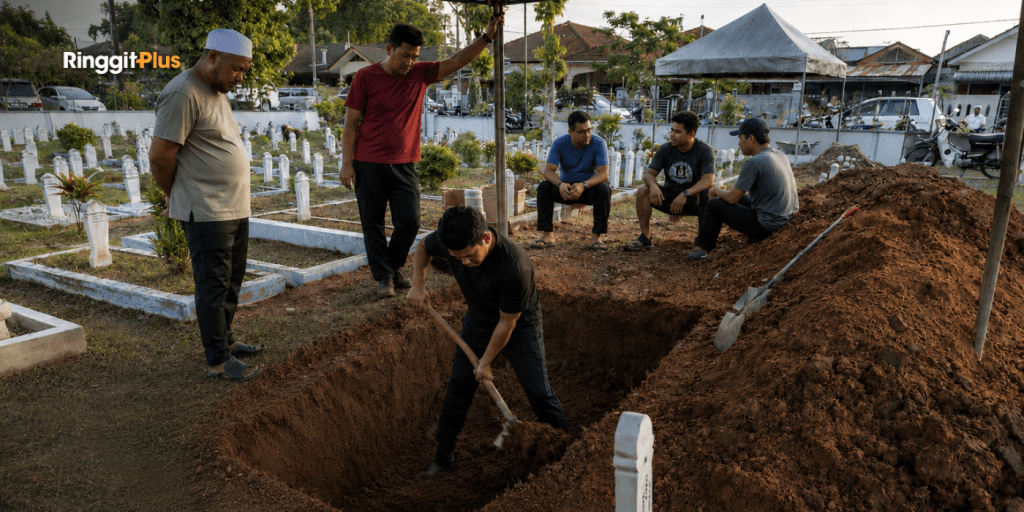
Four Islamic cemeteries in Kuala Lumpur now charge up to RM1,600 for burial. Previously, burial costs were only up to RM500, which means that rates have more than tripled with this increase.
The revised rates took effect on 15 May and cover Tanah Perkuburan Islam Raudhatul Sakinah (TPIRS) at Bukit Kiara 1 and 2, KL-Karak 2 in Taman Selaseh, and Kepong. These four sites come fully under the Federal Territories Islamic Religious Department (JAWI). Other Islamic cemeteries in the city set their own charges.
Anak Kariah, meaning members of the congregation of the mosque serving the cemetery’s area, are now charged RM800 per burial. Everyone else pays double the rate at RM1,600.
The Reasons Given For The Increase
JAWI has said the charges had not been revised in almost 14 years. TPIRS opened in July 2012 at Batu Muda and expanded to seven sites around Kuala Lumpur, and over that period the department says the cost of materials and labour went up while the fee stayed the same. Grave digging at these sites is still done by hand, and the department has pointed to the pay and welfare of the workers doing it.
The revision followed a 2024 convention on Islamic cemeteries in the Federal Territories. JAWI has also argued the new rates are not out of line with other Islamic cemeteries in the city, naming Alam Damai at around RM600 and Taman Ibu Kota at around RM1,450.
What Higher Charges Do To Community Death Funds
Many neighbourhoods run a tabung khairat kematian, a community fund where households pay a small yearly contribution, and the fund covers burial costs when a member dies. These funds were built around the old charges. A fund that budgeted RM300 per burial now faces RM800, and one covering non-members faces RM1,600.
A fund facing that shortfall can either pay out less per death or collect more from its members. Amanah’s Federal Territories branch has called on JAWI and the Federal Territories Islamic Religious Council to review the rates, arguing the increase falls hardest on B40 and asnaf households. If your neighbourhood runs a khairat fund, expect the yearly contribution to come up for discussion.
Checking What YourKhairatFund Covers
Every khairat fund is run by its own committee, so the rules differ from one neighbourhood to the next. The question to put to yours is how the new charges affect the fund and whether the annual contribution is going up as a result.
The other thing to confirm is whether your household is still paid up. Khairat funds usually collect once a year, and a lapsed contribution can leave a family without help at the point they need it. Any increase your committee decides on is likely to appear at the next annual collection.
Follow us on our official WhatsApp channel for the latest money tips and updates.
As a creative content writer, Eloise has covered finance, business, lifestyle topics, and even moonlights as a singer-songwriter outside of RinggitPlus. Her current interests are learning the best ways to optimise spending and credit card hacks to gain more airline miles.
00votes
Article Rating
SHARE
About THE AUTHOR
Eloise Lau
Eloise Lau
As a creative content writer, Eloise has covered finance, business, lifestyle topics, and even moonlights as a singer-songwriter outside of RinggitPlus. Her current interests are learning the best ways to optimise spending and credit card hacks to gain more airline miles.
We provide weekly updates on every Friday at 5pm on the prices of RON95, RON97 and Diesel in Malaysia and a chart that shows the movement of fuel prices across a 6-week period. Bookmark this page now!






Comments (0)