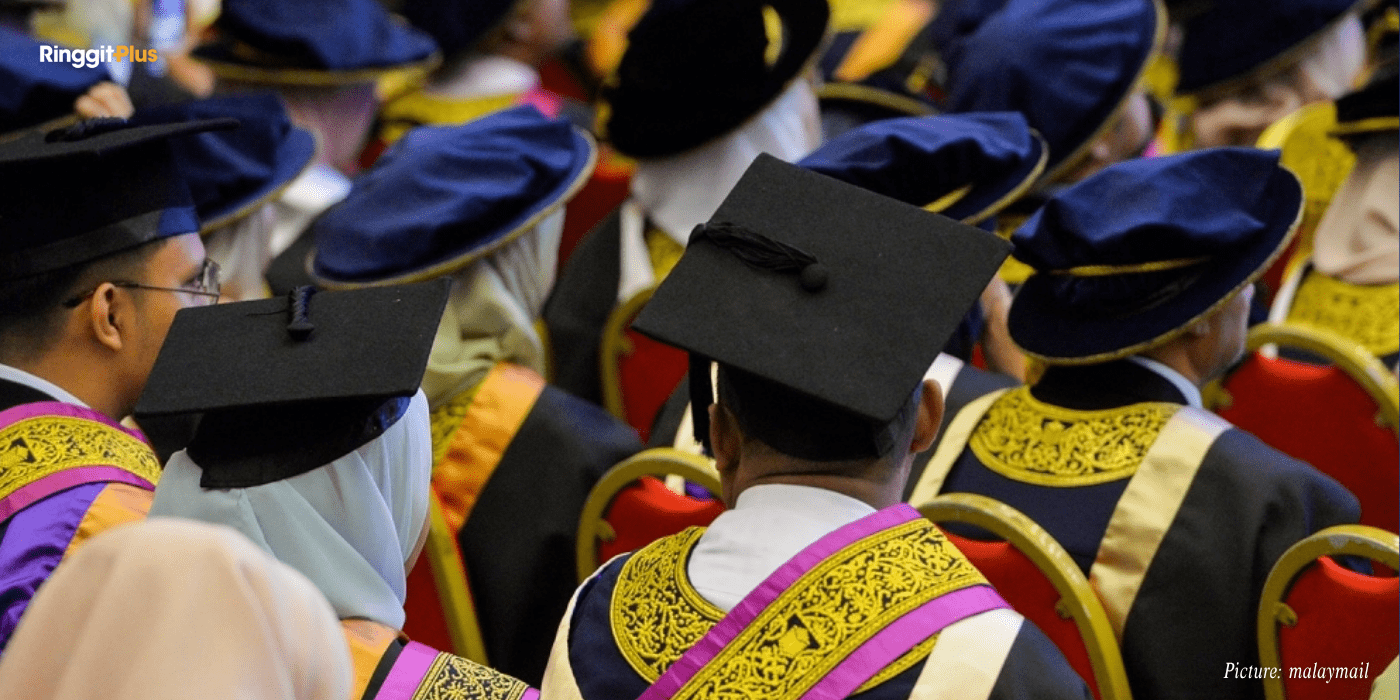
Malaysia’s graduate unemployment rate declined to 3.2% in 2024, down from 3.4% in 2023, reflecting continued growth and resilience in the labour market. The Department of Statistics Malaysia (DOSM) reported that the total number of graduates rose to 5.98 million, supported by higher labour participation and improving job opportunities across key sectors.
More Graduates Entering The Workforce
Chief Statistician Dato’ Sri Dr Mohd Uzir Mahidin said that the positive economic and labour market environment throughout 2024 contributed to the increase in graduate numbers, which now represent 22.3% of the working-age population.
Out of the 5.98 million graduates, 5.14 million were active in the labour force, giving a Graduate Labour Force Participation Rate (GLFPR) of 86%, an improvement from 85.7% in 2023. Degree holders accounted for 54.9% (3.28 million persons), while diploma holders made up 45.1% (2.70 million persons).
Government Initiatives Support Graduate Employability
According to DOSM, the steady improvement in graduate employment aligns with initiatives under Budget 2024, aimed at enhancing employability and supporting a high-knowledge workforce. These include access to RM2 billion in HRD Corporation levy funds to finance graduate salaries, the continuation of the MySTEP training and placement programme, and efforts such as the Graduate Entrepreneur Academy (PUSh), e-Latih online training, and the Graduate Apprenticeship Programme.
Such initiatives, the department noted, reflect the government’s commitment to developing a skilled and innovative workforce in line with Malaysia’s long-term goal of achieving a high-income, knowledge-based economy.
Employment Growth Across Skill Levels
The number of employed graduates grew by 4.6% to 4.98 million in 2024. Around 67.8% were employed in skilled occupations such as professional, technical, and managerial roles. Graduates in semi-skilled and low-skilled categories accounted for 31% and 1.2%, respectively.
Employment growth was recorded across all skill levels, particularly among those in skilled and semi-skilled occupations. The services sector remained the largest employer, engaging 77.6% of employed graduates, followed by manufacturing (13.4%) and construction (6.3%).
Underemployment Shows Signs Of Improvement
Skill-related underemployment, where graduates work in positions below their qualifications, decreased slightly to 32.2% in 2024, down from 32.4% in 2023. This marks a positive step in addressing skill mismatches within the labour market.
Malaysia now performs better than several regional peers, including South Korea (36.8%), Indonesia (42.2%), and the Philippines (56.7%), though it still trails advanced economies such as the United Kingdom (28.5%) and Australia (27.5%).
Time-related underemployment, which measures those working fewer than 30 hours a week but seeking additional work, edged up slightly to 0.8%, affecting around 41,700 graduates.
Female Participation Remains High
Despite the national Female Labour Force Participation Rate standing at 56.2%, the Female Graduate Labour Force Participation Rate was significantly higher at 83.4% in 2024. This indicates that women with tertiary qualifications remain actively engaged in the workforce, contributing strongly to Malaysia’s economic growth.
Overall, Malaysia’s GLFPR improved to 86% in 2024, with male participation rising to 89% from 88.6% the previous year.
Graduate Salaries Continue To Grow
Graduate salaries and wages continued to record steady growth in 2024. The median monthly salary increased by 2.5% to RM4,521, while the mean salary rose by 8.1% to RM5,330.
Salary gains were observed across all occupational skill groups. Skilled graduates earned a median of RM5,723, semi-skilled workers RM2,550, and low-skilled graduates RM1,990.
By state, the highest median salaries were recorded in W.P. Kuala Lumpur (RM5,888), W.P. Putrajaya (RM5,723), and Selangor (RM5,207). These states also recorded strong mean salary levels, reflecting their role as key economic and administrative hubs.
Malaysia’s Labour Market Outlook
Mohd Uzir highlighted that Malaysia’s labour market remained resilient throughout 2024 despite global economic uncertainties. He said continued policy support under Budget 2025 and the focus on employability programmes will further strengthen the country’s human capital development.
Efforts to align education and training systems with industry needs, along with the use of artificial intelligence (AI)-based learning tools, are expected to better prepare graduates for future labour demands.
Looking Ahead: Strengthening Skills And Opportunities
Malaysia’s falling graduate unemployment rate and rising participation in the labour market show that the workforce continues to grow in both size and capability. The increase in salaries and high female participation suggest steady improvements in job quality and inclusivity.
While skill-related underemployment remains a challenge, ongoing reforms in education, training, and job matching are helping close the gap between graduate qualifications and market needs.
DOSM reaffirmed its commitment to supporting evidence-based policymaking to ensure Malaysia’s workforce remains competitive, adaptable, and prepared for a rapidly changing global economy.
Follow us on our official WhatsApp channel for the latest money tips and updates.
Samuel writes about personal finance and financial news, focusing on how banking updates, policies, and promotions affect everyday money decisions. He enjoys making complicated financial topics easier to follow. Outside of writing, he spends his time watching TV shows and occasionally convincing himself he will only watch one episode.
00votes
Article Rating
SHARE
About THE AUTHOR
Samuel Chua
Samuel Chua
Samuel writes about personal finance and financial news, focusing on how banking updates, policies, and promotions affect everyday money decisions. He enjoys making complicated financial topics easier to follow. Outside of writing, he spends his time watching TV shows and occasionally convincing himself he will only watch one episode.
We provide weekly updates on every Friday at 5pm on the prices of RON95, RON97 and Diesel in Malaysia and a chart that shows the movement of fuel prices across a 6-week period. Bookmark this page now!







Comments (0)