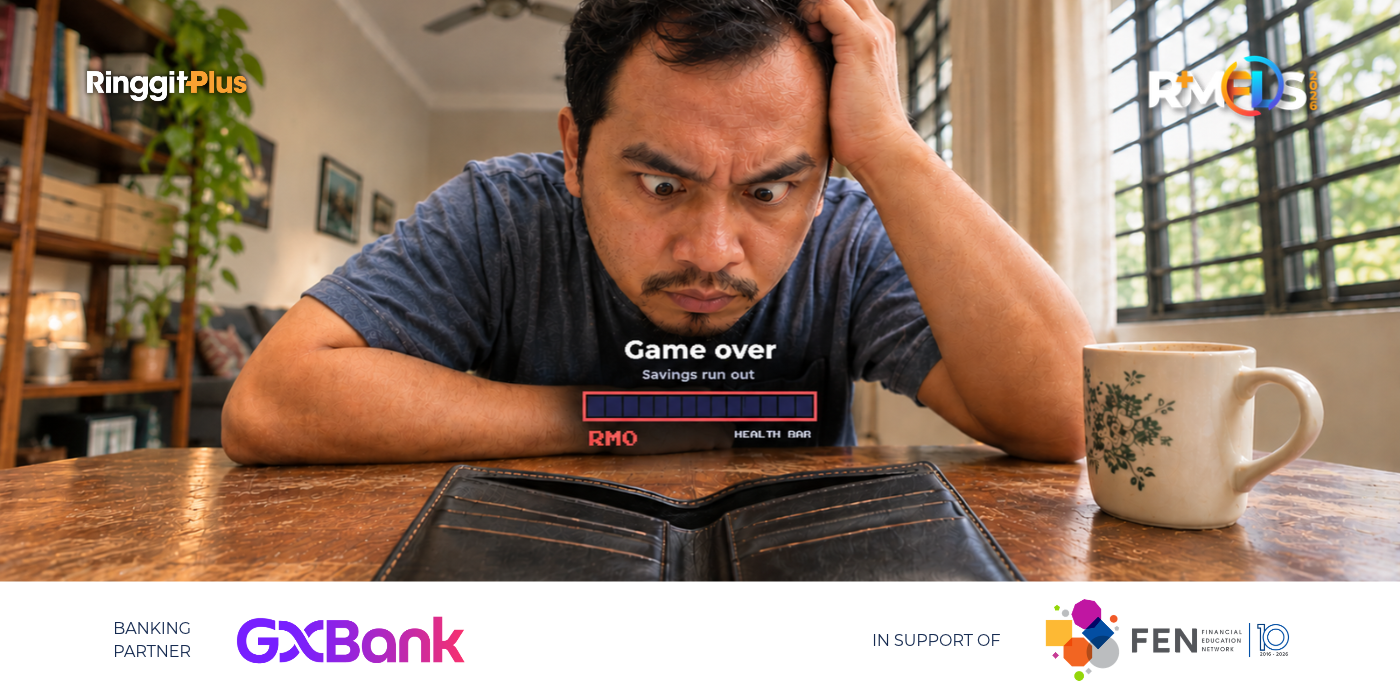
The edges of the screen turn red. Your character stops running and starts to limp, and a heartbeat thuds louder with every step. There’s one potion left in your bag and a few coins in your pocket. The next checkpoint is still somewhere past the hill, and you can hear the boss music starting up.
Every move feels heavier now. Drink the potion, and you’re safe for a minute, but you’ll have nothing left for the fight ahead. Save it, and you might not make it that far.
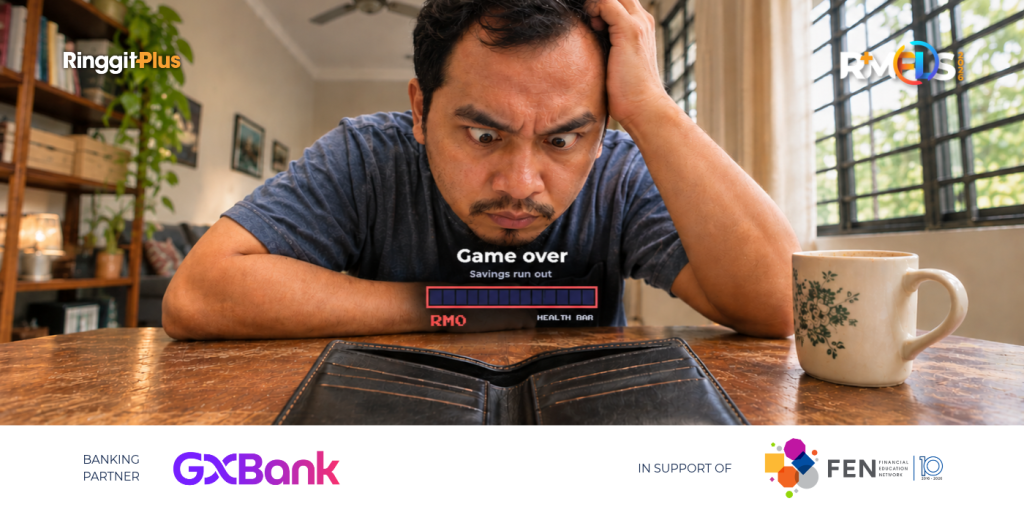
Your emergency savings work like a game health bar. Every surprise bill takes a chunk out of your savings, while your salary tops them up each month. If you lose your job, that refill stops. Your rent, groceries, and loan instalments still come out every month, and your savings drain a little lower with each one.
Savings Run Out Fastest On A Personal Income Under RM2,000
When asked how long their savings would last without a job, 22% of people surveyed said less than a month, while another 35% said one to three months. Only 22% said they could last over six months comfortably.
Among the 1,061 respondents with a personal income under RM2,000, 39% said their savings would last less than a month without a job. Another 36% said they don’t manage to save anything each month. Across all 3,005 people surveyed, 20% said they don’t manage to save any money each month.
A RM9,000 Savings Health Bar Lasts 90 Days
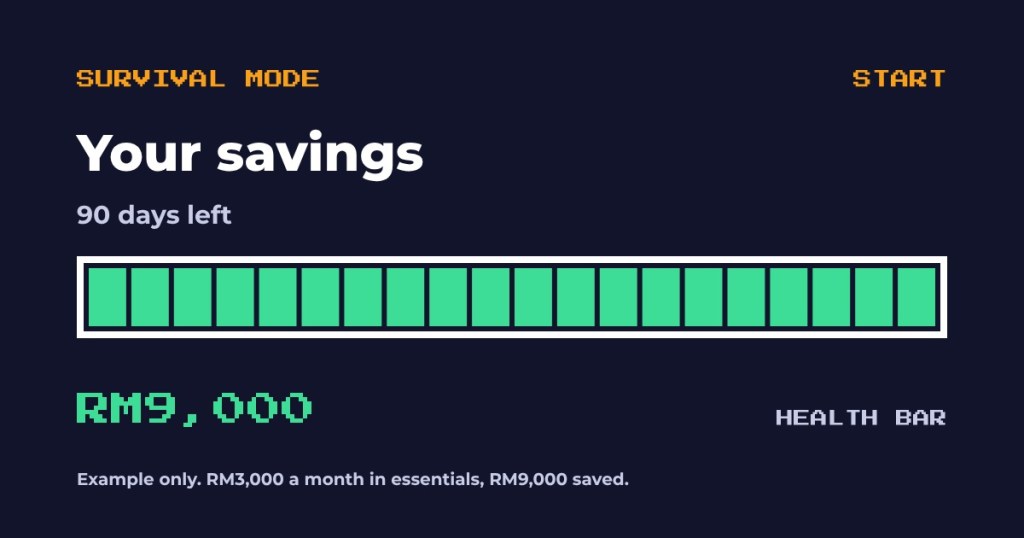
Say you need RM3,000 a month for rent, food, bills, and loan instalments, and you’ve saved RM9,000. That’s RM100 a day, so your health bar holds 90 days, if nothing goes wrong. You should be able to survive, right?
Losing Your Job Takes RM600 In The First Month
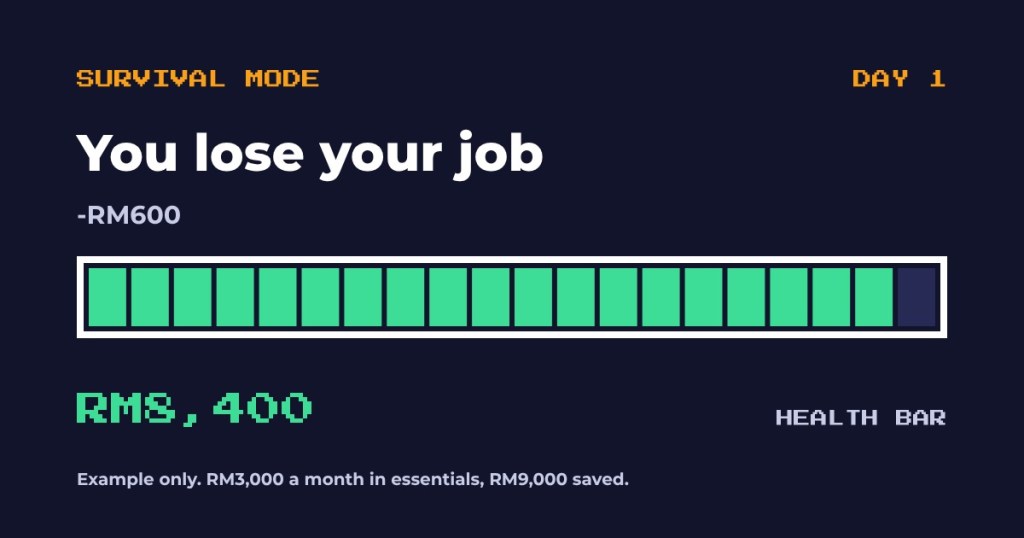
On Day 1, you lose your job. If you qualify for the Employment Insurance System (EIS), the Social Security Organisation (PERKESO) pays a Job Search Allowance for three to six months, depending on your contributions.
The allowance starts at 80% of your assumed monthly wage and drops to 30% by the fifth month. With an assumed wage of RM3,000, that’s RM2,400 in the first month, so RM600 of your RM3,000 still comes out of savings. Your health bar drops to RM8,400.
An RM5,000 Hospital Bill Takes 50 Days Off Your Savings
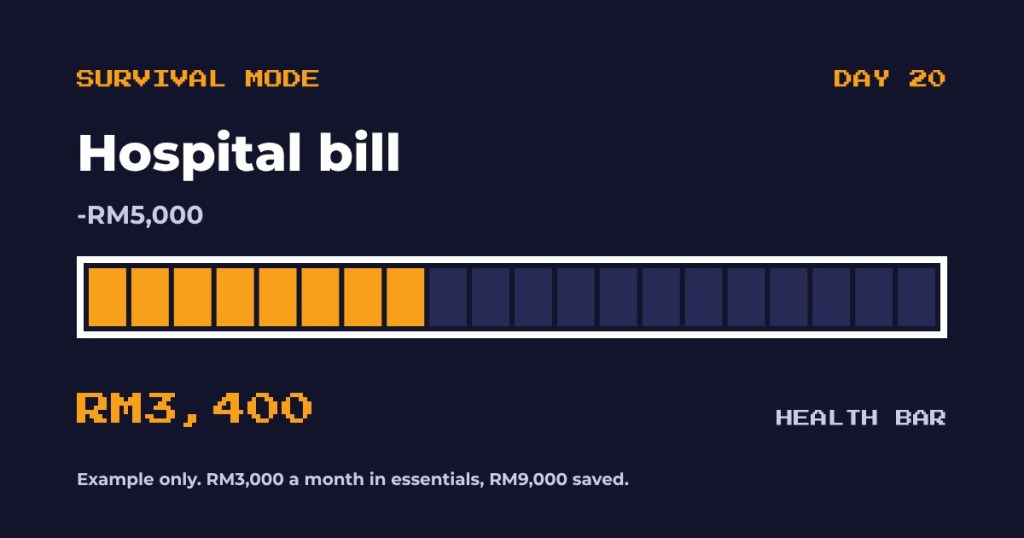
On Day 20, you come down with dengue and spend three days in a private hospital. According to Bank Negara Malaysia and Ministry of Finance figures, private hospitals charged dengue patients RM4,978, when the bill went to an insurer. Round that up to RM5,000, and your health bar drops to RM3,400. That’s 50 days of savings gone in three days.
Your medical card previously came from your employer, so the coverage ended when you left the company. In the survey, 20% of people said their only medical card comes from their employer, and another 36% said they don’t have one at all. Over the past 12 months, 12% of respondents said medical or healthcare costs were one reason they borrowed money or used credit.
An RM800 Car Repair Leaves RM1,100 In Your Savings
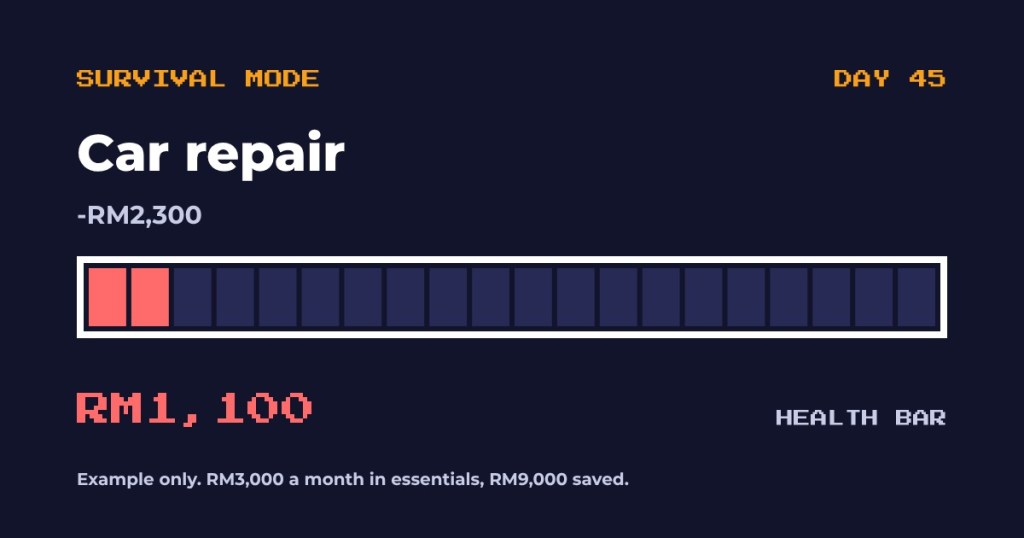
On Day 45, your car breaks down, and the repair costs RM800. Your Job Search Allowance has dropped to RM1,500 this month, so another RM1,500 of your bills comes from savings too. Your health bar is down to RM1,100.
When respondents were asked what they did in a month when their income didn’t cover their commitments. 43% said they used their savings, 23% used Buy Now Pay Later (BNPL), and 22% borrowed from family or friends. Another 6% said they went without food, medicine or medical care they needed. Some respondents may have answered with what they would do, rather than what they did. These percentages describe how people said they’d respond to a shortfall, rather than the share of people who ran short of money.
Separately, 35% of all respondents said they had borrowed money or used credit for food, household bills or medical costs in the past 12 months. This includes loans, credit cards, BNPL, pawnbroking, and money borrowed from family or friends.
The RM9,000 Runs Out On Day 79
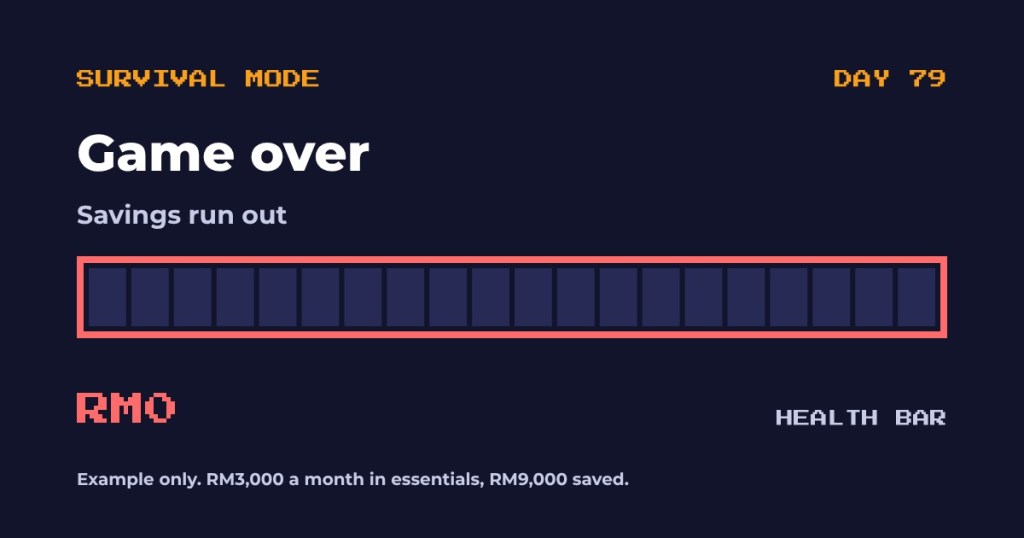
In the third month, the allowance drops to RM1,200, so you need RM1,800 from savings, or RM60 a day. Your last RM1,100 lasts another 18 days, and your health bar hits zero on Day 79.
Without the hospital bill, and with the full six months of allowance, the same RM9,000 would have lasted until Day 156. That one RM5,000 bill cost you 77 days of savings.
Count Your Survival Days With One Simple Sum
You can work out how long your savings would last using two amounts: your savings and your monthly essential expenses.
First, add up what you’d still need to pay each month if your salary stopped, including rent, food, utilities, transport and loan instalments. Then divide that amount by 30 to get your daily spending.
Next, divide your savings by that daily amount. If your essential expenses total RM3,000 a month, you’d need RM100 a day. With RM9,000 in savings, you’d have enough to cover those expenses for 90 days.
Monthly essentials
Savings
Estimated time covered
RM3,000
RM3,000
30 days
RM3,000
RM9,000
90 days
RM3,000
RM18,000
180 days
*Calculations by RinggitPlus. Estimated days = savings ÷ (monthly essentials ÷ 30). Actual expenses may vary.
The usual target is to save enough to cover three to six months of expenses, or 90 to 180 days. If that feels out of reach, start with one month of essential expenses. In this example, that’s RM3,000.
Putting aside RM250 a month would get you there in a year. You may need longer if your income is tight, but even a smaller buffer can give you more time to manage an unexpected expense without immediately turning to credit.
A Personal Medical Card Stays With You When You Change Jobs
A personal medical card stays with you when you change or lose your job, as long as you keep paying the premiums. At a panel hospital, the insurer pays the bill directly, though you may still pay a deductible or co-payment. You can compare medical cards on RinggitPlus by annual limit and pick one you can keep paying in a tight month.
Of 1,096 respondents with both life insurance and a personal medical card, 24% switched to a cheaper plan, reduced their cover, or cancelled in the past 12 months because of higher costs.
If you or your spouse receive Sumbangan Tunai Rahmah (STR), check whether you’re covered by mySalam. The free scheme pays RM8,000 if you’re diagnosed with one of 50 critical illnesses, and RM50 a day for up to 14 days a year in a government hospital.
Give Your Health Bar More Time To Recover
You can’t know which expense will hit next, or how long it might take to find another job. But you can build enough savings to cover your essentials for longer, so one unexpected bill doesn’t leave you struggling to pay the next one.
In a survival game, savings buy you time to recover.
Follow us on our official WhatsApp channel for the latest money tips and updates.
The RinggitPlus Malaysian Financial Literacy Survey 2026 polled 3,005 respondents aged 18 and above online and unweighted, in English, Bahasa Malaysia, and Chinese, with fieldwork from 28 September to 11 October 2026. Percentages are rounded, so some totals may not add up to 100%.
The survey was sponsored by GXBank, which proposed some of its questions. RinggitPlus earns commission or fees when consumers apply for financial products, including loans, credit cards and insurance.
As a creative content writer, Eloise has covered finance, business, lifestyle topics, and even moonlights as a singer-songwriter outside of RinggitPlus. Her current interests are learning the best ways to optimise spending and credit card hacks to gain more airline miles.
00votes
Article Rating
SHARE
About THE AUTHOR
Eloise Lau
Eloise Lau
As a creative content writer, Eloise has covered finance, business, lifestyle topics, and even moonlights as a singer-songwriter outside of RinggitPlus. Her current interests are learning the best ways to optimise spending and credit card hacks to gain more airline miles.




Comments (0)