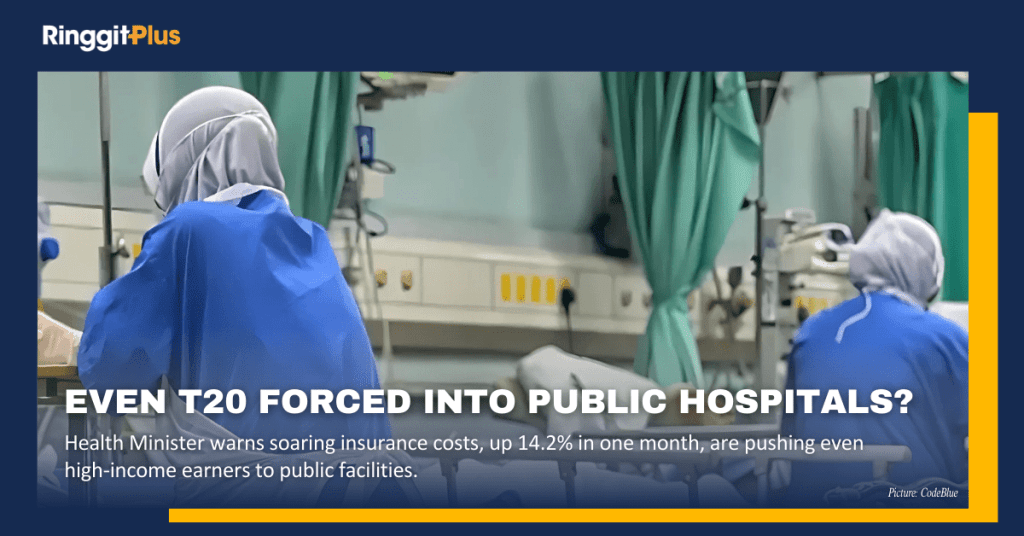
Rising health insurance premiums may be forcing even households in the top 20% income group (T20) to seek treatment at public hospitals, says Health Minister Datuk Seri Dr Dzulkefly Ahmad.
He noted that while T20 families are usually able to afford private healthcare through insurance or out-of-pocket payments, the surge in premiums is causing some to reconsider.
“We cannot rule that out. If insurance premiums continue rising, not only the M40 but even the T20 may rethink their policies. This is why it is important to mitigate and control insurance costs,” he said at the Perak-level Amanah convention on Sunday.
Dzulkefly added that the issue warrants closer study, particularly in the context of targeted subsidies. He also stressed the need for cooperation among insurance companies, takaful operators, Bank Negara, and private healthcare providers to tackle medical inflation, which is rising significantly faster than the national average.
July sees 14.2% Jump in Premiums
Concerns about affordability were sharpened by Department of Statistics Malaysia data showing that health insurance premiums surged 14.2% in July compared to June, and 14.7% year-on-year.
MCA president Datuk Seri Dr Wee Ka Siong, citing the figures, said the increase places a heavy burden on ordinary Malaysians. He argued that insurance, which is meant to help reduce reliance on public hospitals, has become unaffordable. “But when premiums soar by 14.2% in a single month, it shuts the door on affordable protection,” he said.
“Health insurance should be an alternative to ease pressure on government hospitals. But when premiums soar by 14.2% in a single month, it shuts the door on affordable protection,” he said.
Overall inflation in July rose slightly to 1.2% from 1.1% in June, but insurance and financial services saw a sharper spike to 5.5%, driven almost entirely by higher health insurance costs.
Consumer Groups Call it A Red Flag
Consumer advocates say the shift of wealthier Malaysians to public hospitals highlights how serious the problem has become.
The Federation of Malaysian Consumers Associations said it is a red flag when even the T20 group is turning to public facilities due to the rising cost of insurance.
“Public hospitals are already stretched thin. If more people from the T20 group start going there, it could make things worse unless we increase capacity,” said Fomca senior manager Saral James Maniam. She added that better regulation of insurance prices, clearer billing, and stronger preventive care are needed to avoid larger medical bills later.
Consumers’ Association of Penang president Mohideen Abdul Kader echoed the concern, warning that rising premiums could force families to abandon their policies altogether. He noted that Malaysia’s medical inflation is among the highest in Asia, and called for private healthcare providers to support the public sector by sharing equipment at subsidised rates.
Malaysia Consumers Movement secretary-general Harminder Singh stressed that healthcare must remain accessible. “We do not want the public to become debtors for life, borrowing in desperation just to cover medical costs,” he said.
Strain on Public Healthcare
Economists also warn that the influx of patients from higher-income groups will place additional strain on already stretched public hospitals and clinics.
Lee Heng Guie, executive director of the Socio-Economic Research Centre, urged regulation of healthcare costs and insurance premiums to protect access for all Malaysians. “The influx of patients, including those from higher income groups who previously relied on private facilities, places additional strain on the system. The government must take this seriously given the ageing population,” he said.
Dzulkefly stressed that public hospitals are open to all Malaysians regardless of income, but said the government would monitor the situation closely to ensure fair access and sustainable financing.
“This matter needs careful follow-up, particularly regarding whether targeted subsidies should apply when T20 patients receive treatment in public hospitals,” he said.
Gaps in Insurance Coverage
Recent research highlighted just how many Malaysians remained unprotected. The RinggitPlus Malaysian Financial Literacy Survey 2024 found that 42% of Malaysians did not have any medical insurance, while another 14% relied only on company-issued medical cards. Life insurance penetration was also modest, with fewer than half of adults (48%) holding a policy.
Affordability was the biggest barrier. One in four Malaysians (24%) cited cost as the main reason they did not have any form of insurance or takaful coverage. This underscored the pressure that rising premiums placed on households already struggling with the cost of living.
The same survey also revealed shifting consumer behaviour. While 39% still preferred to purchase insurance through an agent, nearly 29% preferred buying policies online, suggesting that digital channels could have played a growing role in expanding affordable coverage.
The next edition of the survey, RMFLS 2025, is expected to provide updated insights into whether Malaysians have improved their insurance protection or if affordability continues to hold many back.
Government Plans for Healthcare Financing Reform
The government has acknowledged that rising medical costs require longer-term solutions. Work is already under way on a basic Medical and Health Insurance/Takaful (MHIT) plan, with the conceptual framework expected by December 2025 and implementation targeted for late 2026. The plan is aimed at providing more affordable coverage for Malaysians who are currently priced out of private insurance.
This initiative is part of the broader RESET strategy, led by Bank Negara Malaysia and the Ministry of Health, which seeks to make private healthcare more affordable, reduce pressure on public facilities, and expand coverage among the M40 group. Only about 22% of Malaysians in this income segment currently hold private health insurance, leaving many vulnerable to rising medical costs.
At the same time, industry-wide figures underline the pressure: Malaysia’s general insurance sector recorded RM23.1 billion in gross written premiums in 2024, a 6.9% year-on-year increase, even as underwriting profits fell.
Follow us on our official WhatsApp channel for the latest money tips and updates.
Samuel writes about personal finance and financial news, focusing on how banking updates, policies, and promotions affect everyday money decisions. He enjoys making complicated financial topics easier to follow. Outside of writing, he spends his time watching TV shows and occasionally convincing himself he will only watch one episode.
Samuel writes about personal finance and financial news, focusing on how banking updates, policies, and promotions affect everyday money decisions. He enjoys making complicated financial topics easier to follow. Outside of writing, he spends his time watching TV shows and occasionally convincing himself he will only watch one episode.








Comments (0)