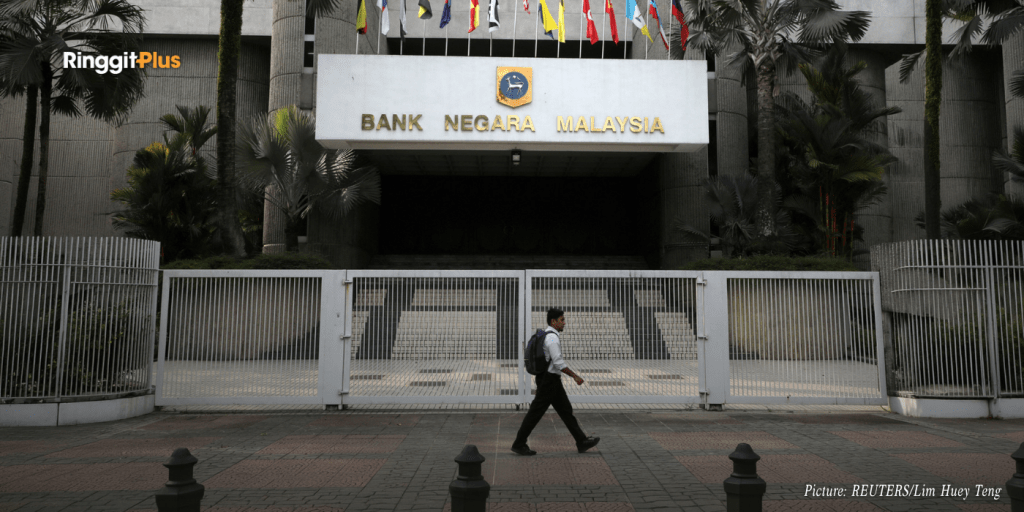
Bank Negara Malaysia’s Monthly Highlights for March 2026 showed inflation rising to 1.7% on higher fuel costs, credit growth holding steady at 5.6%, banks maintaining healthy buffers, and the ringgit weakening 3.8% against the US dollar amid the West Asia conflict.
Inflation Rose On Higher Fuel Prices
Core inflation, which excludes price-volatile and price-administered items, also rose to 2.1% from 2.0% in February. The increase was driven mainly by higher retail fuel prices, in line with elevated global oil prices, partially cushioned by continued targeted subsidies. Malaysian users remained eligible for a subsidised RON95 price of RM1.99 per litre up to 300 litres under the BUDI95 programme, while diesel users in Sabah and Sarawak continued to pay RM2.15 per litre. Lower fresh food prices, particularly for seafood and meat, also helped offset the increase.
Credit Growth Held Steady
Credit to the private non-financial sector expanded by 5.6% in March, unchanged from February. Outstanding loan growth strengthened to 5.6% from 5.1%, while growth in outstanding corporate bonds moderated to 5.8% from 7.4%, reflecting lower bond issuances compared with the same period last year.
Business loan growth picked up to 5.8% from 4.6% in February, driven by stronger lending to non-SMEs, particularly for working capital purposes. Investment-related loan growth remained steady across both SMEs and non-SMEs. Household loan growth held broadly stable at 5.4% from 5.5% in February. The steady borrowing environment reflects BNM’s decision to hold the OPR at 2.75% in March, keeping borrowing costs stable for households and businesses.
Banking System Remained Sound
Gross and net impaired loan ratios were stable at 1.4% and 1% respectively. The loan loss coverage ratio, including regulatory reserves, remained at 125% of gross impaired loans, up slightly from 124.7% in February. The aggregate Liquidity Coverage Ratio stood at 144.6%, down from 149.4% in February but still well above the minimum requirement.
West Asia Conflict Weighed On Markets
The escalation of the West Asia conflict contributed to elevated geopolitical uncertainty and more cautious global investor sentiment, with spillovers into domestic financial markets. The ringgit depreciated by 3.8% against the US dollar in March, broadly in line with regional peers which averaged a 3.6% decline. Malaysia’s nominal effective exchange rate declined by 1.8%.
The 10-year Malaysian Government Securities yield increased by 15 basis points, against a regional average increase of 55 basis points, reflecting global inflation expectations. The FBM KLCI declined by 1.5%, outperforming the regional average decline of 10.2%.
For everyday Malaysians, the 3.8% ringgit depreciation means imported goods and overseas travel cost more than they did a month ago. On fuel, the RON95 subsidy helped keep March inflation in check, though pressure on the subsidy bill continues to grow.
Follow us on our official WhatsApp channel for the latest money tips and updates.
Iman writes about personal finance with curiosity. She is interested in the stories behind money, the hesitation around big decisions, and the small habits that shape financial futures. Off the clock, she is either dissecting a film or climbing her way up the leaderboard in her favourite games.
00votes
Article Rating
SHARE
About THE AUTHOR
Iman Aminuddin
Iman Aminuddin
Iman writes about personal finance with curiosity. She is interested in the stories behind money, the hesitation around big decisions, and the small habits that shape financial futures. Off the clock, she is either dissecting a film or climbing her way up the leaderboard in her favourite games.
We provide weekly updates on every Friday at 5pm on the prices of RON95, RON97 and Diesel in Malaysia and a chart that shows the movement of fuel prices across a 6-week period. Bookmark this page now!







Comments (0)