Malaysia Prepares For Open Finance Rollout

RinggitPlus
11th September 2025 - 4 min read
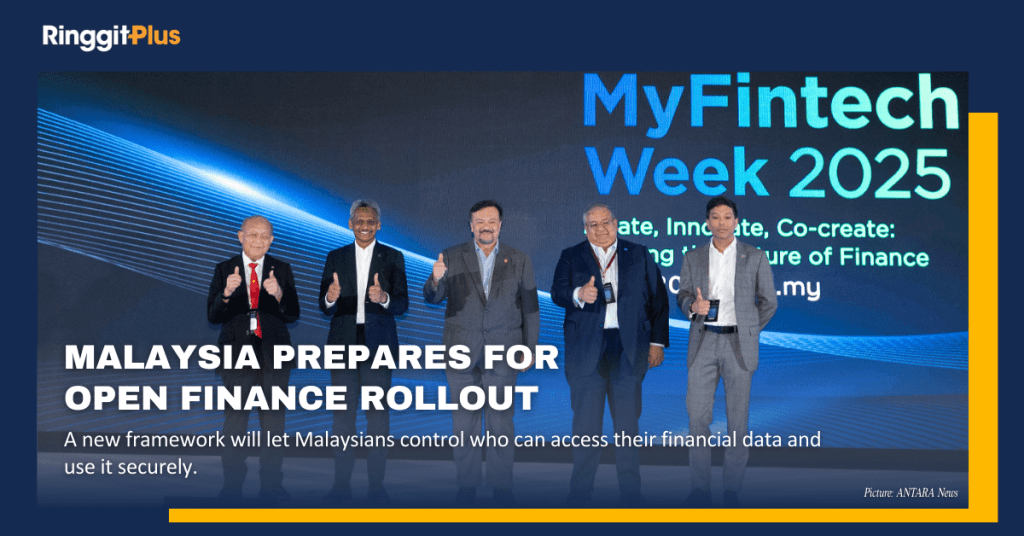
Malaysia is advancing Open Finance, a new framework that will allow individuals and businesses to securely control how their financial data is shared and used. Announced at MyFintech Week 2025, Bank Negara Malaysia (BNM) highlighted Open Finance as a strategic enabler of trust, inclusion, and innovation in the country’s financial system.
Open Finance will be powered by a platform developed by Payments Network Malaysia (PayNet). The system is designed to transmit encrypted, consent-based data between financial institutions and approved third-party providers without storing or viewing customer information. By placing consumers at the centre, it promises safer, faster, and more tailored access to financial services.
In simple terms, Open Finance means you decide which banks, insurers, or companies can see your financial data, and for how long. If you give permission, your information can be shared instantly and securely, instead of sending physical copies or email attachments. This puts you in control of your own financial information.
Why It Matters Now
At RinggitPlus, we’ve observed how digital tools have become nearly universal, yet financial confidence remains a significant concern. This is clearly illustrated by the findings from our RinggitPlus Malaysian Financial Literacy Survey (RMFLS) 2024, which show that over half of Malaysians are spending all or more than they earn each month. Many are also uncertain about their ability to plan for retirement.
Despite widespread digital adoption, many Malaysians still rely on traditional methods for managing and sharing financial data, such as emailing bank statements or using courier services. This is where Open Finance comes in, offering a more secure, efficient, and permission-based way to share financial data.
Open Finance is a timely solution to address these financial challenges. By improving transparency and accessibility, it empowers consumers to make more informed decisions and strengthens their financial resilience.
For the financial sector, Open Finance represents an opportunity to build trust with consumers, providing greater control over their data while enhancing the overall customer experience. As the ecosystem evolves, this framework could lead to more personalised, inclusive financial services that better meet the needs of Malaysians.
Expanding Inclusion And Access
One of the strongest opportunities lies in financial inclusion. With access to alternative data, such as transaction histories, banks and fintech providers can design fairer products for groups that have been underserved, including gig workers and micro-entrepreneurs.
This approach aligns with the RMFLS findings, which revealed that although more Malaysians are saving regularly, many remain underinsured and have yet to start planning for retirement.
By broadening the data available, Open Finance has the potential to improve credit scoring, expand access to financing, and create insurance solutions that better reflect individual needs.
Malaysia’s Roadmap
BNM is guiding the national journey toward Open Finance through a phased rollout that allows the industry to prepare for adoption. An Exposure Draft is expected in the second half of 2025, setting out participation criteria, mandated datasets, and consent management requirements.
Technical development is progressing under PayNet, supported by a pilot group of seven banks and the Employees Provident Fund (EPF). If milestones are met, implementation could begin as early as mid-2026.
This gradual approach ensures that readiness is built across all levels of the financial ecosystem.
Building Trust Through Safeguards
The foundation of Open Finance is trust, and every element of the framework is being designed to reinforce it. Data sharing will remain governed by existing Malaysian laws such as the Personal Data Protection Act and the Financial Services Act, while also aligning with international privacy standards.
Security safeguards include encrypted data flows, strong authentication processes, and redress mechanisms that give customers clear avenues for resolution if issues arise. Importantly, consumers will retain full visibility and authority over how their data is used, ensuring transparency and accountability at every step.
Looking Ahead
Malaysia’s commitment to Open Finance reflects a clear vision for a financial system that is secure, inclusive, and innovation-driven. With regulatory direction from BNM, technical infrastructure from PayNet, and high levels of digital readiness among Malaysians, the country is well-positioned to become a regional leader in trusted data sharing.
At RinggitPlus, we see Open Finance as a natural extension of the financial behaviours revealed in RMFLS. By combining literacy insights with a stronger digital infrastructure, Malaysia is laying the groundwork for a future where financial services are more transparent, accessible, and relevant to every household.
Follow us on our official WhatsApp channel for the latest money tips and updates.
About THE AUTHOR
RinggitPlus
Most Viewed Articles
Most Viewed Articles

Personal Finance News
Birthday Freebies 2026 For A Day Of Free Food And Fun
It’s RinggitPlus’ birthday, and everybody loves free gifts, especially on their birthday! Plenty of brands and attractions offer […]

Personal Finance News
What To Do When Your Landlord Won’t Return Your Deposit
Not getting your rental deposit back can be frustrating, especially when your landlord has stopped responding or is […]

Personal Finance News
Maybank Unveils Enhanced American Express Gold Card In Rose Gold
Maybank has unveiled an enhanced Maybank American Express Gold Charge Card in a new rose gold design, with […]

Personal Finance News
Should You Trust ChatGPT With Your Money?
Asking ChatGPT about money feels a little like Googling your symptoms when you’re feeling ill. Plenty of people […]


Comments (0)