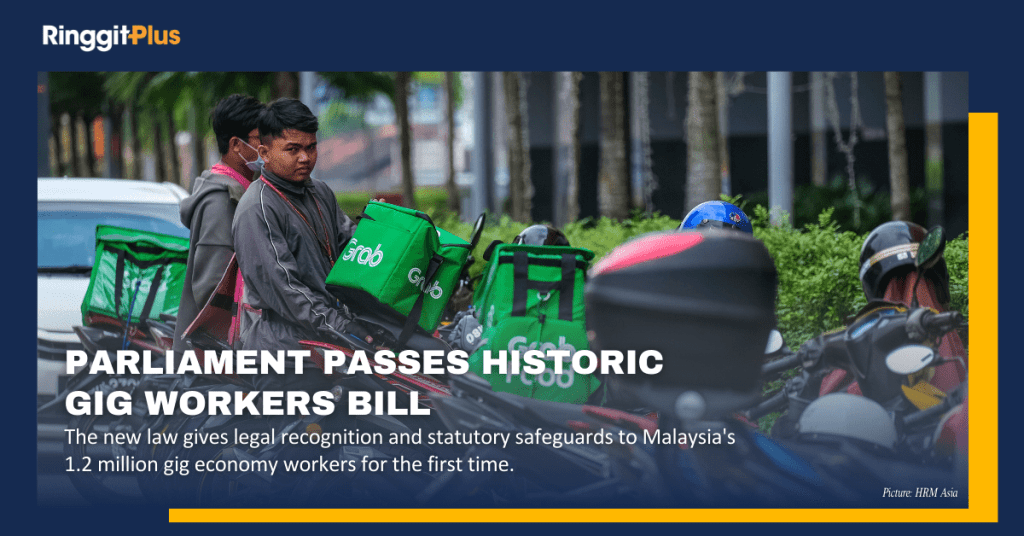
Parliament has passed the Gig Workers Bill 2025, introducing legal recognition and statutory safeguards for Malaysia’s gig economy workforce. The new law is set to benefit around 1.2 million gig workers, including e-hailing and p-hailing drivers, freelancers, and digital content creators.
Gig workers will now be recognised as a separate category of the labour force. They are not classified as employees under traditional contracts of service, nor as independent contractors, but instead fall under a newly defined framework with specific rights and protections.
Written Agreements and Fairer Protections
The legislation requires contracting entities, including digital platforms, to sign written service agreements with gig workers. These agreements must outline minimum standards for payment terms, working arrangements, insurance coverage, and termination procedures.
The bill also prohibits practices such as unilateral rate changes, arbitrary suspension or deactivation of workers, and restrictions on working across multiple platforms. A new Gig Workers Tribunal will be established to resolve disputes, with authority to order compensation, reinstatement, or payment of outstanding wages.
Workers will also have the right to be heard before any suspension. If cleared of wrongdoing, they must be compensated with 50% of their average daily pay, offering legal recourse that was previously unavailable.
Socso Protection Introduced as First Step
For social protection, gig workers will be covered under the Self-Employment Social Security Act 2017 (Act 789). A 1.25% deduction per ride or delivery will be channelled to the Social Security Organisation (SOCSO), providing benefits such as accident coverage, disability protection, and survivor benefits.
EPF contributions are not included in this first phase. However, the Human Resources Ministry confirmed that mandatory EPF savings will be considered later. This follows calls from Members of Parliament, who argued that retirement savings are essential for long-term security, citing Singapore’s Central Provident Fund model as an example.
Negotiation Rights Through a Tripartite Council
Instead of a statutory minimum wage, the new law provides for the creation of a tripartite council for gig workers. Representatives from the government, platforms, and workers will be able to negotiate commission rates, pay structures, and algorithm-related issues.
Sim stressed that gig workers will retain flexibility as freelancers but will, for the first time, have a formal platform to negotiate with companies on more equal terms.
Registrar of Gig Workers and Right to Organise
The law establishes a registrar of gig workers under the Ministry of Human Resources to oversee registrations of both platforms and workers. Gig workers will also gain the legal right to form associations, which can represent them in tribunal proceedings, dispute resolution, and collective negotiations.
Broad Support for the Bill
The Gig Workers Bill, which contains 112 clauses across 10 parts, was passed after debate by 23 Members of Parliament and approved by majority voice vote in the Dewan Rakyat.
Ahead of its passage, the bill received support from industry bodies including the Malaysian Trades Union Congress (MTUC), the Film Workers’ Association of Malaysia, and the Malaysian Sign Language Interpreters and Translators National Organisation, collectively representing more than 1.4 million workers.
Sim described the legislation as a historic milestone in closing long-standing gaps in labour protection, ensuring that Malaysia’s growing digital economy remains competitive while extending fairer safeguards to those working within it.
Follow us on our official WhatsApp channel for the latest money tips and updates.
Samuel writes about personal finance and financial news, focusing on how banking updates, policies, and promotions affect everyday money decisions. He enjoys making complicated financial topics easier to follow. Outside of writing, he spends his time watching TV shows and occasionally convincing himself he will only watch one episode.
Samuel writes about personal finance and financial news, focusing on how banking updates, policies, and promotions affect everyday money decisions. He enjoys making complicated financial topics easier to follow. Outside of writing, he spends his time watching TV shows and occasionally convincing himself he will only watch one episode.
We provide weekly updates on every Friday at 5pm on the prices of RON95, RON97 and Diesel in Malaysia and a chart that shows the movement of fuel prices across a 6-week period. Bookmark this page now!








Comments (0)