Perbadanan Insurans Deposit Malaysia (PIDM) has released its first Data Pulse report, which looks at the money Malaysians keep in the bank. Data Pulse 2026 found that these savings grew by 5.2% per year from 2015 to 2025, but that growth was uneven across states and age groups, and between men and women.
PIDM is the government agency that protects your bank deposits. For the report, it looked at 10 years of savings accounts, current accounts, and fixed deposits at its member banks.
Savings Grew Faster Than Prices, But Not In Every State
PIDM also looked at how much each adult has in the bank, which grew by 3.7% a year on average. Inflation, which is how fast prices go up, averaged 1.8% a year over the same period. So for the average adult, bank savings can buy more today than 10 years ago.
Savings for each adult grew fastest in Sarawak and Pulau Pinang, by 4.9% a year. In Labuan, they grew by just 1.3% a year, and in Perlis, by 1.7%. That’s slower than inflation, so in both places, the average adult’s savings buy a little less today than they did in 2015.
Some States Have Far More Accounts And Bigger Balances
The average adult in Malaysia has 2.4 bank accounts, but adults in Kuala Lumpur have almost six times as many accounts as adults in Sabah.
The average account has almost RM16,000 in it, but that depends a lot on where you live. In Kuala Lumpur and Pulau Pinang, it’s more than RM20,000. In Kelantan and Terengganu, it’s less than RM5,000.
Nationally, 93% of adults had an active bank account in 2024, according to Bank Negara Malaysia data [PDF] quoted in the report. So PIDM says the real difference between states is how many accounts people have and how much they keep in them.
Savings Stalled For People Aged 35 To 54
People usually save more as they get older. Malaysians aged 55 and above have more than 63% of all the money in the bank, even though they own less than 26% of the accounts.
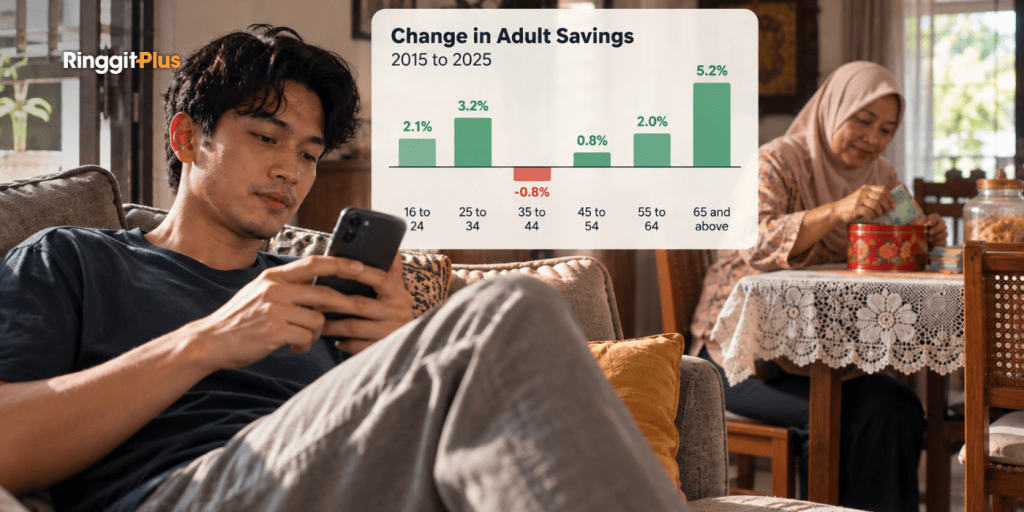
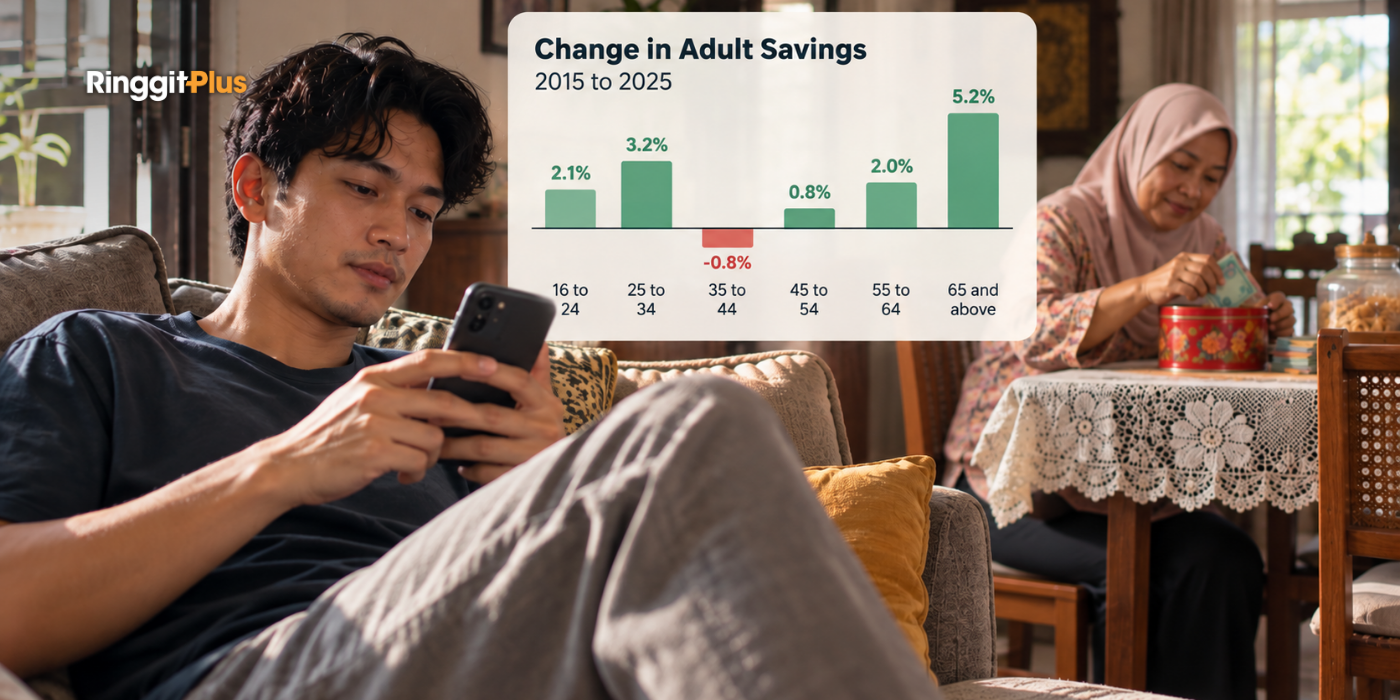
If you’re aged 35 to 44, though, people your age have less in the bank today than people your age had in 2015. Savings for each adult in this group fell by 0.8% a year. If you’re 45 to 54, savings for your age group grew by only 0.8% a year. PIDM calls both groups “broadly stagnant”, meaning their savings have barely moved.
Age Group
Change In Adult Savings, 2015 To 2025
16 to 24
Up 2.1%
25 to 34
Up 3.2%
35 to 44
Down 0.8%
45 to 54
Up 0.8%
55 to 64
Up 2.0%
65 and above
Up 5.2%
Source: PIDM, Data Pulse 2026
For every RM100 that someone aged 35 to 44 had in the bank in 2015, someone the same age in 2025 had about RM92. For people aged 65 and above, RM100 became about RM166 based on PIDM’s yearly rates.
PIDM isn’t sure why savings stalled at this age, but it gives two possible reasons. Your costs, like your home loan and your children’s education, may be rising just as your income reaches its peak. You may also be keeping more of your money outside the bank, such as in EPF, investments, or property, than people your age did 10 years ago.
The report’s example character for this age group is a mid-career saver in his mid-40s. He has four to six bank accounts for different purposes, such as his home loan and his child’s education. He has more in the bank than in his 20s, but his costs have gone up with his income. His wife has saved at a similar pace so far, but PIDM says career breaks and caring for the family could slow her savings over time.
Bigger Balances Move The Most When Interest Rates Change
Bank Negara Malaysia sets the country’s main interest rate, called the Overnight Policy Rate (OPR). When the OPR goes up, banks usually pay you more interest on your savings, and when it goes down, they usually pay you less. PIDM found that the money in bank accounts grew by 9.1% a year on average when the OPR went up, but by only 2.9% a year when it was cut.
People with less than RM10,000 in the bank barely change what they do when rates move. PIDM says that’s likely because a small balance earns very little extra interest in ringgit. People with more money in the bank react much more, and PIDM found that how much you have counts for more than how old you are.
Women Are Catching Up, But Fall Behind From Age 45
Women now have RM88 in the bank for every RM100 men have. Ten years ago, it was RM78. Women’s savings grew by 4.7% a year, faster than men’s at 2.9%, and women now have slightly more bank accounts than men.
Up to age 44, women have more in the bank than men the same age. From 45, women start to fall behind, and at 65 and above, women have only around 80% of what men have. PIDM says time spent caring for children or family, and differences in career growth and pay, may be part of the reason.
How PIDM Protects Your Deposits
If your bank is a PIDM member bank and it goes bankrupt or can no longer keep running, PIDM will pay you back up to RM250,000 per person at each bank, including the interest. Your Islamic and conventional deposits are protected separately, and a joint account has its own RM250,000 limit. You don’t need to sign up or pay for this. Unit trusts and gold investment accounts aren’t bank deposits, though, so PIDM doesn’t protect them.
This limit fully covers 96% of people with money in PIDM member banks, based on PIDM’s latest published count at the end of 2022. In 2025, 79% of people PIDM surveyed knew about PIDM, up from 53% in 2015.
Your Early 40s Have The Most Income To Spare
The Department of Statistics Malaysia’s (DOSM) National Transfer Accounts 2022, quoted in PIDM’s report, shows that people usually earn more than they spend from age 29 to 55. The most money left over is at age 44, at RM14,523 per person a year, or about RM1,210 a month.
After 44, that extra money gets smaller each year, and from 56, the average person spends more than they earn from work. So if you’re in your late 30s or early 40s, the years when you’re paying for a home loan, school fees, and your parents’ needs are also your best chance to build savings for later.
Your Bank Balance Is Your First Safety Net
Start with an emergency fund of three to six months of basic living expenses, kept in the bank so you can use it straight away for a car repair or a hospital bill. Money kept outside the bank can help you later, but it usually takes longer to get to when something goes wrong.
In the RinggitPlus Malaysian Financial Literacy Survey 2025, only 27% of middle-income earners (those earning RM5,000 to RM10,000 a month) said they could live on their savings for more than six months, down from 32% in 2024.
Once your emergency fund is in place, you can earn more on the rest. On 23 September 2026, our savings account comparison page showed basic savings accounts at Maybank, HSBC, and AmBank paying 0.25% p.a. (a year). A 12-month fixed deposit keeps your money in the bank for a year but pays more, like 2.55% p.a. with Alliance Bank’s FD Gold if you put in at least RM5,000.
If You Have
Basic Savings Account (0.25% p.a.) Pays You
12-Month FD (2.55% p.a.) Pays You
RM5,000
RM12.50 a year
RM127.50 a year
RM16,000
RM40 a year
RM408 a year
RM50,000
RM125 a year
RM1,275 a year
Source: RinggitPlus calculations, simple interest over one year
On RM16,000, the average account balance in PIDM’s report, a fixed deposit earns you RM368 more in a year. Our list of fixed deposit promotions shows even higher rates, up to 3.85% p.a. for Alliance Bank’s six-month promotion, until 30 September 2026.
If you’d rather be able to take your money out at any time, some high-interest savings accounts pay more than 0.25% p.a. if you meet conditions, such as having your salary paid into the account.
Whichever you choose, keep your deposits at each bank under RM250,000 as your savings grow, so all of your money stays protected by PIDM.
Get the latest money news and guides from the RinggitPlus team on our WhatsApp channel.
As a creative content writer, Eloise has covered finance, business, lifestyle topics, and even moonlights as a singer-songwriter outside of RinggitPlus. Her current interests are learning the best ways to optimise spending and credit card hacks to gain more airline miles.
00votes
Article Rating
SHARE
About THE AUTHOR
Eloise Lau
Eloise Lau
As a creative content writer, Eloise has covered finance, business, lifestyle topics, and even moonlights as a singer-songwriter outside of RinggitPlus. Her current interests are learning the best ways to optimise spending and credit card hacks to gain more airline miles.



Comments (0)