Unit trusts offer Malaysian investors an accessible way to build wealth without needing to pick individual stocks or bonds. But walk into any bank or investment platform, and you’ll face a wall of options: equity funds, bond funds, balanced funds, sector-specific funds, and regional funds. Each promises different returns, targets different goals, and uses different strategies.
This overwhelming choice creates what behavioural economists call “analysis paralysis.” When faced with too many options, many investors simply freeze up and do nothing. Their money sits in savings accounts earning 2-3% while inflation quietly erodes its value.
The good news? Most financial goals actually fall into just two categories: Income (you need cash flow now) or Growth (you’re building wealth for later). Once you understand which category your goal fits into, choosing the right fund becomes much simpler.
The Two Types Of Investment Goals
Income-focused investing means you want your investments to generate regular cash that you can spend today. Think of it like renting out a property: you keep the asset, but you receive monthly rental income to supplement your salary or cover living expenses.
Common income goals include supplementing your salary before retirement, funding a child’s university fees over several years, or generating passive income while maintaining your capital base. These goals need steady returns you can actually use rather than watching numbers grow on a screen.
Growth-focused investing means you’re building a larger pot of money for the future. You don’t need cash today; you’re aiming to accumulate wealth that compounds over time. This suits retirement planning (when you’re 35 and retirement is 25 years away), buying a property in five to ten years, or building generational wealth for your children.
The key difference isn’t just time horizon, though that matters. It’s about whether you need the returns deposited into your account as spendable cash (income) or reinvested to grow your capital (growth).
A note on Shariah compliance: When choosing between income or growth funds, you’ll also need to decide whether you want Shariah-compliant or conventional options. Shariah-compliant funds avoid investments in sectors like alcohol, gambling, and conventional banking, and use profit-sharing structures rather than interest-based returns. Both types can serve income or growth goals equally well. The choice depends on your personal values and investment principles rather than your financial objectives.
The Golden Rules: Diversification And Time Horizon
Diversification means spreading your money across different types of investments: different sectors, geographies, and asset types. When one area underperforms, others can balance it out. It’s how professional investors manage risk without putting all their eggs in one basket.
For income investing, diversification means not relying on a single bond issuer or sector for your yields. If you hold only government bonds and interest rates change, your returns drop. If you hold only corporate bonds and companies struggle, your income disappears. A multi-sector strategy keeps money flowing from different sources.
For growth investing, diversification means riding out market volatility. Malaysian equities might drop 15% one year but bounce back 20% the next. Global markets might underperform while regional markets surge. Staying invested across multiple asset classes smooths out these ups and downs.
Time horizon determines which strategy works for your goal. Income investors often have shorter horizons (needing cash within 1-5 years) and can’t afford major volatility. Growth investors typically have longer horizons (10-30 years) and can weather short-term market swings for better long-term returns.
Research shows that staying invested in diversified equity portfolios for 15+ years has historically delivered positive returns despite short-term volatility. For income portfolios, consistent 5-7 year returns depend on having multiple fixed income sources that aren’t correlated.
Matching Funds To Goals: The Two Strategies
Once you know whether you need income or growth, you can filter out 90% of available funds and focus on the ones built for your actual goal.
The Income Strategy: Building Cash Flow
If you want passive income to supplement your salary or cover specific expenses, you need a fund designed to generate consistent payouts without excessive volatility. This typically means fixed income strategies that invest in bonds, sukuk, and other income-generating securities.
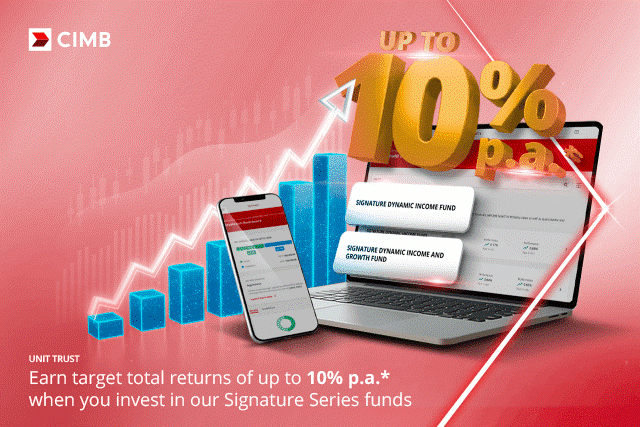
The CIMBSignature Dynamic Income Fund uses a multi-sector fixed income approach. Instead of betting everything on government bonds or corporate bonds alone, it allocates across different fixed income types such as investment grade corporate bonds, securitised credit, preferred securities, high yield corporate bonds and emerging market bonds to diversify across the income spectrum for yield and stability. The Fund aims to generate compelling income with a target distribution yield of up to 6%*, paid monthly (if any).
(*Disclaimer: The target distribution yield of 6% per annum is not guaranteed and is subject to the fund’s performance and the fund manager’s discretion. Past performance is not indicative of future results. Distributions, if any, are paid monthly and may vary based on market conditions and the fund’s income generation.)
This dynamic strategy means the fund manager actively adjusts portfolio allocations based on market conditions. When corporate bonds offer better yields, the allocation shifts there. When securitised credits provide stability in times of uncertainty, the portfolio reallocates defensively. You’re not locked into a static strategy that works only in certain market conditions.
For someone who wants an extra RM300 monthly (RM3,600 annually), you’d need to invest around RM60,000 in a fund targeting 6% annual returns. That supplemental income could cover your phone bill, insurance premiums, or petrol costs while your capital remains invested. Or if you’re starting smaller, investing RM20,000 would generate around RM100 monthly at the same rate.
The Growth Strategy: Building Long-Term Wealth
If you’re building a retirement nest egg or saving for a goal years away, you need a fund focused on capital appreciation rather than current income. This means accepting short-term volatility for potentially higher long-term returns.
The CIMBSignature Dynamic Income and Growth Fund takes a multi-asset approach using actively managed Exchange-Traded Funds (ETFs). ETFs offer instant diversification across various asset classes such as equities, bonds and alternatives in a single investment, while active management means investment professionals proactively rebalance the portfolio rather than passively tracking an index.
The Fund targets up to 10%* in total return over the long-term by balancing its investments between income and growth assets. During market downturns, the portfolio allocation into bond and equity income ETFs cushions total return through income. Dynamic rebalancing keeps the portfolio aligned with long-term growth without taking excessive risk.
(*Disclaimer: The target distribution yield of 10% per annum is not guaranteed and is subject to the fund’s performance and the fund manager’s discretion. Past performance is not indicative of future results. Distributions, if any, are paid monthly and may vary based on market conditions and the fund’s income generation.)
For a 35-year-old targeting RM1 million at retirement (age 60), starting with RM100,000 and adding RM1,000 monthly at 10% annual returns would reach RM1.06 million in 25 years. That same strategy at 6% returns would only reach RM680,000, showing how growth-focused returns compound significantly over time.
Making It Easy: CIMB MyWealth Platform
Understanding your strategy is one thing. Executing it smoothly is another. The MyWealth digital platform handles the practical side of investing so you can focus on your goals rather than paperwork.
The platform offers the accessibility to buy and sell unit trust funds digitally, meaning you can invest when you’re ready rather than physically going to the branches and filling out forms. All fund prospectuses are available on the platform, so you can review detailed fund information before committing. Transaction history, account statements, and performance tracking all live in one place.
For investors who want to start small, the minimum investment requirements are accessible compared to traditional unit trust investments that might require RM10,000 or more upfront. You can begin building your income or growth strategy with amounts that fit your current financial situation.
The platform also shows you exactly how your chosen fund is performing, how much you’ve invested, and what your current value is. This transparency helps you stay disciplined with your strategy rather than panicking during short-term market movements.
Getting Started: Align Your Money With Your Goals
The first step is defining what you actually need from your investments. Do you need cash flow you can spend today, or are you building wealth for later?
Once you know that, match the strategy. Income goals work well with funds offering steady payouts like the CIMB Signature Dynamic Income Fund (targeting 6% p.a.). Growth goals benefit from capital appreciation funds like the CIMB Signature Dynamic Income and Growth Fund (targeting up to 10% p.a.).
Log into MyWealth via the CIMB Octo app today to start investing in any unit trust or Shariah-compliant fund for as low as RM100. Place your investment fund today!
Disclaimer:
This is an advertisement.
The information provided herein is not intended for general circulation but for discussion purposes only. It does not take into account the specific investment objectives, financial situations or particular needs of any particular person. This does not constitute an offer, solicitation or recommendation to buy or sell or subscribe for any security or financial instrument or to enter into any transaction or to participate in any particular trading or investment strategy. Information contained herein should not be relied upon when making investment decisions. You should seek independent legal or tax advice before making any investment decisions. Investments are subject to investment risks, including the possible loss of the principal amount invested. Value of the investments and the income, if any, may fall or rise.
No representation or warranty whatsoever (including without limitation any representation or warranty as to accuracy, usefulness, adequacy, timeliness or completeness) in respect of any information (including without limitation any statement, figures, opinion, view or estimate) provided herein is given by CIMB Bank Berhad (“CIMB”) and it should not be relied upon as such. CIMB does not undertake an obligation to update the information or to correct any inaccuracy that may become apparent at a later time. CIMB shall not be responsible or liable for any loss or damage whatsoever arising directly or indirectly howsoever in connection with or as a result of any person acting on any information provided herein. The information provided herein may contain projections or other forward-looking statements regarding future events or future performance of countries, assets, markets or companies. Actual events or results may differ materially. Past performance figures are not necessarily indicative of future or likely performance. The information provided herein is based on certain assumptions, information and conditions available as at the date of this advertisement and may be subject to change at any time without notice.
Any reference to any specific company, financial product or asset class in whatever way is used for illustrative purposes only and does not constitute a recommendation on the same. CIMB does not guarantee that all risks associated to the transactions mentioned herein have been identified, nor does it provide advice as to whether you should enter into any such transaction. The contents hereof may not be reproduced or disseminated in whole or in part without CIMB’s written consent.
The distribution of this advertisement may be restricted in certain other jurisdictions. The above information is for general guidance only and it is the responsibility of any persons in possession of this advertisement to observe all applicable laws and regulations of any relevant jurisdictions.
This advertisement has not been reviewed by the Securities Commission Malaysia.
As a creative content writer, Eloise has covered finance, business, lifestyle topics, and even moonlights as a singer-songwriter outside of RinggitPlus. Her current interests are learning the best ways to optimise spending and credit card hacks to gain more airline miles.
52votes
Article Rating
SHARE
About THE AUTHOR
Eloise Lau
Eloise Lau
As a creative content writer, Eloise has covered finance, business, lifestyle topics, and even moonlights as a singer-songwriter outside of RinggitPlus. Her current interests are learning the best ways to optimise spending and credit card hacks to gain more airline miles.








Comments (0)