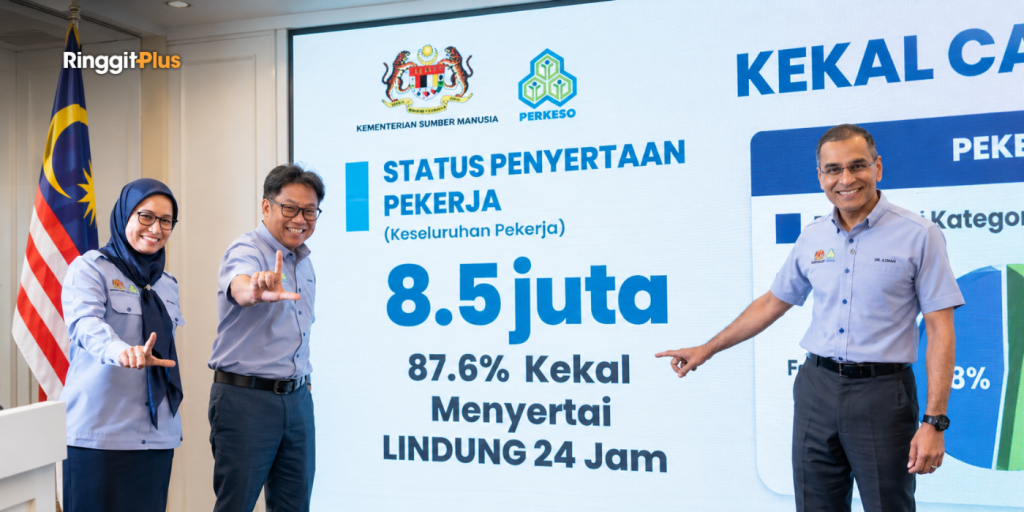
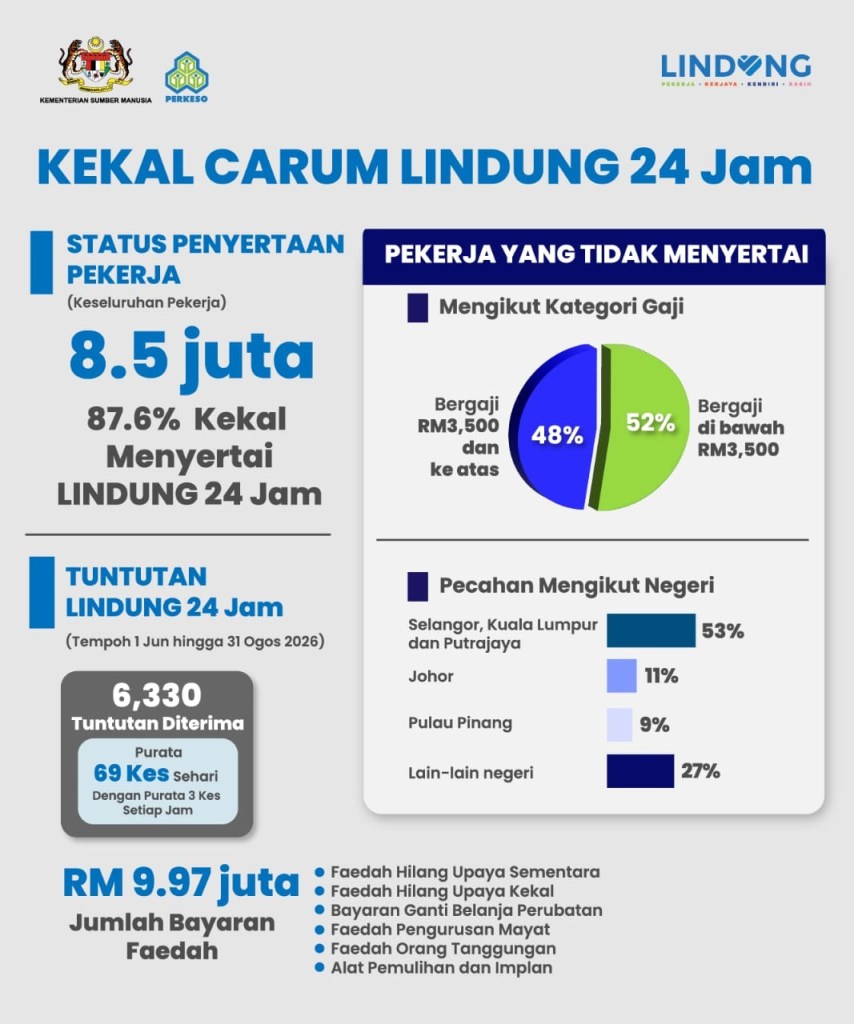
A total of 8.5 million, or 87.6% of Malaysian workers, have chosen to remain in LINDUNG 24 Jam, officially known as the Non-Work-Related Accident Scheme, run by the Social Security Organisation (PERKESO). This is despite contributions to the scheme no longer being mandatory for local workers since July, with the option to opt out.
LINDUNG 24 Jam took effect on 1 June 2026, extending SOCSO protection to accidents that happen outside working hours. PERKESO Group Chief Executive Officer Dato’ Sri Dr. Mohammed Azman Aziz Mohammed said a formal sector worker in Malaysia spends only about 33% of the year at work, including commuting time, leaving roughly 67%, or about 244 days a year, unprotected against non-work accidents without this scheme.
RinggitPlus was there as PERKESO laid out the numbers at Menara PERKESO, giving us a closer look at why 8.5 million workers have chosen to stay in LINDUNG 24 Jam even though it’s no longer mandatory.
Workers Earning Below RM3,500 Make Up The Largest Group Opting Out
Of the 12.4% of workers who opted out, nearly 52% earn below RM3,500 a month. Mohammed Azman said this is concerning, since most of this group falls under the B40 category, and according to 2024 Bank Negara Malaysia (BNM) data, only 4% of B40 households have life insurance, against a national life insurance participation rate of 45.5%.
He described LINDUNG 24 Jam as social protection rather than insurance. “Don’t compare us with insurance. We are totally different from insurance. Ours is social protection,” he said, describing the scheme as a last safety net that catches workers before an accident pushes them into poverty. He added that he hopes those who opted out will reconsider and choose to rejoin.
Staying In Is Automatic, Opting Out Requires A Form
Mohammed Azman explained that LINDUNG 24 Jam is provided for under an Act of Parliament, which is why coverage is automatic by default, while opting out requires a signed form. Workers who want to opt in or rejoin do not need to sign anything, since staying covered is the default position under the law. Signing the opt-out form is how PERKESO records that a worker has chosen not to be covered, according to Azman.
Staying in also comes with a separate protection: your employer cannot take any action to dismiss or remove you from employment while you’re receiving benefit payments for an accident under LINDUNG 24 Jam.
There’s No Deadline To Rejoin The Scheme
The official opt-out window closed on 31 August 2026 and will not reopen. If you’ve already opted out, you can still rejoin the scheme at any time, with no deadline, online at lindungfaedah.perkeso.gov.my. This facility has been open since 2 September, and PERKESO’s guide on choosing whether to join walks through the portal steps.
If you remain in the scheme, your coverage continues as long as you meet the conditions under the Employees’ Social Security Act 1969 (Act 4). PERKESO calls this principle “Once In, Always In.”
This scheme is specifically for local workers contributing under Act 4 (LINDUNG PEKERJA). Contributions for foreign workers remain mandatory separately. After the Cabinet decided on 8 July that contributions would no longer be mandatory for local workers, PERKESO opened an opt-out window from 13 July to 31 August 2026 for anyone who did not want to continue their participation.
RM9.97 Million In Benefits Already Paid Out In Three Months
PERKESO received 6,330 claims in the scheme’s first three months, from 1 June to 31 August 2026, an average of 69 cases a day, or around three cases every hour. Total benefits paid out reached RM9.97 million, covering Temporary Disablement Benefit, Permanent Disablement Benefit, medical expense reimbursement, Funeral Benefit, Dependants’ Benefit, and rehabilitation aids and implants.
These short-term payments can turn into long-term payments, with the total amount reaching more than 10 times the original payout.
Some individuals who had opted out still tried to file benefit claims after being involved in accidents outside working hours. At the same time, between 9,000 and 10,000 workers who initially opted out have already rejoined the scheme since the rejoining facility opened on 2 September, a figure Mohammed Azman called still very early, since the window has only been open nine days.
Data shared also showed that 74% of workers who filed benefit claims under the scheme earn below RM3,500, most of them young, low-income workers.
Your Contribution Is 35 To 40 Sen A Day
Asked whether the contribution rate is too high for some workers, Mohammed Azman said the 0.75% rate is among the lowest in the world for this type of coverage. For example, if you earn RM2,000 a month, the minimum wage, the 0.75% contribution works out to only about 35 to 40 sen a day.
He said no other country in Southeast Asia offers 24-hour coverage like this, with the nearest country with a similar scheme in the Asia Pacific being New Zealand, and said Malaysia is among the first countries in the world to introduce such coverage. We understood that PERKESO can share a fuller comparison of contribution rates against neighbouring countries on request.
Selangor Accounts For More Than Half Of All Opt-Outs
By state, 53% of workers who opted out are based in Selangor, Kuala Lumpur and Putrajaya. Johor accounts for 11%, Penang 9%, and the remaining 27% is spread across other states.
Mohammed Azman offered two explanations for this. These states have higher population density and more active, dynamic economic activity, which he said raises accident risk generally, even outside working hours. He also said, while cautioning that he did not want to speculate, that higher earners in these states may assume their existing private insurance already covers them, which he called a mistaken way to think about it, since personal insurance and social protection are not equivalent regardless of income level.
What We Learned About The Scheme’s Sustainability
Asked whether a 12.4% opt-out rate raises questions about the scheme’s long-term sustainability, Mohammed Azman said LINDUNG 24 Jam remains essential regardless, pointing out that about 42% of Malaysia’s workforce has no insurance coverage at all, rising to 96% among B40 workers. He compared the scheme’s approach, pooling contributions and sharing risk across all workers, to how Malaysia’s existing mandatory employment insurance system already works, and said PERKESO will continue raising awareness to bring opted-out workers back in rather than treating the current opt-out rate as a fixed outcome.
He also noted that PERKESO does not yet have a final contribution collection figure, since employers remit the following month’s contributions by the 15th, meaning August’s numbers won’t be confirmed until after 15 September.
Contribution Rate To Rise To 1.25% By Year Six
The current 0.75% contribution rate won’t stay fixed forever. PERKESO Deputy Chief Executive (Strategy and Corporate) Edmund Cheong Peck Huang has previously revealed the rate will rise in stages to 1.25% by the sixth year of the scheme.
This increase also means your income replacement benefit will rise from 48% now to 80% once the full contribution rate is reached. PERKESO considers 0.75% the lowest practical rate for the early stage of implementation, according to Cheong.
Follow us on our official WhatsApp channel for the latest money tips and updates.
Iman writes about personal finance with curiosity. She is interested in the stories behind money, the hesitation around big decisions, and the small habits that shape financial futures. Off the clock, she is either dissecting a film or climbing her way up the leaderboard in her favourite games.
00votes
Article Rating
SHARE
About THE AUTHOR
Iman Aminuddin
Iman Aminuddin
Iman writes about personal finance with curiosity. She is interested in the stories behind money, the hesitation around big decisions, and the small habits that shape financial futures. Off the clock, she is either dissecting a film or climbing her way up the leaderboard in her favourite games.
We provide weekly updates on every Friday at 5pm on the prices of RON95, RON97 and Diesel in Malaysia and a chart that shows the movement of fuel prices across a 6-week period. Bookmark this page now!








Comments (0)