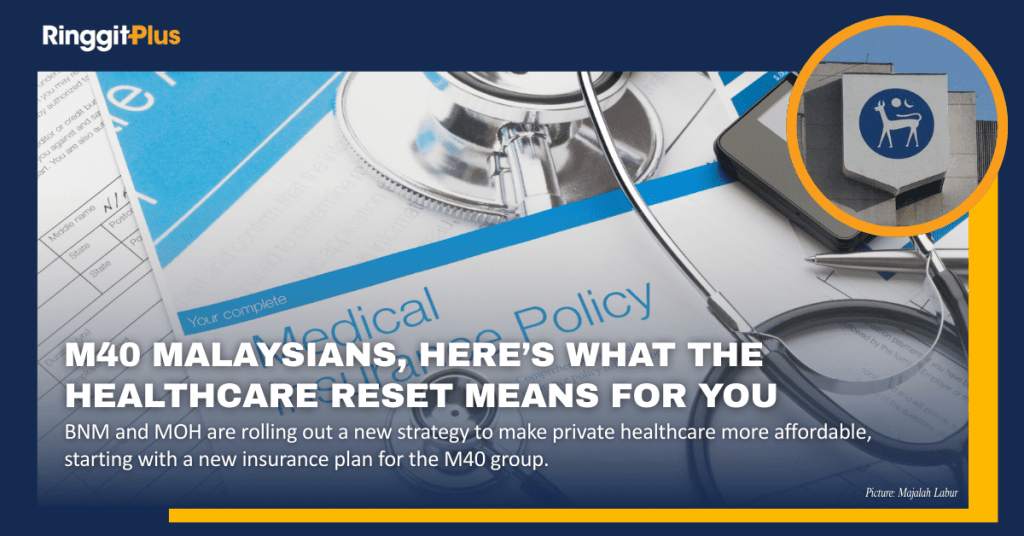
Malaysia’s healthcare financing system is set for a major overhaul. Bank Negara Malaysia (BNM) and the Ministry of Health (MOH) are working together on reforms to make private healthcare more affordable, reduce pressure on public hospitals, and build a more sustainable system for the future.
These details were shared at a recent media workshop on the RESET strategy, jointly organised by BNM and MOH.
At the heart of the reforms is a new base medical and health insurance/takaful (MHIT) product, designed especially for the M40 income group. Only about 22% of Malaysians currently have private health insurance, and the government hopes this new plan will widen coverage while reshaping how the entire market works.
A Different Kind of Health Insurance
Unlike existing health insurance, where premiums can vary widely between insurers, the new base MHIT will use standardised premiums approved by BNM. The aim is to keep premiums more sustainable by spreading healthcare costs more evenly across everyone who is insured. In practice, this means fewer steep jumps in price for individuals, because the risks are shared as a group rather than pushed onto certain people alone.
For example, if one policyholder needs expensive surgery, the cost of their care does not fall only on them. Instead, it is spread across all the premiums collected from everyone in the pool. This way, one person’s illness does not cause their premiums to skyrocket, because the risk is shared by the whole group.
The plan will cover treatment at mid-tier private hospitals, with top-up plans available for patients who want access to premium hospitals. This tiered approach is designed to provide essential protection for many, while leaving room for competitive add-ons in the private insurance market.
Authorities are also studying whether the base plan can include preventive care like screenings and vaccines, if these can be shown to reduce serious illness and long-term costs. Coverage of pre-existing conditions is under review too, with safeguards such as waiting periods or proof of stable symptoms. This could allow some patients who are now excluded from private health insurance to join the system.
Another feature under discussion is requiring patients to see a general practitioner (GP) as the first point of care before referral to a hospital. At present, many Malaysians go straight to private specialists, which drives up costs and can result in unnecessary procedures. A GP-first approach is meant to strengthen primary care and ensure referrals are clinically appropriate.
Changing How Hospitals Are Paid
RESET also introduces reforms in the way private hospitals bill for treatment. Malaysia will phase in Diagnosis-Related Groups (DRGs) from 2026, starting with common, low-severity conditions.
Today, most private hospitals charge on a fee-for-service model, billing separately for every test, scan, and procedure. This can sometimes encourage extra tests or longer stays, increasing costs for patients and insurers.
Under DRGs, hospitals will instead receive a bundled payment for a diagnosis. For example, appendicitis would carry a fixed package cost covering the operation, hospital stay, and related care. This model incentivises hospitals to treat patients effectively within that budget, which should mean more predictable bills for consumers and less medical inflation.
However, safeguards will be needed to ensure hospitals do not cut corners or discharge patients too early in an effort to control costs.
Private hospitals have already started sharing billing data, and Malaysia-specific DRG price weights are being developed to support the rollout.
Expanding Public Options with Rakan KKM
RESET also addresses reforms in the public sector. Through the Rakan KKM initiative, government hospitals will introduce “premium economy” wards for elective procedures. While specific details on facilities and pricing have not yet been disclosed, the scheme is designed as a middle option between standard government care and private hospitals.
Unlike the Full Paying Patient (FPP) scheme, where most revenue goes to specialists, Rakan KKM will share earnings more widely with specialists, nurses, and the ministry. About 75% of MOH specialists have shown interest, and recently retired doctors and nurses may also be involved.
The goal is to make better use of underutilised facilities after hours, generating new revenue while reducing waiting times. Funds raised will also be used for cross-subsidies to support non-paying patients.
Supporting Policyholders and Households
RESET is not just about new products and hospital systems. It also includes measures to help households manage their healthcare spending.
BNM has said consumer focus groups will be held to test which benefits Malaysians value most, from surgical coverage to room charges or outpatient care, to ensure the base MHIT plan strikes the right balance between affordability and meaningful protection.
Policyholders will also have the option to use their EPF Account 2 savings to pay for premiums. This will be voluntary, not compulsory. In addition, an advisory service linked to EPF is being explored, similar to retirement planning guidance, to help families plan how much to set aside for medical needs as they age.
Meanwhile, the Credit Counselling and Debt Management Agency (AKPK) has launched a new service to help policyholders manage their finances if premiums are repriced. This service has been available nationwide since 15 August 2025.
Measuring RESET’s Success
BNM and MOH say RESET will be assessed not just on cost savings but also on outcomes. Success indicators include slower medical inflation, reduced hospital readmission rates, and a wider share of Malaysians with health insurance coverage.
Ultimately, the strategy aims to create a fairer and more resilient healthcare system, where patients get meaningful protection, hospitals are incentivised to focus on outcomes, and public facilities can operate more sustainably.
Follow us on our official WhatsApp channel for the latest money tips and updates.
Samuel writes about personal finance and financial news, focusing on how banking updates, policies, and promotions affect everyday money decisions. He enjoys making complicated financial topics easier to follow. Outside of writing, he spends his time watching TV shows and occasionally convincing himself he will only watch one episode.
Samuel writes about personal finance and financial news, focusing on how banking updates, policies, and promotions affect everyday money decisions. He enjoys making complicated financial topics easier to follow. Outside of writing, he spends his time watching TV shows and occasionally convincing himself he will only watch one episode.
We provide weekly updates on every Friday at 5pm on the prices of RON95, RON97 and Diesel in Malaysia and a chart that shows the movement of fuel prices across a 6-week period. Bookmark this page now!







Comments (0)