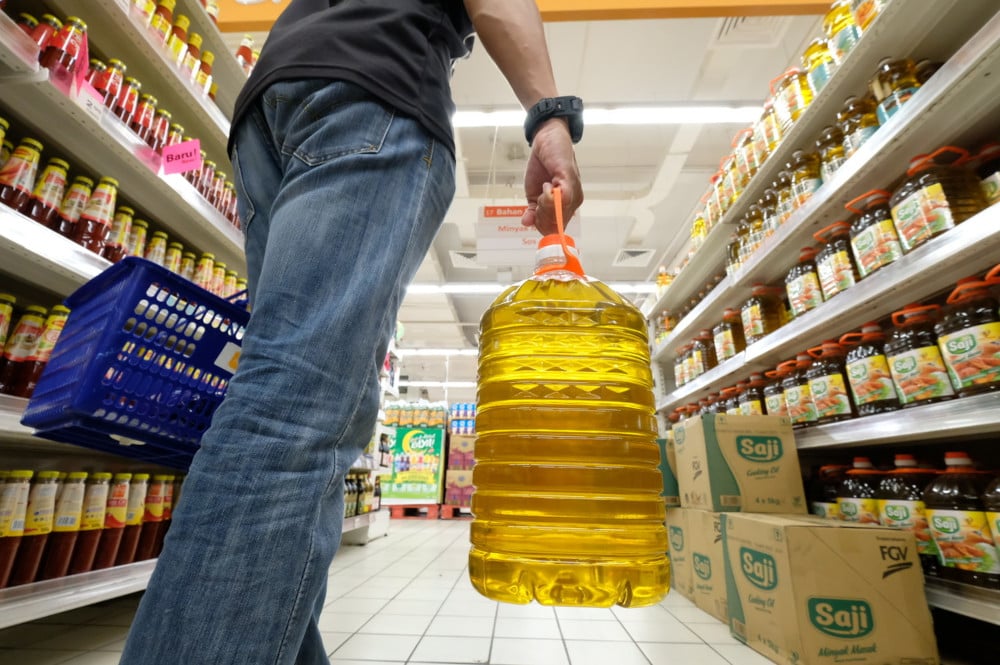
The government is set to roll out its zoning system for the distribution of subsidised cooking oil across the country, aiming to reduce supply interruptions and ensure more precise allocation of resources. This strategy, already in effect in Sabah and Sarawak, will now be extended to all states.
According to Deputy Minister of Domestic Trade and Cost of Living, Fuziah Salleh, the scheme mandates that packaging companies deliver their designated quotas exclusively to retailers registered with the ministry.
She noted that shortages of subsidised cooking oil should not occur, as the nationwide quota has been fixed at 60,000 metric tonnes per month, equivalent to 60 million one-kilogramme packets, distributed by a network of 330 packaging firms.
The zoning mechanism was introduced following recurring disruptions in supply, particularly in remote regions, which were found to stem from poorly coordinated distribution practices.
(Image: Bernama)
Fuziah explained that many packaging companies are based close to palm oil plantations and therefore tend to prioritise those surrounding areas. This often leaves interior and rural communities undersupplied, especially under the previous system, which allowed vendors to sell to any buyer as long as stock was cleared.
The system will be activated in Johor starting tomorrow, with an initial allocation of 3,112 metric tonnes. This rollout will involve 19 packaging companies and a range of retailers, including supermarkets and selected local shops.
“We will assess the performance in Johor and adjust as needed,” Fuziah said.
(Image: Bernama)
She also acknowledged that leakages in the subsidised cooking oil distribution chain do exist, but described them as manageable with the current enforcement tools and the newly introduced zoning approach.
“With zoning, we believe we can plug gaps and avoid future disruptions in supply,” she added.
Although the subsidy is mainly intended for domestic consumption, Fuziah recognised that small-scale food vendors also rely heavily on it, with some reportedly using up to 15 packets daily.
“At present, the government has no intention of restricting micro businesses from using subsidised cooking oil. Doing so could drive up prices and shift the burden to consumers,” she said.
Samuel writes about personal finance and financial news, focusing on how banking updates, policies, and promotions affect everyday money decisions. He enjoys making complicated financial topics easier to follow. Outside of writing, he spends his time watching TV shows and occasionally convincing himself he will only watch one episode.
Samuel writes about personal finance and financial news, focusing on how banking updates, policies, and promotions affect everyday money decisions. He enjoys making complicated financial topics easier to follow. Outside of writing, he spends his time watching TV shows and occasionally convincing himself he will only watch one episode.
Recently i happened to be with a friend from Germany in a hypermarket in KL. I was speechless when she asked ” Why Malaysia has to ration the cooking oil when ur country is the top producer of palm oil ? .”
That’s a very common question! While Malaysia is one of the top producers of palm oil, the subsidised cooking oil you see in hypermarkets is meant to help Malaysians manage cost of living.
To keep prices low, the government limits the supply of 1kg subsidised cooking oil packs, hence the rationing. Most of our palm oil production is actually exported or used for industrial purposes, not local subsidised cooking oil.
We provide weekly updates on every Friday at 5pm on the prices of RON95, RON97 and Diesel in Malaysia and a chart that shows the movement of fuel prices across a 6-week period. Bookmark this page now!









Comments (2)
Recently i happened to be with a friend from Germany in a hypermarket in KL. I was speechless when she asked ” Why Malaysia has to ration the cooking oil when ur country is the top producer of palm oil ? .”
Hi Farah,
That’s a very common question! While Malaysia is one of the top producers of palm oil, the subsidised cooking oil you see in hypermarkets is meant to help Malaysians manage cost of living.
To keep prices low, the government limits the supply of 1kg subsidised cooking oil packs, hence the rationing. Most of our palm oil production is actually exported or used for industrial purposes, not local subsidised cooking oil.
Hope that helps explain it a bit! 😊