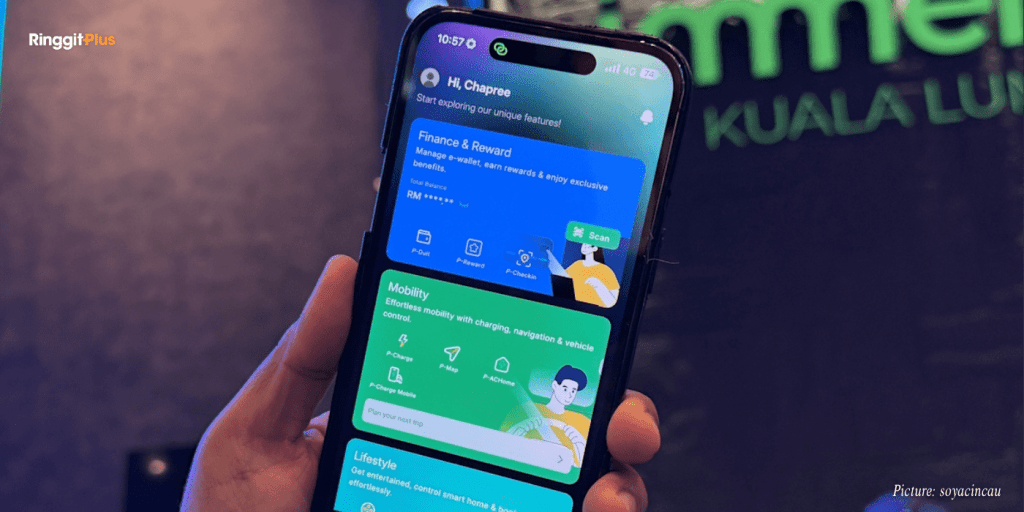
Perodua rolled out P-Circle on Monday, signalling its most significant digital push as the company prepares to enter Malaysia’s electric vehicle market before year-end.
The app centres on P-Duit, a new e-wallet that accepts payments at EV charging stations nationwide alongside standard retail transactions. The move addresses a persistent complaint from early EV adopters: juggling multiple payment apps across different charging networks.
“The P-Circle offers mobility as a lifestyle as all these offerings covers a significant portion of our online services engagement under one superapp,” said Dato’ Sri Zainal Abidin Ahmad, Perodua’s President and CEO. He positioned the launch as aligning with industry shifts toward connected vehicles and smart homes.
App Features Extend Beyond Automotive
P-Circle bundles vehicle management with lifestyle features. P-Health tracks fitness through smartwatch integration. P-Home manages connected home devices. P-Guardian provides security monitoring, including support for cameras mounted on home charging units.
The P-Vehicle feature, launching alongside the new EV, enables remote door locking, climate control activation, and GPS tracking. P-Charge maps nearby charging stations and offers emergency mobile charging services.
Additional modules include P-Marketplace for genuine parts purchases, P-Map for navigation, P-Chat for owner discussions, P-Reward loyalty programme, and P-Entertainment for local content streaming.
The app is available now on the Apple App Store and Google Play. Related accessories, including mobile chargers and smartwatches, are sold through Perodua’s nationwide sales and service network.
Perodua has not confirmed specific pricing or specifications for its first electric vehicle, scheduled for release in the fourth quarter of 2025.
Planning Your Perodua EV Purchase
If you’re looking to buy the upcoming Perodua EV, Budget 2026’s incentive changes work in your favour. The tax exemptions for locally assembled vehicles mean a lower purchase price, and banks typically offer better interest rates for locally assembled models compared to fully imported ones. With exemptions ending for imported EVs on 1 January 2026, you’ll get double savings: reduced on-the-road price and more competitive loan rates.
The RM4,000 scrappage grant for vehicles over 20 years old works as a down payment booster. Banks typically require 10% down for car loans. On a hypothetical RM80,000 EV, that’s RM8,000 upfront. The scrappage grant covers half this amount, reducing your immediate cash outlay and potentially improving loan approval odds if you’re trading in an ageing Myvi or Kancil.
Taxi and e-hailing drivers get additional advantages. The 100% tax exemption directly lowers the on-the-road price, which means borrowing less. Lower principal amounts translate to smaller monthly instalments, helpful for managing daily operating expenses and vehicle repayments simultaneously.
Comparing car loan rates now establishes your financing baseline before the EV launches. Interest rates vary significantly between banks, and early research helps you budget accurately for the year-end purchase.
Follow us on our official WhatsApp channel for the latest money tips and updates.
As a creative content writer, Eloise has covered finance, business, lifestyle topics, and even moonlights as a singer-songwriter outside of RinggitPlus. Her current interests are learning the best ways to optimise spending and credit card hacks to gain more airline miles.
As a creative content writer, Eloise has covered finance, business, lifestyle topics, and even moonlights as a singer-songwriter outside of RinggitPlus. Her current interests are learning the best ways to optimise spending and credit card hacks to gain more airline miles.
We provide weekly updates on every Friday at 5pm on the prices of RON95, RON97 and Diesel in Malaysia and a chart that shows the movement of fuel prices across a 6-week period. Bookmark this page now!





Comments (1)
Another e-Wallet? How many e-Wallets do we need?!