Income tax is compulsory by law in Malaysia, and the amount you owe is based on your total taxable income for the year. If you’re filing for the first time, the process is more straightforward than most people expect. Registration, account setup, and filing can all be done online through the Inland Revenue Board of Malaysia’s (LHDN) MyTax portal.
Your starting point is your EA form (also called Form EA), which is a statement of your annual remuneration. Your employer is required to provide this to you by the end of February each year. This form summarises your total income, EPF and SOCSO contributions, and PCB deductions for the year.
To file, you’ll need to register yourself as a taxpayer with the LHDN, and then set up your MyTax account to access the e-Filing platform.
1) Check Your TIN and Register as a Taxpayer With the LHDN
Before you start the e-Daftar process, it’s worth checking whether you already have a Tax Identification Number (TIN). Since 2023, the LHDN has automatically assigned a TIN to all Malaysian citizens and permanent residents aged 18 and above, using data from the National Registration Department (JPN).
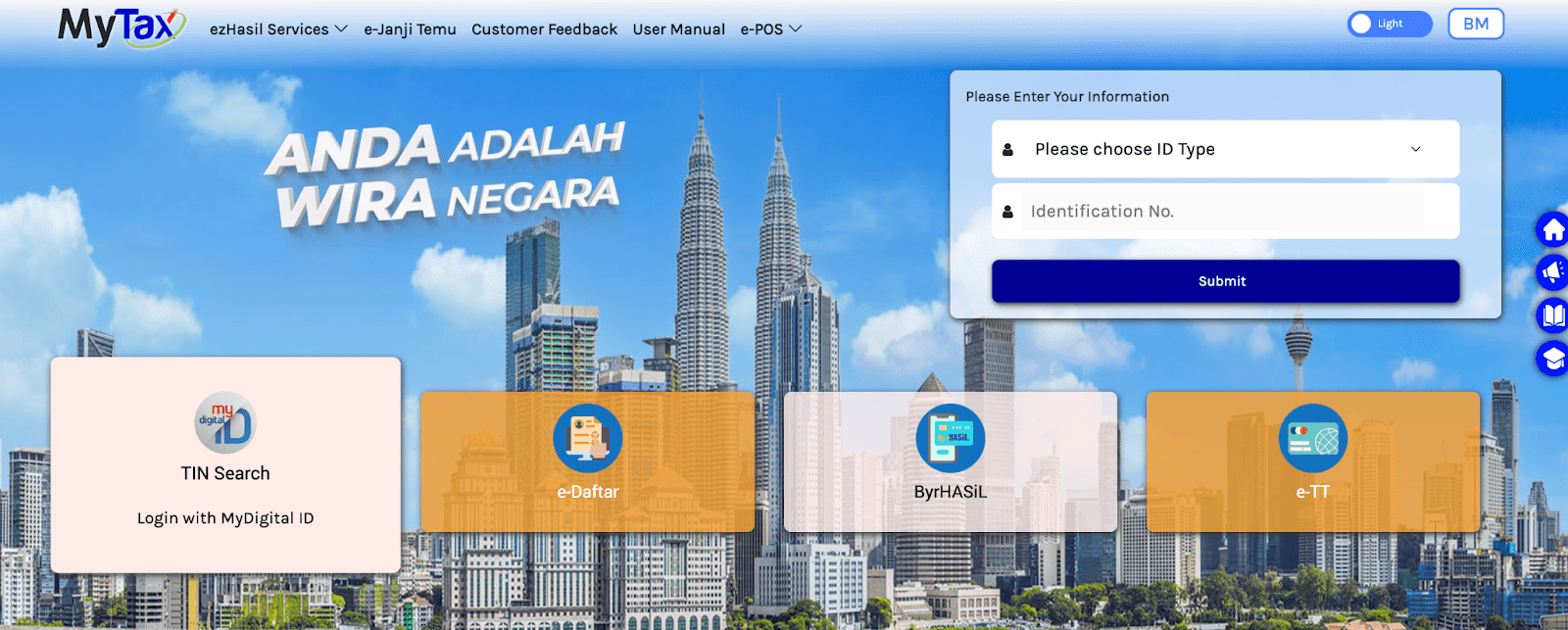
You can check your TIN status by logging into the MyTax portal and entering your IC number. If you already have a TIN, you can skip straight to activating your digital certificate (Step 2).
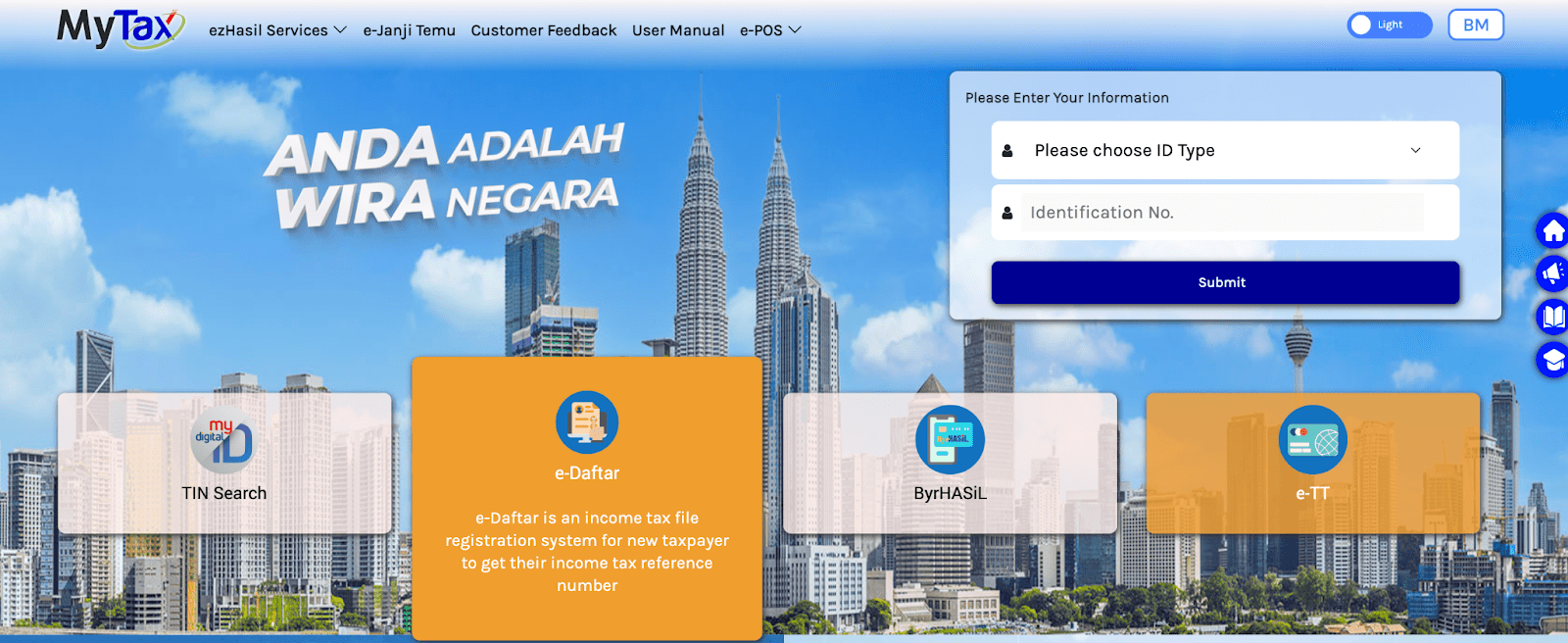
If you don’t have a TIN yet, head to the MyTax website and click on e-Daftar. Fill in the required details, and the website will notify you that you don’t yet have an income tax number. From there, you’ll be prompted to complete the full e-Daftar registration form.
You’re allowed to save and continue the form later if you can’t complete it all at once. When you return to the e-Daftar page, key in your details again and click “Update Details” to resume. You’ll also need to upload a digital copy of your MyKad as a supporting document, so prepare that beforehand.
Once you submit, your application may be immediately approved (you’ll get your income tax number on the spot), or you’ll receive an acknowledgement receipt with your application number. If that happens, your income tax number will be emailed to you within seven working days.
2) Register For Your e-Filing Account
a) Getting your digital certificate
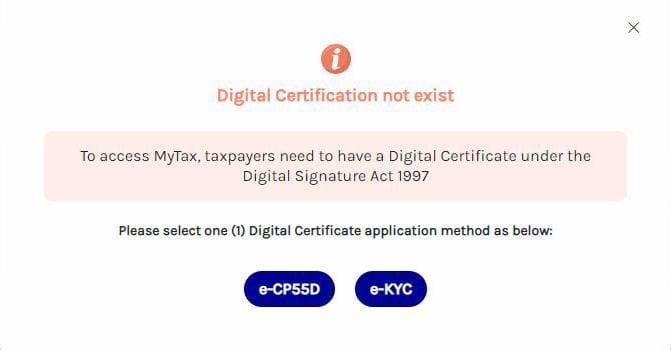
Head back to MyTax and key in your IC number. You’ll be informed that your “Digital Certificate does not exist”. This is normal; you haven’t set up your MyTax account yet, which is what gives you access to the e-Filing portal.
You’ll be prompted to apply for a digital certificate using one of two methods.
Using e-CP55D (web portal) Select e-CP55D, confirm your registered email address and personal details, amend if necessary, then submit. An activation link will be sent to your email, which you must click to activate your digital certificate. The activation link expires after two days, so don’t leave it too long.
Using e-KYC (MyTax app) If you’d prefer to skip the e-CP55D form, you can use e-KYC through the MyTax mobile app instead. This involves scanning your MyKad and completing a selfie verification, and it lets you activate your digital certificate without visiting an LHDN branch.
b) Getting your one-time PIN and access to MyTax and e-Filing
Once your digital certificate is activated (whether via the email link or e-KYC), head back to MyTax and key in your IC number again. This time, you should be able to log in, with your PIN number automatically displayed. Create your password and security phrase, then click “Submit”.
Once submitted, log in again, and you’ll be able to access your MyTax dashboard and the e-Filing service.
3) File Your Taxes
For YA 2025, e-Filing opened on 1 March 2026. The deadline for salaried employees filing Form BE is 30 April 2026, with a grace period until 15 May 2026 for e-Filing submissions.
Before you start filling in your return, make sure you have your EA form, receipts for any tax relief claims (medical expenses, lifestyle purchases, education fees, insurance premiums), and your EPF contribution statement. The e-Filing system will walk you through each section, and it automatically calculates your tax based on what you enter.
Malaysia offers a range of tax reliefs that can reduce your chargeable income. Every individual automatically receives RM9,000 in personal relief, and there are additional reliefs for lifestyle purchases, EPF contributions, and insurance premiums.
Say you’re a fresh graduate earning RM3,600 per month (RM43,200 per year). Subtract your reliefs: RM9,000 personal relief, RM4,000 for EPF contributions, and RM2,500 for a laptop you bought for work. That brings your chargeable income down to RM27,700. The tax on that amount works out to about RM381. But because your chargeable income is under RM35,000, you also qualify for a RM400 tax rebate, which wipes out your tax bill entirely. If your employer has been deducting PCB from your salary all year, you’d get all of it back as a refund, typically within 30 working days of filing.
Steffi Manisha Arokiam is a Tax Director at ThinkTX Consultants, where she leads the firm’s Transfer Pricing and e-Invoicing practice. She advises both individuals and corporations across a wide range of tax matters, including Real Property Gains Tax (RPGT), stamp duty, estate tax, and global mobility for expatriates. Recognised for combining strong technical expertise with a practical, solutions-driven approach, Steffi helps clients navigate complex tax issues with clarity and confidence.
A respected thought leader in taxation, Steffi has authored numerous technical articles and professional newsletters. Her work has been published by the International Bureau of Fiscal Documentation (IBFD) and Wolters Kluwer (CCH), and she has been featured on BFM 89.9 discussing crypto taxation.
Professional Affiliations
Member of the Malaysian Institute of Accountants (MIA)
Member of the Chartered Tax Institute of Malaysia (CTIM)
ASEAN Chartered Professional Accountant (ASEAN CPA)
Member of the International Fiscal Association (IFA)
Professional Trainer certified by HRD Corp
As a trusted tax partner of RinggitPlus, Steffi reviews and verifies all content relating to Malaysian taxation to ensure it is accurate, up to date, and practical — helping readers better understand the tax system and make the most of their tax position.
00votes
Article Rating
SHARE
About THE AUTHOR
Steffi Manisha Arokiam
Steffi Manisha Arokiam
Steffi Manisha Arokiam is a Tax Director at ThinkTX Consultants, where she leads the firm's Transfer Pricing and e-Invoicing practice. She advises both individuals and corporations across a wide range of tax matters, including Real Property Gains Tax (RPGT), stamp duty, estate tax, and global mobility for expatriates. Recognised for combining strong technical expertise with a practical, solutions-driven approach, Steffi helps clients navigate complex tax issues with clarity and confidence.
A respected thought leader in taxation, Steffi has authored numerous technical articles and professional newsletters. Her work has been published by the International Bureau of Fiscal Documentation (IBFD) and Wolters Kluwer (CCH), and she has been featured on BFM 89.9 discussing crypto taxation.
Professional Affiliations
Member of the Malaysian Institute of Accountants (MIA)
Member of the Chartered Tax Institute of Malaysia (CTIM)
ASEAN Chartered Professional Accountant (ASEAN CPA)
Member of the International Fiscal Association (IFA)
Professional Trainer certified by HRD Corp
As a trusted tax partner of RinggitPlus, Steffi reviews and verifies all content relating to Malaysian taxation to ensure it is accurate, up to date, and practical — helping readers better understand the tax system and make the most of their tax position.
Untuk makluman, perbelanjaan perubatan yang telah ditanggung atau dibayar semula (reimbursed) oleh majikan tidak boleh dituntut lagi sebagai pelepasan cukai.
Ini kerana pelepasan cukai hanya dibenarkan untuk perbelanjaan yang ditanggung sendiri oleh pembayar cukai. Jika jumlah RM6,000 tersebut telah dituntut daripada syarikat, maka ia tidak layak untuk dituntut sekali lagi.
Namun, jika ada baki perbelanjaan perubatan yang tidak ditanggung oleh majikan, akak masih boleh menuntut bahagian tersebut (tertakluk kepada syarat LHDN).







Comments (3)
hi akak ada medical expenses RM6,000.
akak dah claim from company.
boleh ke akak claim tax relief lagi? mohon pencerahan. jazzakallah khair
Hi akak 😊
Terima kasih atas soalan.
Untuk makluman, perbelanjaan perubatan yang telah ditanggung atau dibayar semula (reimbursed) oleh majikan tidak boleh dituntut lagi sebagai pelepasan cukai.
Ini kerana pelepasan cukai hanya dibenarkan untuk perbelanjaan yang ditanggung sendiri oleh pembayar cukai. Jika jumlah RM6,000 tersebut telah dituntut daripada syarikat, maka ia tidak layak untuk dituntut sekali lagi.
Namun, jika ada baki perbelanjaan perubatan yang tidak ditanggung oleh majikan, akak masih boleh menuntut bahagian tersebut (tertakluk kepada syarat LHDN).
Harap membantu!
aduh melepas la akak!!! thank you bantu beri pencerahan