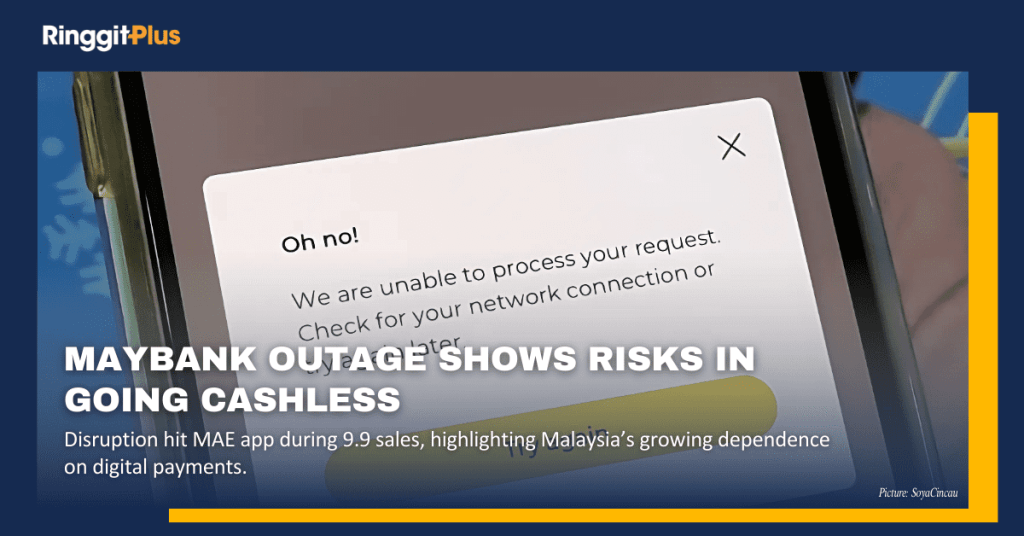
From 8 September 2025, Maybank users began reporting problems with the MAE app. Services such as transfers, bill payments, Scan & Pay, and Secure2U were affected, and multiple user posts on social media. With Secure2U unavailable, customers were redirected to temporary six-digit TAC codes delivered via push notifications, but many experienced delays.
While Maybank later announced that services had been restored, users continued to highlight errors, especially with QR-based payments. The timing drew attention because the disruption overlapped with the nationwide 9.9 online sales, a period of peak digital payment activity.
The Scale of Maybank’s Role
Maybank is Malaysia’s largest retail bank and a major provider of DuitNow QR payments. This scale meant the outage quickly became visible across everyday transactions. Customers reported difficulties paying at restaurants and retail outlets, while merchants relying on Maybank QR experienced failed or delayed transactions.
The effect was not limited to individual consumers. For small businesses, particularly those using QR codes as their main payment channel, the downtime represented an immediate disruption to sales.
Malaysia’s Growing Dependence on Digital Payments
The disruption reflects how reliant Malaysians have become on mobile apps and e-wallets. According to the RinggitPlus Malaysian Financial Literacy Survey 2024, 95% of Malaysians now use at least one e-wallet, and cash is no longer the preferred payment method. Contactless cards and QR payments are increasingly the default at retail outlets, restaurants, and transport services.
The same survey also found that 45% of Malaysians already hold an account with at least one digital bank, with a further 26% intending to open one soon. As more consumers shift away from cash and towards app-based banking, service disruptions have a wider impact than they would have only a few years ago.
Limited Alternatives When Systems Fail
The Maybank outage also highlighted the lack of backup options. SMS TAC codes, once a common fallback for transaction approvals, were discontinued in 2021. With Secure2U unavailable, Maybank temporarily used in-app TAC push notifications as an alternative, but delays meant many customers still struggled to complete transactions.
Transfers through the Maybank2u website remained possible, but this option was impractical for in-store transactions or QR-based purchases that require real-time confirmation. Bank Negara Malaysia statistics show consistent growth in electronic payments, particularly QR transactions, making the absence of redundancy a growing concern as volumes rise.
Implications for Malaysia’s Cashless Transition
The incident illustrates how Malaysia’s rapid shift to digital payments brings both convenience and risk. Consumers who do not carry cash may find themselves unable to complete purchases during outages, while merchants relying on a single payment provider risk losing revenue when systems fail.
At a broader level, resilience in digital payment infrastructure is becoming a policy concern. The Financial Sector Blueprint 2022–2026 published by Bank Negara Malaysia highlights the aim of accelerating cashless adoption nationwide. Outages such as this underscore the importance of ensuring reliable systems and backup channels as Malaysia reduces its dependence on cash.
Building Resilience in Malaysia’s Digital Economy
The recent disruptions have prompted broader discussion about how Malaysia’s financial system can strengthen its digital infrastructure. Industry observers note that banks may need to increase investment in core systems to ensure stability, as millions of digital transactions are now processed daily. Beyond adding new app features, upgrading foundational systems is seen as essential to maintaining reliability.
Clear communication during outages has also been highlighted as a key area for improvement. Financial technology experts point out that timely updates and transparent information can help maintain customer trust when services are disrupted.
From a regulatory perspective, Bank Negara Malaysia has already taken steps to hold institutions accountable. Recent enforcement actions against banks for service interruptions have been interpreted as a signal that performance and resilience will remain under close scrutiny.
The rise of digital banking also brings new considerations for consumers. RMFLS 2024 found that nearly half of Malaysians already hold a digital bank account, and more are expected to join in the near future.
Alongside this growth, raising awareness of online safety, including spotting scams and protecting personal information, is expected to remain a priority for both banks and regulators.
Follow us on our official WhatsApp channel for the latest money tips and updates.
Samuel writes about personal finance and financial news, focusing on how banking updates, policies, and promotions affect everyday money decisions. He enjoys making complicated financial topics easier to follow. Outside of writing, he spends his time watching TV shows and occasionally convincing himself he will only watch one episode.
Samuel writes about personal finance and financial news, focusing on how banking updates, policies, and promotions affect everyday money decisions. He enjoys making complicated financial topics easier to follow. Outside of writing, he spends his time watching TV shows and occasionally convincing himself he will only watch one episode.






Comments (0)