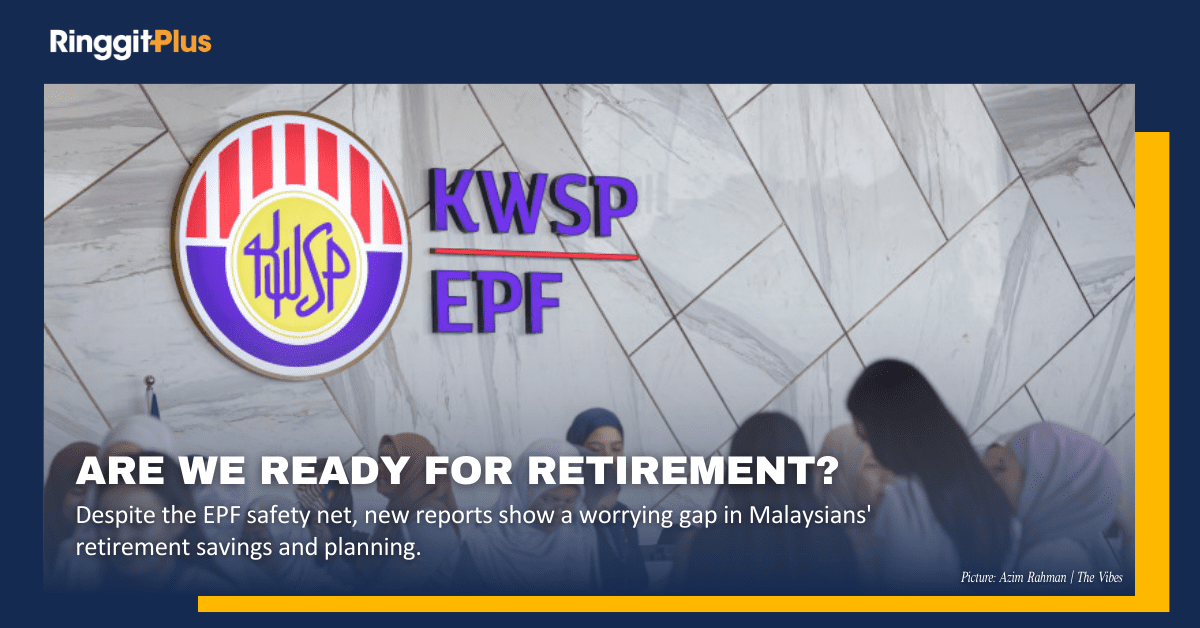
Financial security after leaving the workforce remains a major concern in Malaysia. Although the Employees Provident Fund (EPF) is the country’s main savings vehicle, many people still find themselves short of funds in later life.
Savings Gaps Are Widening
Aon’s 2025 Malaysia Employee Benefits and Wellbeing Report [PDF] highlights that the challenge is not just about how much people save. Rising costs, job-hopping trends, and weak financial planning are also shaping whether Malaysians can accumulate enough for life after work.
Aon’s findings echo our RinggitPlus Malaysian Financial Literacy Survey (RMFLS) 2024, which highlighted a worrying lack of preparation for retirement. According to the RMFLS 2024, four in ten adults had not started planning for retirement, and only 19% believed their EPF savings were enough. Of those who had not started, nearly half said they did not know where to begin.
Put side by side, the findings from Aon and the RMFLS underline the same problem. Malaysians are not saving enough to match what they will need in later life. While the EPF provides a foundation, the amounts set aside are often eroded by the rising cost of housing, healthcare, and daily essentials.
Longer life expectancy makes the gap even more serious, as savings have to stretch across more years. The result is a growing mismatch between what households are building today and what will be required to maintain a basic standard of living tomorrow. The RMFLS 2024 results suggested that many Malaysians are too focused on day-to-day survival to build consistent long-term savings.
Younger Workers Eye the Exit
The Aon report, which covered 130 companies across sectors including banking, manufacturing, and professional services, found that job-hopping is now common. About 40% of workers under 29 and 53% of those aged 30–34 plan to change jobs within a year. The survey also found that 51% of employees with three to five years of experience, often in mid-level and business-critical roles, are considering leaving. This highlights how widespread turnover intentions are across both age and tenure.
With wages in many sectors struggling to keep up with inflation, the chase for better pay is understandable. But frequent job moves come at a cost. Each switch risks disrupting EPF contributions, and without long-term consistency, savings growth is undermined.
Compensation Still the Biggest Factor
In Aon’s survey, compensation ranked as the top factor influencing whether employees join or stay with a company. Inadequate compensation can quickly push workers to leave, even if other benefits are attractive.
Aon’s survey shows differences in emphasis: older workers tend to value work-life balance and stability, while younger employees place more weight on career growth.
The Role of Benefits and Wellbeing
Employee benefits now play a bigger role in attracting and keeping talent. Flexible work arrangements, like Work From Home, and career development opportunities were highly valued by respondents of Aon’s survey, alongside healthcare and work-life balance.
For employers, however, rising healthcare costs remain a challenge. Many companies face annual increases of 5–10% in medical benefits, forcing some to reconsider the level of coverage they can provide.
Aon’s Head of Wealth Solutions, Surendran Ramanathan, noted that employee wellbeing spans financial, emotional, physical, social, and work-life factors. Strengthening one area often benefits the others. Investing in wellbeing, he said, is no longer optional but essential for long-term organisational success.
Flexibility vs Workplace Culture
Flexible work is now the norm in Malaysia. Aon’s 2025 survey found that 82% of organisations offer some form of flexibility. The most common arrangements are flexible hours (62%) and hybrid models (53%), where staff split their time between home and office. A smaller number of companies provide fully remote roles (6%) or compressed workweeks (5%).
Both employers (81%) and employees (77%) agree that these arrangements improve work-life balance. But flexibility comes with trade-offs. More than half of employees (57%) said reduced interaction with colleagues is a drawback. Employers share similar concerns, with 73% worried about collaboration and 66% concerned about preserving company culture.
The challenge is striking the right balance. Workers want flexibility in how and where they work, but organisations also need to maintain teamwork, knowledge-sharing, and a sense of community.
The Retirement Gap Remains Wide
Perhaps the most striking gap is between what Malaysians know they should do and what they actually do. While 96% of Aon’s respondents said financial wellbeing is important, only 30% have assessed whether their savings will last.
The RMFLS 2024 survey shed light on why: many are still struggling with day-to-day realities. More than half of Malaysians spend all or more than they earn, and 34% who tapped their new EPF Flexible Account did so to cover rising living costs.
The safety margin is thin. Nearly four in ten Malaysians say they could only survive three months or less without income, while just 18% believe their savings could last beyond six months.
A Demographic Headwind
These financial gaps are unfolding against the backdrop of Malaysia’s demographic shift. The national fertility rate has dropped to 1.7, well below the 2.1 replacement level. DOSM data shows live births fell 11.5% year-on-year in the first quarter of 2025.
Looking further ahead, Malaysia’s population is projected to peak in 2059 before beginning a gradual decline. By 2052, the death rate will exceed the birth rate, and by 2048 the country will be an aged society with 14% of its people aged 65 or older. Major cities like Kuala Lumpur are expected to become super-aged by 2060, with over one in five residents elderly.
Put together, this means fewer working-age Malaysians will be supporting more retirees, raising the stakes for both EPF and individual savings.
What This Means for Malaysians
The findings are clear: compensation and job satisfaction matter, but so does long-term financial planning. Younger workers in particular need to look beyond immediate pay rises and job moves, and focus on building sustainable savings strategies.
Employers, meanwhile, face rising benefit costs and higher expectations from workers. Balancing both will be key to ensuring Malaysia’s workforce is not only productive today but also financially secure in the future.
The findings from Aon and RMFLS 2024 highlight clear gaps in savings and planning. The upcoming RinggitPlus Malaysian Financial Literacy Survey (RMFLS 2025) will show whether Malaysians are making progress or if the challenges are becoming more severe. Stay tuned for the results.
Follow us on our official WhatsApp channel for the latest money tips and updates.
Samuel writes about personal finance and financial news, focusing on how banking updates, policies, and promotions affect everyday money decisions. He enjoys making complicated financial topics easier to follow. Outside of writing, he spends his time watching TV shows and occasionally convincing himself he will only watch one episode.
Samuel writes about personal finance and financial news, focusing on how banking updates, policies, and promotions affect everyday money decisions. He enjoys making complicated financial topics easier to follow. Outside of writing, he spends his time watching TV shows and occasionally convincing himself he will only watch one episode.
We provide weekly updates on every Friday at 5pm on the prices of RON95, RON97 and Diesel in Malaysia and a chart that shows the movement of fuel prices across a 6-week period. Bookmark this page now!









Comments (0)