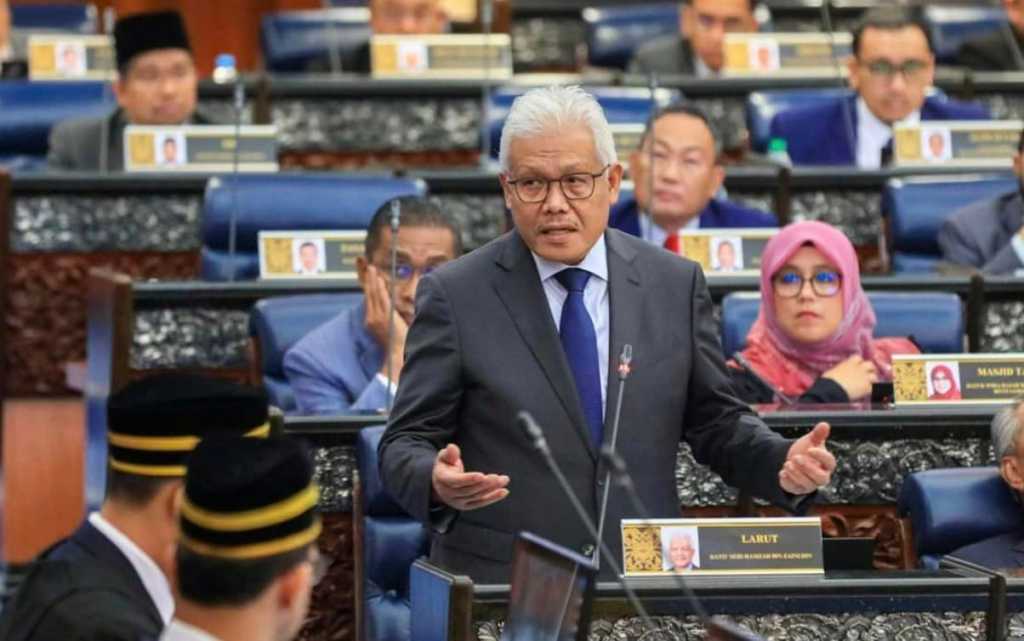
Opposition Leader Datuk Seri Hamzah Zainudin has called on the government to delay the implementation of key policy measures, including the targeted RON95 fuel subsidy rationalisation, the planned electricity tariff hike, and Malaysia Aviation Group’s purchase of 30 Boeing aircraft, in light of global economic instability.
Speaking during a special parliamentary sitting today to address the impact of the United States tariffs on Malaysia, Hamzah said that such significant fiscal decisions should be postponed to avoid worsening economic pressure on the public and businesses. The RON95 subsidy rationalisation is scheduled to begin in June, followed by the electricity tariff increase in July.
“The rationalisation of RON95 subsidies in June this year should be put on hold and if possible, let’s delay the hike in electricity tariffs.In an uncertain economic situation, we should also postpone the purchase of 30 Boeing planes. That is our request here,” he said during his speech in Parliament.
(Image: Bernama)
He also pointed to the government’s recent decision to defer the expansion of the Sales and Service Tax, initially planned for May 2025 under Budget 2025, as a step in the right direction. Hamzah argued that similar flexibility should be applied to other economic measures that could burden Malaysians during a volatile global period.
In his remarks, Hamzah proposed the formation of a bipartisan task force or caucus to deliberate on Malaysia’s response to the evolving tariff landscape. He suggested that the task force include both government backbenchers and opposition leaders, along with representatives from state governments. He cited a similar initiative undertaken in 2016 to review the Comprehensive and Progressive Agreement for Trans-Pacific Partnership (CPTPP) as precedent.
Hamzah also highlighted the need for Malaysia to maintain a neutral stance amid the escalating trade conflict between the United States and China, warning against being seen as favouring one side.
He noted that Malaysia’s trade surplus with the United States has been shrinking over the past three years, falling from RM255 billion in 2022 to RM214 billion in 2023, and down to RM136 billion last year. This downward trend, he said, should not be ignored.
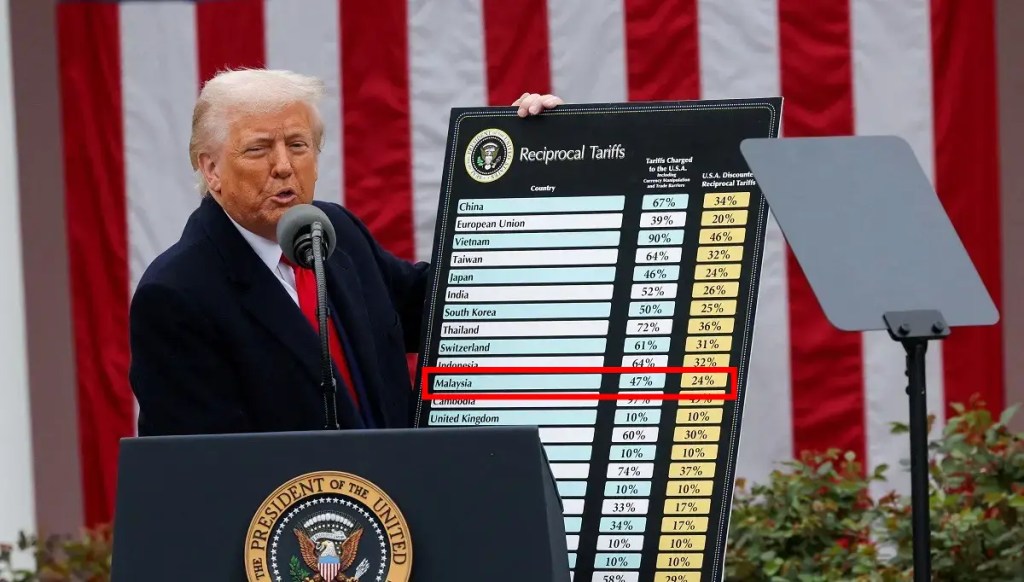
(Image: Reuters)
Although the United States has announced exemptions for certain sectors such as electronics, pharmaceuticals, and energy, Hamzah cautioned that further changes to the tariff list could still emerge. He expressed concern that the tariffs could disrupt Malaysia’s broader economic ecosystem, including the agriculture sector.
Hamzah also stressed the importance of food security and urged the government to reduce dependence on imported food and agricultural products. He advocated for stronger support for local farmers and fishermen, saying their interests must be prioritised in national policy decisions.
Members of Parliament from both the government and opposition took part in the special sitting, which was convened in response to the United States’ decision in April to impose a 24% “reciprocal” tariff on Malaysian imports.
This measure forms part of the “Liberation Day” trade policy introduced by President Donald Trump, which also includes a universal 10% tariff on most other imports. While the reciprocal tariff is currently on a 90-day pause, the universal tariff has already been enforced.
Samuel writes about personal finance and financial news, focusing on how banking updates, policies, and promotions affect everyday money decisions. He enjoys making complicated financial topics easier to follow. Outside of writing, he spends his time watching TV shows and occasionally convincing himself he will only watch one episode.
Samuel writes about personal finance and financial news, focusing on how banking updates, policies, and promotions affect everyday money decisions. He enjoys making complicated financial topics easier to follow. Outside of writing, he spends his time watching TV shows and occasionally convincing himself he will only watch one episode.
We provide weekly updates on every Friday at 5pm on the prices of RON95, RON97 and Diesel in Malaysia and a chart that shows the movement of fuel prices across a 6-week period. Bookmark this page now!








Comments (0)